
Best Treadmills for Seniors: Safe, Easy Walking at Home

The best treadmills for seniors: low step-up decks, long handrails, slow start speeds and safety keys, plus walking-focused picks and a safe way to start.
This article may contain affiliate links. If you buy through them, we may earn a small commission at no extra cost to you. Learn more.
As an Amazon Associate, we earn from qualifying purchases. If you buy through a link on this page we may earn a small commission at no extra cost to you. It never changes what we write.
Walking is the most natural exercise there is, and a home treadmill lets you do it in any weather, on a flat, predictable surface. For older adults that matters: no icy sidewalks, no uneven curbs, and a handrail within reach.
But not every treadmill is a good fit. A high deck, short rails or a belt that starts too fast can make a treadmill feel risky. This guide focuses on the features that make walking safer and more comfortable, then suggests models that have them.
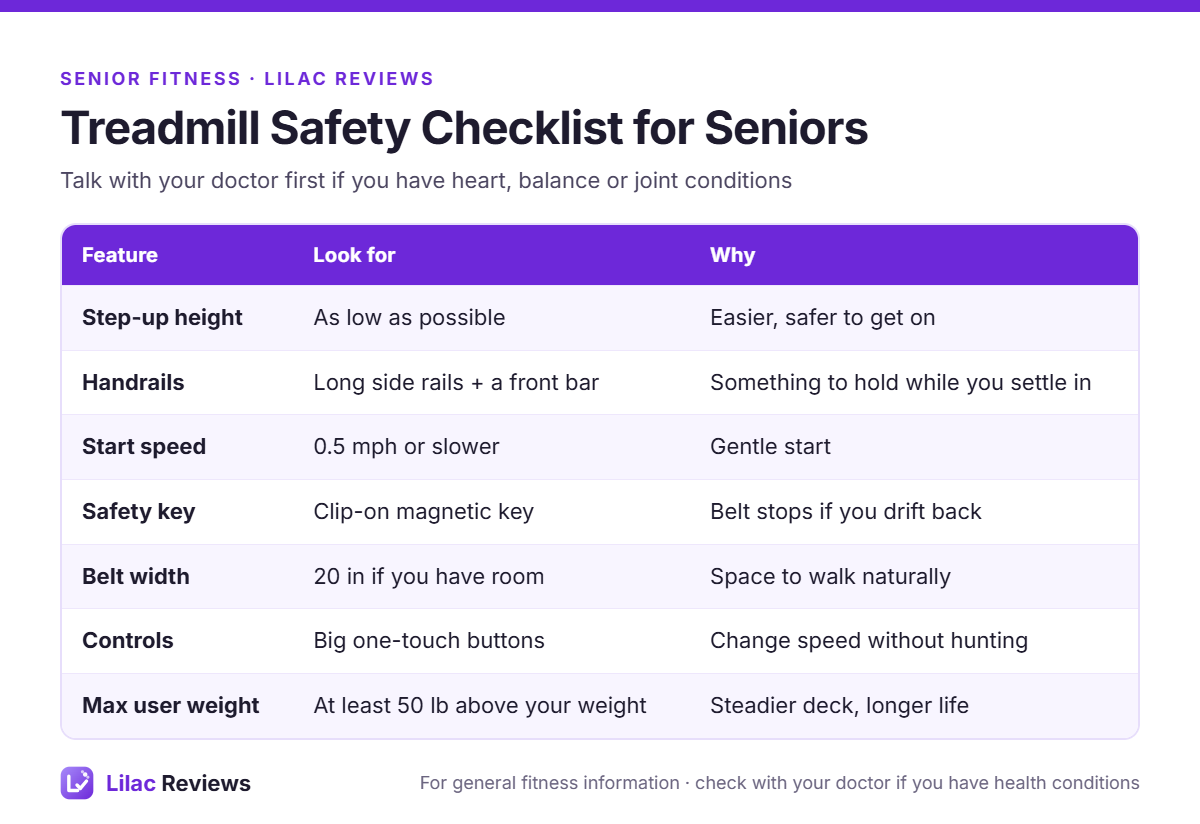
Senior treadmill safety checklist
Low step-up height
The deck height is the step you take to get on. Lower is easier and safer, especially if you have stiff hips or knees. Manufacturers do not always list it, so check the specifications or the Q&A on the listing.
Long, sturdy handrails
Side rails that run most of the length of the deck give you something to hold while getting on, starting the belt and stepping off. A front bar is a bonus. Use rails for balance, not to lean on.
Slow start speed and small speed steps
Look for a start speed of 0.5 mph or slower and buttons that change speed in 0.1 mph steps. Quick-set buttons are fine, but avoid jumping several mph at once.
A safety key you will actually use
Almost every treadmill has a magnetic safety key on a clip. If you drift too far back, the key pulls out and the belt stops. Clip it to your clothes every single time.
Cushioning, belt width and weight rating
A cushioned deck is kinder to knees and hips. A 20-inch wide belt gives you room to walk naturally. And a max user weight at least 50 lb above your own weight usually means a steadier machine.
The best treadmills for seniors
We have not lab-tested these ourselves. Picks are based on published specifications and independent reviews, chosen for walking comfort and safety features. Check the current listing for exact specs.
Best overall for walkers: Horizon T101
The Horizon T101 starts at 0.5 mph, has simple one-touch buttons, a 20 x 55 inch belt, incline up to 10 percent and a 300 lb user rating. Its controls are easy to read and it folds up when not in use. For most older adults who walk and maybe jog lightly, it covers everything without extra complexity.
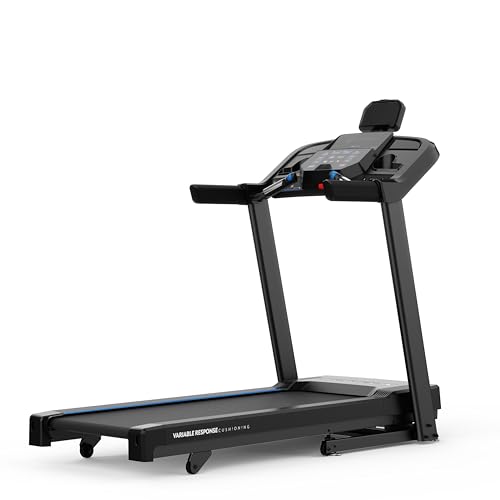
Best for extra support: Exerpeutic TF1000 Walk to Fitness
This walking treadmill is built around safety rather than speed. Exerpeutic lists a high 400 lb user capacity, a slow top speed for walking, and extra-long handrails that run alongside you. It is a sensible pick for people who want the steadiest possible support while walking, or who are heavier and want plenty of margin.
It is not for jogging, and the motor is modest. Think of it as a dedicated walking machine.
Best premium pick: Sole F63
If you want a heavier, more cushioned deck that will last for years, the Sole F63 is a strong choice. It has a 20 x 60 inch belt, a 325 lb user limit and Sole’s cushioned deck, and its side rails are easy to reach. It costs more and is heavier to move, but it is very steady underfoot.

What about walking pads?
Walking pads are compact and popular, but most have no handrails. They are fine for people with steady balance; otherwise choose a treadmill with rails. If you are curious, our WalkingPad C2 review explains the trade-offs.
How to get on and off safely
- Clip the safety key to your clothing.
- Stand on the side rails (the non-moving edges), not the belt.
- Hold the handrails and start the belt at the lowest speed.
- Step onto the moving belt one foot at a time.
- Raise speed slowly in small steps once you feel steady.
- To finish, lower the speed, press stop, wait for the belt to stop completely, then step off.
A gentle walking plan
Start with 10 minutes at a comfortable pace, three to five days a week. Add two to five minutes each week until you reach 30 minutes. The CDC recommends that adults 65 and older get 150 minutes of moderate activity a week, and brisk walking counts. When flat walking feels easy, a small incline is safer than walking faster; our incline walking workout shows how to build up.
Where to put the treadmill
Leave clear space behind it (about 6.5 feet is the common safety guideline) and some space on each side. Keep cords out of walkways, put a mat underneath, and make sure lighting is good. Our home gym safety guide has a full checklist.
FAQ
Is a treadmill safe for seniors?
For most seniors, yes, with a slow start speed, handrails and the safety key clipped on. If you have balance problems, dizziness or heart conditions, talk with your doctor first.
What speed should a senior walk on a treadmill?
Whatever feels like brisk but comfortable walking. For many people that is 2 to 3.5 mph. You should be able to talk, but not sing.
Treadmill or recumbent bike for seniors?
If you enjoy walking and have reasonable balance, a treadmill. If balance or joint pain is a concern, a recumbent bike is safer. See our best recumbent bikes for seniors.
Bottom line
The best treadmill for a senior is slow to start, easy to step onto and has rails you can reach. The Horizon T101 suits most walkers, the Exerpeutic TF1000 puts support first, and the Sole F63 is a long-term premium pick. Whichever you choose, clip on the safety key and build up slowly.
Check with your doctor before starting a new exercise routine, especially if you have heart, joint or balance conditions.
This guide is for general information only and is not medical advice. Talk to a qualified professional before starting a new exercise program, especially if you have an injury or health condition.