
Incline Treadmill Walking Workout for Beginners (4-Week Plan)

Start incline walking the right way: beginner settings, a 4-week incline treadmill walking workout, form tips and the mistakes that make it harder.
This article may contain affiliate links. If you buy through them, we may earn a small commission at no extra cost to you. Learn more.
Incline walking is one of those workouts that looks too easy until you try it. You set the treadmill to a slope, walk at a pace you could hold a conversation at, and ten minutes later your calves, glutes and lungs are all asking what happened. That is exactly why it works so well for beginners: you get a real training effect without running, jumping or pounding your knees.
This guide gives you a 4-week incline treadmill walking workout for beginners, how to pick your starting incline and speed, the form mistakes that make it harder than it needs to be, and how to keep progressing once the first month feels easy.
Quick answer: where should a beginner start?
Start with 3 to 5% incline at 2.5 to 3.0 mph for 15 to 20 minutes, three days a week. You should be breathing harder than normal but still able to speak in full sentences. Raise the incline by 1 to 2% each week, not every day, and only add time once the current session feels comfortable.
That’s it. No heart-rate zones to memorize, no 12% hill on day one.
Why incline walking is worth your time
Walking uphill asks more of your body than walking on the flat. Your hips and calves have to lift you against gravity on every step, so your heart rate climbs even though your speed stays low. For a lot of people that’s the sweet spot: the effort of a jog with the joint stress of a walk.
- Lower impact than running. One foot is always on the belt, so there’s no landing shock.
- More work for the back of your legs. Glutes, hamstrings and calves do much more on a slope than on flat ground.
- Easy to measure. Incline, speed and time are right on the console, so progress is obvious.
- It counts toward your weekly activity target. The CDC recommends at least 150 minutes of moderate-intensity activity per week for adults, and brisk incline walking fits that category for most people.
If you’ve seen the “12-3-30” trend online (12% incline, 3 mph, 30 minutes), it’s a legitimately tough session. It is not a beginner starting point. Think of it as a goal you might reach after a couple of months, not a test you should pass in week one.
How to find your starting incline and speed
Treadmill numbers don’t mean the same thing for everyone. A 5’2″ walker and a 6’3″ walker will feel 3.0 mph very differently. So instead of copying someone else’s settings, use the talk test:
- Warm up for 3 to 5 minutes at 0 to 1% incline at an easy pace.
- Set the speed to something brisk but relaxed, usually 2.5 to 3.2 mph.
- Raise the incline 1% every minute.
- Stop raising it when you can still talk, but singing would be out of the question.
That incline is your “working” level for week one. For many beginners it lands between 3 and 6%. If it’s lower, that’s fine. The plan works from wherever you start.
The CDC’s guide to measuring intensity explains the talk test and perceived exertion in more detail if you want a second opinion on what “moderate” should feel like.
The 4-week incline treadmill walking plan
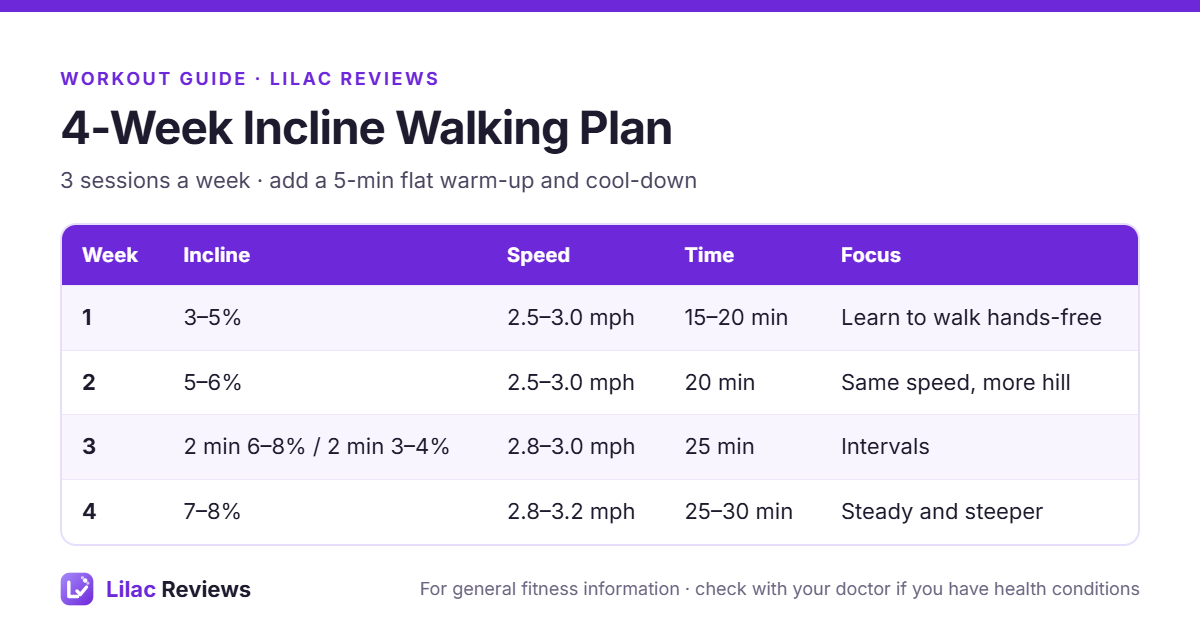
Do three sessions a week with at least one rest or easy day between them (Monday, Wednesday, Friday works well). Each session starts with a 5-minute flat warm-up and ends with a 3 to 5-minute flat cool-down, which aren’t included in the times below.
Week 1: get used to the slope
15 to 20 minutes at your working incline (about 3 to 5%) and 2.5 to 3.0 mph. The only goal is finishing every session without holding the handrails. If your shins burn early, drop the incline by 1% and keep walking.
Week 2: add a little hill
20 minutes at 5 to 6%. Keep the same speed as week one. Most people notice their breathing settles faster this week, which tells you the first week did its job.
Week 3: introduce intervals
25 minutes total. Alternate 2 minutes at 6 to 8% with 2 minutes at 3 to 4%. The easier blocks are not rest; keep the pace brisk. Intervals let you spend time at a steeper grade without having to hold it continuously.
Week 4: steady and steeper
25 to 30 minutes at 7 to 8%, at 2.8 to 3.2 mph. If that’s too much in one block, split it into two halves with a 2-minute flat walk in the middle. After this week, you can start nudging toward 10% or more, or add a fourth session.
Form tips that make a big difference
Let go of the handrails
This is the big one. Holding the rails (especially leaning back on them) takes a lot of your body weight off your legs, so the workout gets much easier and your posture gets worse. If you can’t walk without holding on, the incline or speed is too high. Lower it until you can. Light fingertip contact for balance is fine if you’re nervous at first.
Stand tall and lean slightly from the ankles
A small forward lean is natural on a hill. Folding at the waist isn’t. Keep your chest up, eyes forward and let your arms swing as they would outside.
Shorten your stride
Long, reaching steps on a slope pull on your calves and Achilles. Take slightly shorter, quicker steps and push through the whole foot.
Wear proper shoes
Supportive walking or running shoes beat flat trainers here. Your heels and calves will thank you after week two.
Common mistakes beginners make
- Starting at 12 or 15% because a video said so. Steep inclines without a base are a fast route to sore shins and tight calves.
- Increasing everything at once. Change incline, speed or time in a given week, not all three.
- Skipping the cool-down. Walking flat for a few minutes helps your calves and heart rate come down gradually.
- Forgetting the treadmill’s limits. Many budget and folding treadmills top out at 10% or have only a few manual incline settings. Check your model’s manual before planning steep sessions.
- Doing it every day from the start. Three days a week is plenty for the first month. Our guide on how many days beginners should work out explains why rest days help you stay consistent.
How to keep progressing after week 4
Once 30 minutes at 7 to 8% feels comfortable, pick one of these levers and pull it slowly:
- Incline: +1% per week, up to around 10 to 12%.
- Time: +5 minutes per week, up to 40 to 45 minutes.
- Speed: +0.1 to 0.2 mph per week.
- Frequency: add a fourth, easier session (flat or low incline).
Write your settings down after each session. Even a note on your phone with “6%, 3.0 mph, 25 min, felt easy” is enough. If you want a simple system, see how to track workout progress at home.
Setting up your treadmill at home
If you’re doing this at home, a few setup details matter more than people expect. Leave at least 2 meters (about 6.5 feet) of clear space behind the treadmill and around 50 cm (20 inches) on each side. Put it on a firm, level floor or a proper equipment mat so the incline motor isn’t fighting a wobble. Before you buy one, measure doorways and stairwells too. Our guide to home gym door clearance walks through it, and the equipment assembly guide covers putting it together safely.
Always clip the safety key to your clothing. It stops the belt if you drift too far back, which is easier to do on an incline than you’d think.
Who should check with a doctor first
Incline walking is low-impact, but it does raise your heart rate quickly. Talk to your doctor before starting if you have heart or lung conditions, high blood pressure that isn’t controlled, recent surgery, or joint problems in the ankles, knees or hips. Stop immediately if you feel chest pain, dizziness, or unusual shortness of breath.
FAQ
Is incline walking better than running?
It isn’t better or worse, it’s different. Running burns more calories per minute, but incline walking is easier on your joints and much easier to stick with if you’re new to exercise or carrying extra weight.
How long should I walk on an incline as a beginner?
Start with 15 to 20 minutes plus a warm-up and cool-down. Build to 30 minutes over three or four weeks.
What incline is good for beginners?
Most beginners do well between 3 and 6%. Use the talk test rather than a fixed number.
Can I do incline walking every day?
Once you’ve built up over a month or so, many people do. Start with three days a week and add sessions gradually, keeping some of them easier.
Why do my calves hurt so much?
Calves work hard on a slope, and tight calves are the most common complaint in week one. Lower the incline slightly, shorten your stride, and stretch your calves after the cool-down.
This guide is for general information only and is not medical advice. Talk to a qualified professional before starting a new exercise program, especially if you have an injury or health condition.