
How to Track Workout Progress in a Home Gym Without Overcomplicating It

If you’re setting up your first home gym, the easiest way to tell whether your training is working is to track a few things consistently and ignore the noise. You do not need a complicated system. You need a repeatable one.
The simplest sustainable beginner system is this: log your exercise, sets, reps, and load after each workout, then check weekly body weight averages and one monthly measurement or photo. That is usually enough to tell whether your plan is moving in the right direction.
The main idea is simple: if your workouts are productive, something should improve over time. That might be strength, endurance, body measurements, how your clothes fit, or how quickly you recover between sessions. One number rarely tells the whole story, which is why beginners do better when they track a small set of signals instead of staring at the scale every morning.
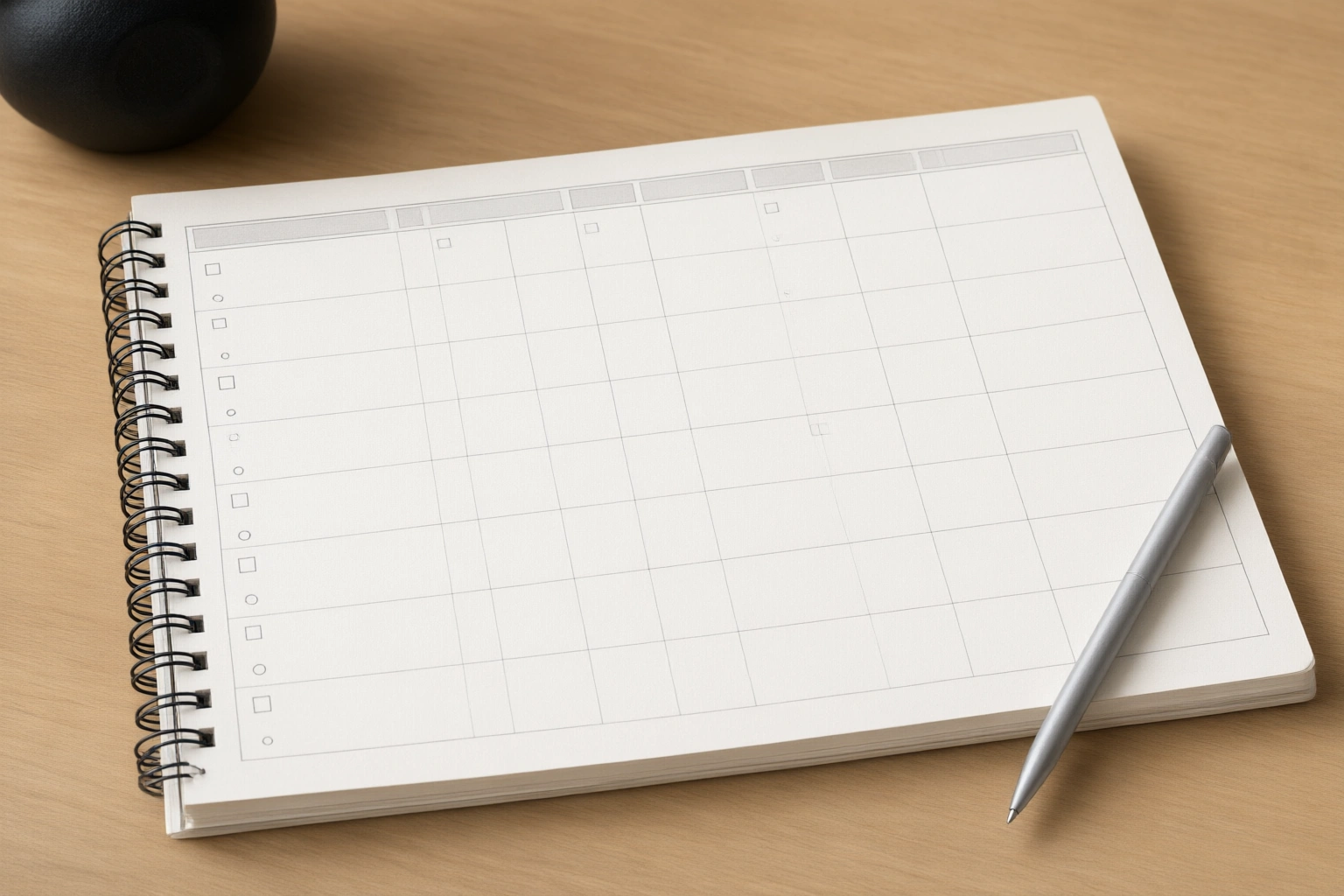
A basic workout log helps you compare each session.
A practical home-gym approach is to track:
– your workout log
– your strength progress
– your body weight or measurements
– progress photos
– performance markers like endurance, recovery, and consistency
That gives you enough information to answer the real question: “Is this plan actually doing anything?”
For general exercise tracking and safe activity habits, the CDC’s physical activity guidance and the ACSM exercise resources can be useful starting points. If you want more strength-focused guidance, NSCA has educational material on training basics.
The Simple Answer: What to Track First
If you only want the shortest possible starter system, track these three things:
- What you did in the workout
- How your body weight is trending
- One monthly body check, such as a measurement or photo
That is the simplest sustainable setup for most beginners. If you want one extra layer, add a strength note so you can see whether your lifts are improving too.
What each metric tells you
| Metric | What it shows | What it misses |
|---|---|---|
| Workout log | Whether you’re repeating and improving sessions | Body composition changes |
| Strength numbers | Progressive overload and performance gains | Fat loss or muscle gain by itself |
| Scale weight | Overall body mass trend | Muscle gain, fat loss, and water fluctuations |
| Body measurements | Changes in size over time | Strength and performance |
| Progress photos | Visible changes in shape and posture | Day-to-day noise and lighting changes |
| Endurance/recovery | Fitness and work capacity | Exact body composition |
The main mistake beginners make is treating one metric like the full truth. A flat scale does not mean nothing is happening. A stronger lift does not always mean visible change yet. The useful habit is to compare several signals together.
Start With a Basic Workout Log
Your workout log is the foundation. Without it, you’re guessing.
At minimum, write down:
– exercise name
– weight used
– reps completed
– sets completed
– a quick note on difficulty
That can be as simple as this:
- Goblet squat — 30 lb dumbbell — 3 sets of 8 — last set felt challenging but controlled
- Dumbbell floor press — 20 lb each hand — 3 sets of 10 — had 2 reps left on the last set
- Plank — 30 seconds x 3 — core felt steady
That small note matters because it helps you compare today’s session to the last one. If the same workout felt easier, or you did one more rep with the same weight, that is progress.
Why logging difficulty helps
Beginners often forget that effort matters, not just numbers. If you used the same dumbbells but the workout felt much easier, you may be ready to add reps, sets, or load. If the numbers stayed the same but the workout felt harder, that tells you fatigue, sleep, stress, or recovery may be affecting performance.
A simple “easy / moderate / hard” note is enough. You do not need a complex rating system to get value from the log.
How to Track Strength Progress at Home
Strength progress is one of the cleanest signs that a home workout plan is working.
In a home gym, you may not always have access to a full rack of weights. That is fine. You can still track progress using the tools you have.
Start with the easiest first-choice methods
For a true beginner, the simplest ways to track strength are:
- More reps with the same weight
- More weight for the same reps
- Same workout with less effort
Those three are usually enough to show whether you are getting stronger without adding unnecessary complexity.
Ways to measure strength progress
You can look for any of these changes:
- More reps with the same weight
- More weight for the same reps
- More sets with good form
- Same workout with less effort
- Harder exercise variation
Example: if you started with push-ups on a countertop, then moved to the floor, then later added a pause at the bottom, that is progression even if you never touched a barbell.
That idea is called progressive overload: gradually asking your body to do a little more over time. It does not have to mean adding weight every week. It can also mean doing more total work, improving technique, or choosing a tougher variation.
What to do when equipment is limited
If your dumbbells are too light or you do not have adjustable equipment, progression can come from small changes that still make the movement harder:
- Add reps: go from 8 reps to 10 or 12 with the same weight
- Add sets: move from 3 sets to 4 if recovery is good
- Slow the tempo: lower the weight over 3 to 5 seconds instead of rushing
- Increase range of motion: squat deeper, lower push-ups farther, or use a fuller stretch when safe
- Use pauses: hold the hardest part of the rep for 1 to 2 seconds
- Use unilateral movements: switch from two-leg or two-arm work to single-leg or single-arm versions
- Shorten rest slightly: reduce rest only if form stays solid
For example:
– If 20 lb dumbbells feel too easy for rows, try 12 reps instead of 8.
– If that still feels easy, slow the lowering phase to 3 seconds.
– If that is not enough, do one-arm rows instead of two-arm rows.
– If you can squat only with light dumbbells, try split squats or Bulgarian split squats to make the same load more challenging.
A realistic home-gym example
Let’s say your dumbbell row looked like this:
- Week 1: 20 lb dumbbells, 3 sets of 8
- Week 3: 20 lb dumbbells, 3 sets of 10
- Week 5: 25 lb dumbbells, 3 sets of 8
That is clear progress. You did more reps at the same weight, then moved to a heavier load.
Track Body Progress Without Relying on the Scale Alone
The scale is useful, but it is not a full progress report.
Body weight can change from water, food, sleep, salt intake, soreness, and normal daily fluctuation. That means a single weigh-in is easy to misread. The better approach is to use weight as one trend line, not the whole answer.
Separate your goal before choosing what to track
Beginners often mix up strength progress, muscle gain, and fat loss. They are related, but they are not the same thing.
| Goal | Best things to track | What matters less |
|---|---|---|
| Strength | Reps, sets, load, exercise variation, workout difficulty | Scale weight by itself |
| Muscle gain | Body measurements, progress photos, workout log, strength numbers | Daily weigh-ins alone |
| Fat loss | Weekly body weight averages, waist measurement, progress photos | Single workout performance alone |
If your goal is strength, focus on lifting performance first. If your goal is muscle gain, watch size changes and strength together. If your goal is fat loss, body weight trends and waist measurements usually matter most.
Scale weight: useful, but incomplete
Scale weight helps you see whether your body mass is trending up, down, or staying stable. That can be helpful if your goal is fat loss, muscle gain, or maintenance. But it does not tell you what changed.
You could be:
– losing fat and gaining muscle
– holding weight while getting stronger
– retaining water after a hard workout
– seeing short-term changes from food and hydration
A simple way to read body weight trends
For beginners, the easiest method is to weigh yourself under the same conditions each time, such as:
– first thing in the morning
– after using the bathroom
– before eating or drinking
– with similar clothing, or no clothing if that is your normal routine
Then compare weekly averages instead of daily numbers. A single weigh-in can jump around for normal reasons, but a weekly average gives you a much clearer trend.
For example:
– Week 1 average: 180.4 lb
– Week 2 average: 180.1 lb
– Week 3 average: 179.6 lb
– Week 4 average: 179.2 lb
That trend is more useful than reacting to one random morning at 181.3 lb.
Body measurements: better for shape changes
Measurements can show changes the scale misses. Common spots include:
– waist
– hips
– chest
– arms
– thighs
For beginners, the waist is often the most useful single measurement because it can help show whether body size is changing over time. If you want more detail, add one or two other areas, but do not turn it into a full science project.
Progress photos: useful when done consistently
Photos are one of the best ways to notice visual changes, especially if you take them under the same conditions each time:
– same lighting
– same pose
– same distance from camera
– similar clothing
– same time of day when possible
Photos are not perfect. Lighting and posture can make a big difference. But if you take them consistently, they can reveal changes that are hard to see day to day.
A good beginner setup is:
– weigh yourself regularly if that fits your goal
– measure one or two body areas every few weeks
– take photos at the same interval
That gives you a better picture than any one method alone.
Other Signs of Progress: Endurance, Recovery, and Consistency
Progress is not only about lifting heavier.
Endurance
If you can do more work before getting tired, that is a real improvement. In a home gym, that might look like:
– more reps at the same load
– shorter rest periods with the same quality
– holding a plank longer
– finishing a circuit without needing to slow down as much
Recovery
Recovery is easy to overlook, but it matters. If you bounce back faster between workouts, that often means your body is adapting well. Signs include:
– less soreness after the same session
– fewer “dead” days after training
– better energy for the next workout
Consistency
This is the unglamorous one, but it matters a lot. A simple program you actually follow beats a perfect plan you abandon. If you trained three times a week for a month instead of skipping sessions, that is progress in the real world.
A beginner who logs workouts consistently is usually in a much better position to improve than someone who tracks everything but never finishes a session plan.
Choose the Easiest Tracking Method You’ll Actually Use
The best system is the one you’ll keep using when you’re tired, busy, or rushing between work and training.
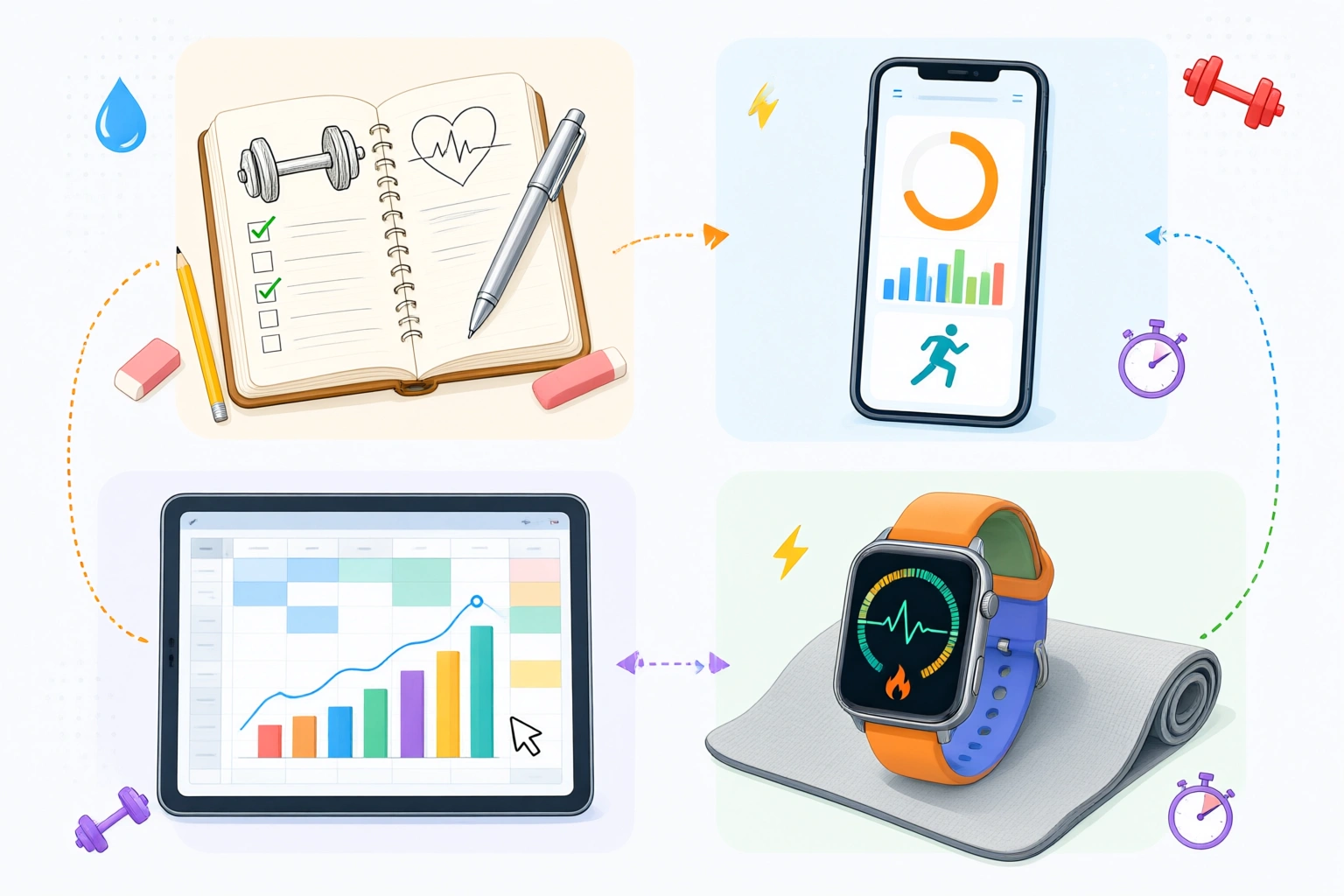
Pick the system you’ll actually keep using.
Here’s the practical comparison.
| Method | Best for | Trade-off |
|---|---|---|
| Notebook | Simplicity and low friction | Harder to search or graph later |
| Fitness app | Fast logging and reminders | Can tempt you to overtrack or rely on your phone during training |
| Spreadsheet | Flexible review and trend spotting | Takes more setup and discipline |
| Wearable tracker | Passive data like steps, heart rate, or activity time | Good for trends, but not a replacement for logging your lifts |
Notebook
A notebook is the easiest place to start. It is cheap, simple, and hard to mess up. If you train in a garage gym and want zero distractions, this is often the best first step.
Fitness app
Apps are convenient if you like quick logging and automatic reminders. The downside is that some people get distracted by the phone or spend too much time organizing data instead of training.
Spreadsheet
A spreadsheet is ideal if you like seeing patterns over time. It takes more effort up front, but it can help you spot plateaus, weekly trends, and total training volume more clearly.
Wearable tracker
A wearable can be useful for activity trends, recovery clues, or general movement. It is not enough on its own for strength progress, because it usually won’t tell you what happened in your actual workout sets.
If you want the lowest-friction choice, use a notebook. If you want easier review later, use a spreadsheet. If you want reminders and fast entry, use an app.
How Often to Measure and Review Progress
The simplest beginner routine is to keep the same schedule every week instead of checking everything constantly.
Default beginner schedule
- After every workout: log exercise, weight, reps, sets, and difficulty
- Once per week: review your workout log and compare weekly body weight averages
- Once per month: take one measurement or progress photo
- Every 2 to 4 weeks if helpful: add extra measurements or photos, but only if you’ll actually use them
Why this works
Daily fluctuations are normal, especially for body weight and energy. If you react to every small change, you’ll end up changing your plan before it has time to work.
A weekly or monthly review gives you enough data to see whether the pattern is improving, flat, or slipping.
Why weekly review works better than daily judgment
One bad workout can happen for a lot of reasons:
– poor sleep
– stress
– bad timing
– not enough food
– lingering soreness
A weekly or biweekly review gives you enough data to see whether the pattern is improving, flat, or slipping.
How to Read the Data Without Getting Discouraged
Mixed results are normal.
You might see:
– scale weight staying the same while strength improves
– strength stalling for a week while your body measurements improve
– good workouts followed by one sluggish session
– photos that look unchanged even though your clothes fit better
That does not mean the plan failed. It usually means you need more than one data point.
What counts as real progress?
Real progress usually shows up as a pattern, not a single lucky day. For example:
– more reps over several workouts
– more weight handled with good form
– a downward trend in waist measurement
– better workout consistency over several weeks
– less fatigue after the same routine
If one metric is flat but others are moving, keep going and keep tracking.
A simple example of trend-based review
Instead of judging one workout or one weigh-in, compare a short block of time.
For example, look at the last four weeks of your log:
– Week 1: dumbbell press 3 x 8
– Week 2: dumbbell press 3 x 9
– Week 3: dumbbell press 3 x 9
– Week 4: dumbbell press 3 x 10
Even if Week 3 felt slow, the four-week trend is still moving up. The same idea works for body weight: compare weekly averages, not one random day.
When a plateau is just noise
A plateau is more believable when the same lift, effort level, and setup have been stuck for multiple sessions and you’ve ruled out obvious recovery problems. If it’s only one bad day, treat it like a bad day.
When to Adjust Your Workout Plan
Adjust your plan when the evidence repeats itself.
Good reasons to make a change:
– the same lift has stalled across several workouts
– your effort is rising but performance is not
– recovery is getting worse instead of better
– form is breaking down before the set is done
– you’re no longer challenged by a movement
Before changing anything, look at the log. Ask:
– Did I sleep poorly?
– Was I unusually sore?
– Did I jump weight too soon?
– Have I been repeating the same session too long?
If the answer is “yes” to one of those, the fix may be recovery or a smaller progression step, not a full program overhaul.
If progress stalls and fatigue or pain is building, that is a good time to back off and consider talking with a qualified professional. Tracking should help you train smarter, not push through warning signs.
A Beginner-Friendly Tracking Template You Can Copy
Here is a simple weekly system you can use right away.
After every workout, write:
- Date
- Exercise
- Weight
- Reps
- Sets
- Difficulty note
Example:
Monday
– Goblet squat — 25 lb — 3 x 8 — hard but controlled
– Dumbbell press — 20 lb — 3 x 10 — moderate
– Row — 20 lb — 3 x 10 — moderate
Once per week, add:
- body weight weekly average
- one note on recovery
- one note on consistency
- one note on what improved
Example:
– Body weight weekly average: steady
– Recovery: good
– Consistency: completed all planned workouts
– Improvement: added 2 reps to rows
Once per month, add:
- waist measurement
- progress photo
- short review of what improved
- one adjustment for next month if needed
Example:
– Waist: slightly smaller
– Photos: shoulders look more defined
– Strength: rows and presses improved
– Next month: add reps before increasing weight
Blank copy-and-fill template
Workout log
– Date:
– Exercise:
– Weight:
– Reps:
– Sets:
– Difficulty:
– Notes:
Weekly review
– Week of:
– Weekly body weight average:
– Recovery:
– Consistency:
– What improved:
– What needs attention:
Monthly review
– Month:
– Waist or other measurement:
– Progress photo taken?:
– Strength trend:
– Body weight trend:
– Next step:
That is enough for a beginner. You can always get more detailed later, but this will already tell you whether your training is working.
FAQs
What should I track if I only want the basics?
Track your workout log, weekly body weight average, and one monthly measurement or photo. If you want the easiest version, start with exercise, sets, reps, load, and body weight.
How often should I check progress?
Log every workout. Review body weight weekly. Use measurements or photos monthly. That keeps the system simple without making you obsess over daily changes.
What if the scale is not moving but I’m getting stronger?
That can still be progress. You may be gaining muscle, losing fat, or simply improving performance without changing body weight much. Look at strength, measurements, and photos together.
Is a notebook enough?
Yes. A notebook is enough for most beginners. If you use it consistently, it will tell you far more than a fancy system you never open.
What counts as progress at home if I have limited equipment?
More reps, better form, harder variations, shorter rest, and better consistency all count. You do not need a full gym to track meaningful improvement.
Final Takeaway
If you want one simple rule, use this: track the fewest things that answer whether your training is working, and review them on a regular schedule.
For a first home gym, the easiest setup is usually a workout log with sets, reps, and load, plus weekly body weight averages and one monthly measurement or photo. If those trends are moving the right way, keep going. If they are flat for several weeks, then it is time to adjust.