
Are Resistance Bands Effective for Building Strength on a Budget?

If you’re building a home gym on a budget, resistance bands are not a gimmick. Used well, they can build strength, support muscle growth, improve endurance, and make home training far more practical in a small space.
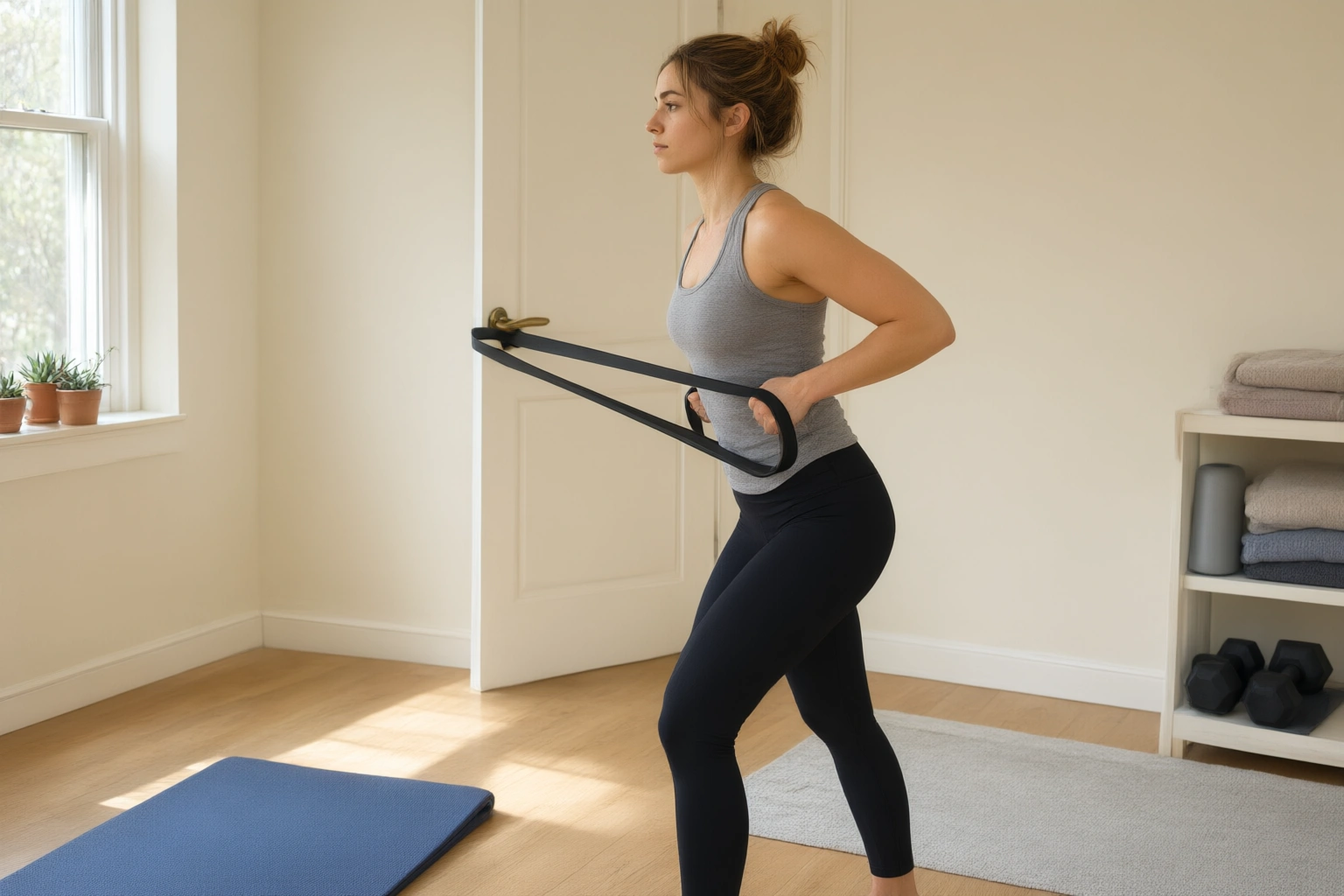
The catch is that bands are not identical to dumbbells or machines. They work best when you understand what they do well: provide smooth, joint-friendly resistance, make bodyweight work harder, and let you train a lot of movement patterns for very little money. They are less ideal when you want to load a lift very heavily and measure progress in small, precise jumps.
My practical verdict as a trainer: resistance bands are effective for beginners and budget home gyms, especially if your goal is general fitness, muscle building, or getting stronger without much equipment. They can be enough on their own for a while. If you get stronger and want heavier lower-body loading or more exact progression, bands usually work best as part of a small equipment mix rather than as your only tool.
Are Resistance Bands Effective? The Short Answer
Yes — resistance bands are effective, but “effective” needs context.
If you use them with enough tension, good form, and progressive overload, bands can absolutely help you build strength and muscle. The research generally suggests that elastic resistance training can be a legitimate option for beginners, but that does not mean it is always interchangeable with heavy dumbbells or machines for every exercise or long-term goal. In practice, bands seem especially useful when the main goal is to start training consistently, build a strength base, and make movements harder in a controlled way.
For a beginner, that matters more than it sounds. Most people do not need a perfect barbell setup to get started. They need a tool that lets them train consistently, challenge the muscles, and recover well enough to repeat the work next week. Bands do that well.
Where people go wrong is expecting bands to feel like free weights. They do not. The resistance increases as the band stretches, so the hardest part of the movement often happens near the end range. That is useful, but it changes the training feel and the type of progression you’ll use.
How Resistance Bands Work
Resistance bands create tension by stretching. The farther you pull them, the more resistance they provide. That is called variable resistance.
This is different from a dumbbell, which gives the same load throughout the movement. With bands, the tension is lighter at the start and heavier near the top or end of the rep. That can be a benefit because it keeps tension on the muscle through a large part of the movement, and it can also make some exercises feel smoother on the joints.
The main training principle is still progressive overload. You just apply it differently. Instead of adding 5 pounds to a dumbbell, you might:
- use a thicker band
- step farther from the anchor point
- shorten the band by choking up on it
- add reps
- slow the tempo
- pause longer in the hardest part of the rep
That flexibility is one reason bands fit budget home gyms so well.
For a beginner, this means a band can grow with you for a while. Once a movement becomes too easy, you do not need to replace the whole setup. You can change the tension or the exercise angle and keep progressing.
What Results You Can Realistically Expect
Resistance bands can produce real results, but the results depend on your goal and how you train.
How much to expect
For a typical beginner training consistently with bands 2 to 4 times per week, the most realistic 8- to 12-week outcome is noticeable improvement in exercise control, endurance, and the number of reps you can handle with good form. Strength gains are common, especially in pressing, rowing, squatting patterns, and hip work. Muscle gain is possible too, but usually modest at first and more noticeable in how your body looks and feels than in dramatic size changes.
A good rule of thumb is this: if you are new to training, bands can absolutely help you get stronger and build some muscle over a few months, but they are not a shortcut to advanced-level strength or rapid transformation. Progress tends to be steady rather than dramatic.
Strength
Bands can improve strength, especially for beginners and intermediate exercisers. They can produce meaningful strength gains in some settings, but that does not mean they are always equal to heavy free weights for every lift or every trainee. It means they are strong enough to matter.
A realistic beginner outcome is better pressing, rowing, squatting, and hip work over several weeks to months, provided the sets are challenging. If you can finish every set with plenty left in the tank, the band is probably too light.
Muscle gain
Bands can support hypertrophy, which is the training term for muscle growth. The key is hard sets taken close to failure and enough weekly volume. If you only do a few casual band curls once in a while, results will be limited. If you use bands for full-body work two to four times per week and push the muscles hard, they can absolutely help you build size.
That said, if your long-term goal is maximizing muscle gain, bands alone may eventually feel limiting for larger muscle groups, especially legs and back. At that point, heavier loading options become more useful.
Endurance and general fitness
Bands are very good for muscular endurance because they let you accumulate reps with continuous tension. They are also useful for general fitness because they are easy to set up and repeat often. That makes consistency easier, and consistency is what drives most beginner progress.
Mobility and range of motion
Bands can be helpful for mobility work and for strengthening through a fuller range of motion. They are often used in rehab and prehab settings for light, targeted work.
Fat loss
Bands can support a fat-loss plan only in the same indirect way any training tool can: by helping you exercise consistently and burn energy. They do not cause fat loss by themselves. If someone says bands “tone” you, what they usually mean is that bands help build muscle while you manage body fat with overall training and nutrition.
Where Resistance Bands Work Best
Bands shine when you want low-cost, low-space, full-body training.
They are especially effective for:
- rows and pulldowns
- chest presses
- overhead presses
- banded squats and split squats
- glute bridges and hip thrusts
- lateral walks and glute activation
- curls, triceps extensions, and shoulder raises
- warm-ups and mobility drills
They are also useful for making bodyweight training harder. A push-up with a band across your back is a very different exercise from a standard push-up. The same goes for squats, glute bridges, and even split squats. Bands add external resistance without needing a bench, rack, or heavy dumbbells.
For a beginner in an apartment, that is a major advantage. You can build a simple workout around one or two long loop bands and cover most major muscle groups without filling a room with equipment.
A second advantage is that bands are easy to use often. If your setup is simple enough that you can train in five minutes, you are more likely to train three times a week than if every session feels like a project.
Where Resistance Bands Fall Short
Bands are not a perfect replacement for everything.
Their biggest limitation is loading. You can make many exercises hard with bands, but loading does not always scale as neatly as it does with dumbbells or barbells. That becomes more noticeable as you get stronger, especially in lower-body movements and heavy back work.
Here are the main trade-offs:
- Less precise progression: It is easier to jump from one band to the next than to add small weight jumps.
- Different resistance curve: The tension changes through the movement, so the feel is not the same as free weights.
- Harder to max out legs and back: Stronger trainees may outgrow bands for some compound lifts.
- Anchor dependence: Some exercises need a safe door anchor or post, which adds setup constraints.
Bands are also less ideal if you want a very heavy strength phase, power-focused lifting, or highly repeatable loading for specific barbell-style progressions. That does not make them bad. It just means they are better viewed as a practical home training tool than a complete substitute for every strength method.
Resistance Bands vs Dumbbells, Machines, and Bodyweight
Here is the simplest way to compare the main options for a beginner home gym.
| Training Tool | Best For | Main Advantage | Main Limitation |
|---|---|---|---|
| Resistance bands | Budget home workouts, portability, full-body training, rehab/prehab-style work | Cheap, compact, versatile, easy to store | Harder to load very heavily and progress precisely |
| Dumbbells | Strength, muscle gain, straightforward progression | Easy to understand and progressively overload | Cost, space, and storage add up quickly |
| Machines | Stable resistance and easy targeting of muscles | Very controlled and beginner-friendly | Expensive, bulky, not realistic for most home gyms |
| Bodyweight training | Minimalist training, general fitness, strength foundations | Free and simple | Hard to load some movements enough without extra resistance |
If you are choosing only one tool on a tight budget, bands usually beat machines and often beat dumbbells on cost and space. If your goal is long-term strength progression with simple loading, dumbbells are easier to live with. If your goal is to start now, in a small space, for very little money, bands are hard to beat.
Bodyweight work is the cheapest option, but bands make bodyweight training more scalable. That is why many beginners do best with a hybrid approach: push-ups plus bands, split squats plus bands, rows plus bands.
For planning a small setup, it helps to think beyond the equipment itself. A home gym is only useful if it fits your space and your routine, which is why articles like how to create a functional home gym and home gym planning mistakes are worth reading before you buy a lot of gear.
Which Type of Resistance Band Should You Buy?
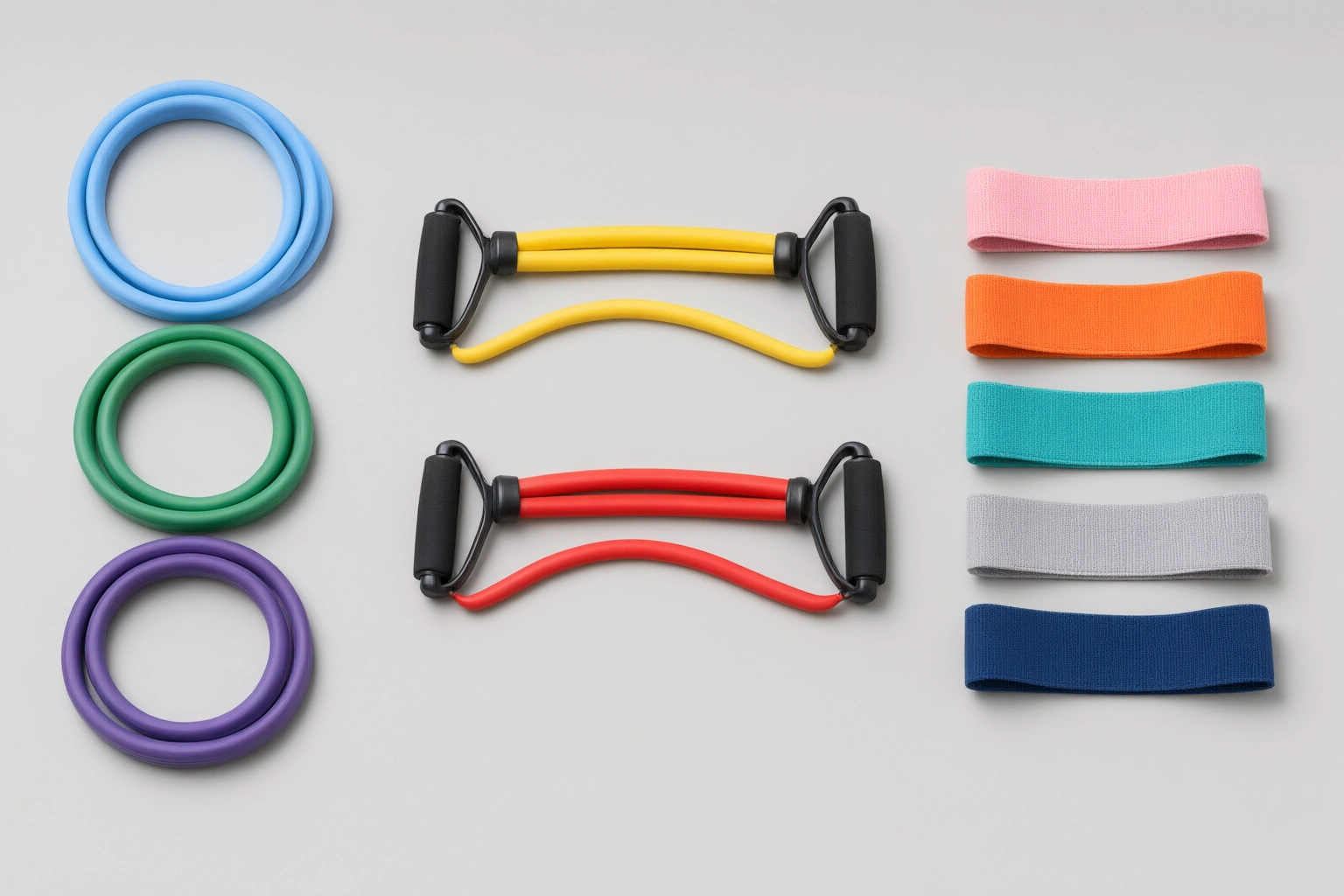
The three common types are loop bands, tube bands, and mini bands.
Loop bands
Long loop bands are the most versatile choice for a beginner home gym. They work for pressing, rowing, squatting, deadlifting patterns, curls, and assisted movements. If you want one band style that can cover the most exercises, this is usually it.
Best for:
– full-body training
– anchoring to doors or sturdy posts
– lower-body and upper-body work
Trade-off:
– they can feel awkward at first if you are used to handles
Tube bands
Tube bands usually come with handles. They are easy for presses, rows, and arm work, and they feel more familiar to people who have used gym cable machines.
Best for:
– upper-body exercises
– beginners who prefer handles
– simple home workouts
Trade-off:
– they are often less versatile than long loop bands for lower-body work, and some budget tube bands may wear out faster than high-quality loop bands
Mini bands
Mini bands are short loops, usually used around the thighs or ankles.
Best for:
– glute activation
– lateral walks
– warm-ups
– hip stability work
Trade-off:
– they are not a full replacement for longer bands because the range of exercises is limited
If I were helping a beginner buy just one type, I would usually point them toward long loop bands first, then mini bands if glute work or warm-ups are a priority.
How to Choose the Right Resistance Level
The best starting band is the one that makes the last few reps challenging without breaking form.
A simple rule: choose a band that lets you perform about 8 to 15 controlled reps with good technique on your main exercises. If you can do far more than that, the band is probably too light for strength or muscle-building work. If you cannot keep your form clean for even a handful of reps, it is too heavy.
A helpful setup for beginners is to buy more than one resistance level. That gives you room to progress without replacing everything immediately. Many band sets include light, medium, and heavy options for that reason.
For common beginner use cases, a practical starting point is:
– Upper body: a light-to-medium band for presses, rows, and shoulder work
– Lower body: a medium-to-heavy band for squats, deadlift patterns, and hip bridges
– Mini bands: a light or medium mini band for lateral walks and glute activation
Best Beginner Resistance Band Exercises
A beginner does not need a complicated program. These movements cover the major patterns.
- Band row: good for upper back and posture-focused pulling
- Band chest press: useful if you do not have dumbbells or a bench
- Band squat: a simple lower-body pattern with external resistance
- Band Romanian deadlift: trains the hips and hamstrings
- Band overhead press: builds shoulders and pressing strength
- Band glute bridge or hip thrust: strong option for glutes
- Band curl and triceps pressdown: easy arm finishers
- Mini-band lateral walk: useful for glute medius and hip stability
A simple full-body session might be:
1. Band squats
2. Band rows
3. Band chest presses
4. Band Romanian deadlifts
5. Mini-band lateral walks
That is enough to train the whole body without overcomplicating the process.
If your space is tight, think about how your room layout affects training. A band workout still needs a safe anchor point and a clear path for movement. If you are setting up in a spare room or basement, guides like spare room home gym ideas and how to turn a basement into a home gym can help you avoid awkward setup problems.
How to Use Resistance Bands Safely
Bands are generally beginner-friendly, but they still deserve respect.
Check the band before each session. Look for cracks, thin spots, tears, or worn handles. If a band looks damaged, retire it. A snapped band can hit hard enough to startle you or cause injury, especially near the face or eyes.
Anchor bands only to secure points. A door anchor should be placed on the correct side of a closed door, and the door should be locked or otherwise unable to open toward you. Do not clip bands to unstable furniture or anything that can move.
Keep the band under control through the whole rep. Sudden release creates snapback. That is one reason bands feel safer than free weights in some situations, but they are not risk-free. Good setup and control matter.
A few safety rules worth following:
– keep your face out of the line of tension
– do not overstretch a band beyond its intended range
– use smooth reps instead of jerking
– match the band to the exercise, not your ego
– avoid standing too close to the anchor point, which can make the band feel unstable and harder to control
– make sure the band does not twist during the rep, since twisting can change the resistance and increase wear
– use a strong, well-fitted door anchor rather than a weak or improvised setup
If you are unsure about form, a certified trainer can help you choose the right band, anchor it correctly, and build a simple program around it.
Are Resistance Bands Worth It for a Budget Home Gym?
For most beginners, yes.
Bands are one of the best first purchases for a budget home gym because they are compact and flexible enough to support real training. They are especially worth it if you want to work out in a small room, train without noise, or add resistance to bodyweight exercises.
Bands alone are enough if:
– your goal is general fitness
– you are a beginner
– you have limited space
– you want the lowest-cost effective setup
– you are happy with moderate strength and muscle gains for now
Bands should probably be paired with other equipment if:
– you want heavier lower-body loading
– you want simpler long-term progression
– you are already fairly strong
– you want more variety in loading angles and exercise styles
For many budget home gyms, the smartest move is not “bands or weights.” It is “bands first, then add the next piece only when the bands stop matching your goals.”
When to Ask a Certified Trainer
Ask a certified trainer if you are unsure how to anchor bands safely, if you have pain during training, or if you want a simple plan that matches your space and goals. That is especially useful if you are returning to exercise after a long break or trying to build a routine around limited equipment.
A good trainer will not overload you with complexity. They should help you choose a small number of exercises, the right resistance levels, and a progression you can actually stick to.
FAQs
Do resistance bands really build muscle?
Yes, they can. The key is using enough tension and taking sets close to failure with consistent weekly training. Bands are not magic, but they are strong enough to stimulate muscle growth for beginners and many intermediate lifters.
Are resistance bands better than dumbbells?
Neither is universally better. Dumbbells are easier for precise loading and heavier strength work. Bands are cheaper, more portable, and better for small spaces. For a budget home gym, bands often win on practicality.
Can resistance bands replace a gym?
They can replace a lot of gym work for a beginner, especially if your goal is general fitness, toning, and moderate strength gains. They are less likely to replace a gym forever if you want very heavy strength training or advanced muscle-building progress.
What resistance band should a beginner buy first?
A long loop band is usually the best first buy because it covers the widest range of exercises. Add mini bands if you want glute and hip work. Tube bands with handles are useful if you prefer a more familiar grip.
Are resistance bands safe?
They are generally safe when used correctly, but they are not risk-free. Inspect them, anchor them securely, and avoid sudden release. Most band-related problems come from poor setup or worn equipment, not from the band itself.
How do I know if my band is too light?
If you can do well over 15 reps without much effort and the last reps do not feel challenging, the band is probably too light for strength or muscle growth. You want the final reps to be hard while still controlled.
Can I lose weight with resistance bands?
Bands can help as part of a larger plan because they support regular exercise and muscle retention. They do not guarantee weight loss on their own. Results depend on your overall activity, food intake, and consistency.
Are loop bands or tube bands better?
Loop bands are usually better for full-body training and versatility. Tube bands are often more convenient for presses, rows, and arm exercises because of the handles. If you only buy one style, long loop bands usually give you more value.