
How to Create a Functional Home Gym

A functional home gym is one you can use consistently without rearranging the room every time or buying gear that does not match how you train.
That means the setup should be built around a few practical questions: What workouts will you actually do? How much space do you really have? What can your budget support now, and what can wait? Once those decisions are clear, the rest becomes much easier.
If you are in a house, apartment, or rental, the same basic rule applies: build for use, not for display.
Quick Step-by-Step Checklist
- Set your goal: strength, cardio, mobility, general fitness, or a mix.
- Measure the space: floor area, ceiling height, door swings, and clearance.
- Set your budget: decide what you can spend now and what can wait.
- Choose core equipment: buy the few items that match your training style.
- Plan flooring: use mats or flooring that fit the room and reduce wear.
- Add storage: keep the floor clear and equipment easy to reach.
- Map the layout: leave a training zone, a storage zone, and a clear path.
Start With Your Fitness Goals and Workout Style
Before buying anything, define what the gym needs to support on a normal week. That sounds obvious, but it is the step most people skip. They buy equipment for an imagined routine instead of the one they will actually follow.
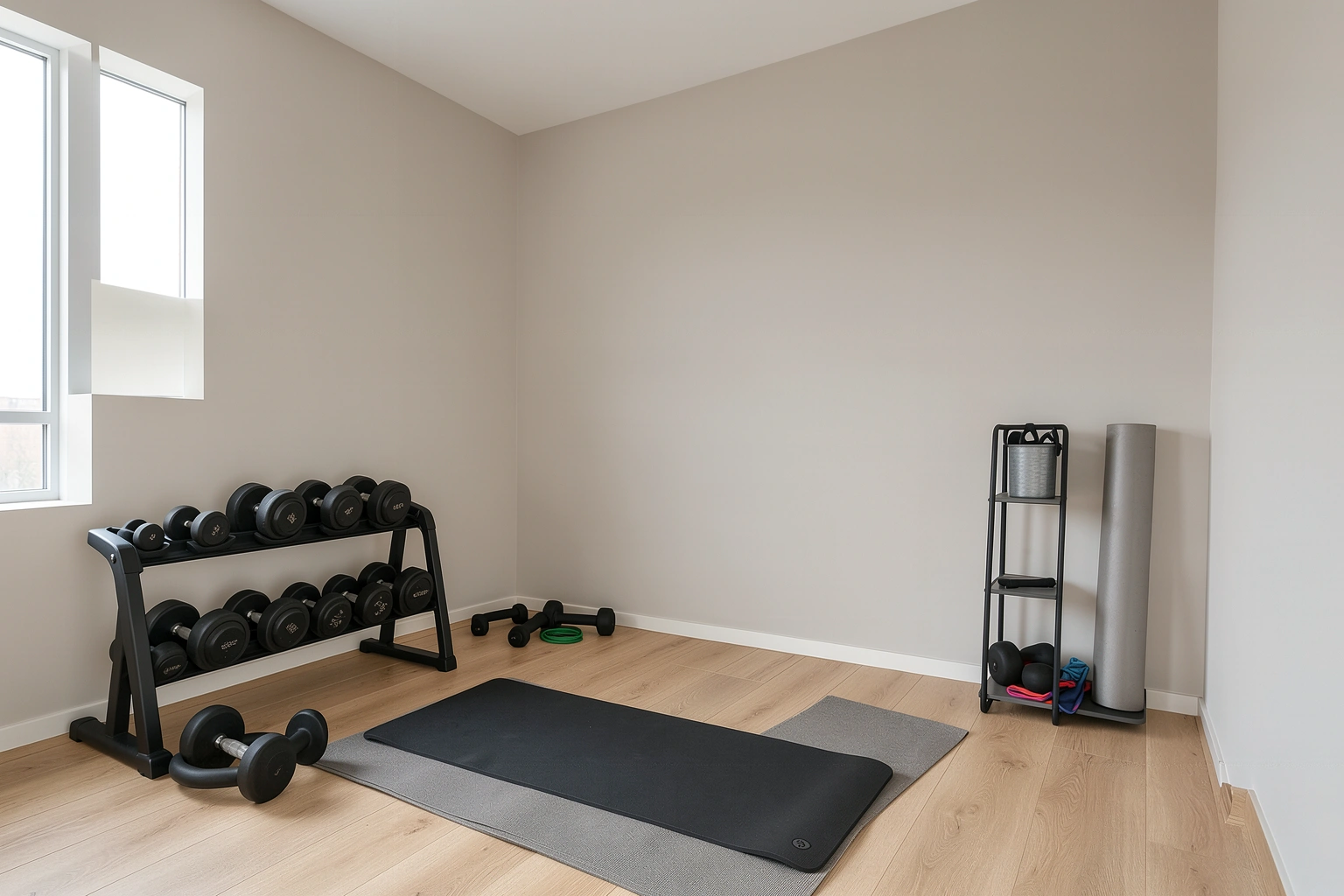
If your workouts are mostly strength-based, your priorities will be different from someone who wants cardio, mobility, or general fitness. A strength-focused setup may center on a bench, dumbbells, and eventually a rack or barbell. A mobility-focused space may need little more than open floor space, a mat, bands, and maybe a mirror. Someone who wants a mix of everything usually does best with versatile equipment rather than specialty machines.
A useful test is to write down your last three to five workouts. If they all look similar, that is your answer. If they vary a lot, choose equipment that can cover several movement patterns instead of one narrow use case.
For example, a renter who mostly follows dumbbell strength workouts and short bodyweight sessions does not need a large machine setup. Adjustable dumbbells, a bench, resistance bands, and a mat may be enough to create a genuinely useful routine.
Assess Your Space, Ceiling Height, and Real-World Constraints
Once the training goal is clear, measure the space honestly. Do not just look at the room and guess. Measure floor length and width, then note ceiling height, door swing, outlets, windows, and anything that affects movement.
Ceiling height matters more than many people expect. Overhead presses, jumping movements, pull-up bars, and even some cardio equipment can feel cramped in low-ceiling rooms. If you plan to lift overhead or use a rack, make sure you will not be forced into awkward form or unsafe angles.
Also account for clearance around equipment. A bench pressed against a wall may seem space-efficient, but if you cannot walk around it or load weights comfortably, the layout will become annoying fast. The same applies to treadmills, bikes, and rowers. Some equipment needs more room than the footprint alone suggests.
Shared walls and floors add another layer. In an apartment or condo, vibration and noise can matter as much as size. Rubber flooring, controlled movements, and quieter equipment often make a bigger difference than adding more gear. If noise is a major concern, a compact setup built around bands, dumbbells, and a mat may be more realistic than a heavy lifting station.
For general room planning and safety, manufacturer installation guides are worth checking before buying larger items. Equipment manuals often include clearance, anchoring, and assembly requirements that are more useful than broad guesses. For building and safety basics, the Consumer Product Safety Commission is a solid reference point for home equipment precautions.
Set a Practical Budget and Decide What to Buy First
A functional home gym does not need to be built all at once. In fact, phased buying usually leads to better results because it forces you to prioritize what you will actually use.
A practical budget plan has three layers:
- Essentials — the minimum needed to train consistently
- Support items — gear that makes the space safer or more versatile
- Upgrades — equipment that improves convenience, variety, or comfort
For most people, essentials come first: flooring or mats, one or two primary pieces of training equipment, and storage that keeps the space usable. Support items might include a bench, bands, or a mirror. Upgrades can wait until you know the room is being used regularly.
A common mistake is spending too much on one large item and leaving nothing for the basics. A better approach is to fund the full system in a smaller version before expanding.
If you are choosing between a premium setup and a budget setup, ask one question: will this item make the gym easier to use three times a week? If the answer is no, it belongs later.
Example purchase priorities by budget level
Very limited budget
– Start with a mat or basic flooring piece
– Add resistance bands
– Choose one versatile strength tool, such as adjustable dumbbells if the budget allows, or a kettlebell if not
– Use open floor space before buying a bench or larger storage
Mid-range budget
– Add adjustable dumbbells first
– Buy a bench second if you lift regularly
– Add flooring that covers the main training area
– Include a simple storage rack or shelf
– Consider a second training tool, such as kettlebells or a pull-up solution, if your routine needs it
Higher budget
– Start with flooring, storage, and the main training area
– Add adjustable dumbbells or a barbell-and-rack setup based on your training style
– Include a quality bench
– Add cardio equipment only if you will use it often
– Finish with comfort items such as mirrors, better lighting, or specialty accessories
A clearer purchase order helps beginners avoid overbuying. In a very small space or tight budget, the best first buys are usually flooring or a mat, then the most versatile training tool you will use most often, then storage. A bench, rack, or cardio machine should come after the basics are already working.
Choose the Core Equipment That Makes the Gym Functional
A functional gym usually needs only a handful of categories to cover most workouts. The goal is not to collect everything. The goal is to cover the broadest range of movement with the fewest pieces.
The core pieces most people use often
- Adjustable dumbbells: Useful for presses, rows, lunges, squats, carries, and accessory work without taking up the space of multiple fixed pairs.
- Weight bench: Adds versatility for upper-body work, step-ups, split squats, and supported movements.
- Resistance bands: Low-cost, compact, and valuable for warm-ups, mobility, pulling movements, and assistance work.
- Mat or flooring: Makes floor exercises more comfortable and helps protect the room.
- Kettlebell or two: Good for swings, goblet squats, carries, and conditioning-style work.
- Cardio option, if needed: This can be a bike, rower, treadmill, jump rope, or simply a clear area for bodyweight conditioning.
A barbell and power rack can be excellent additions for a strength-focused gym, but they are not required for everyone. They make the most sense when you lift regularly, have enough clearance, and want a more dedicated strength setup.
The decision should follow use, not aspiration. If you train with dumbbells four days a week and barbell lifts once a week, a barbell-centered room may be overkill. If you squat, bench, and deadlift often, the rack becomes much more valuable.
All-in-one adjustable equipment vs. individual pieces
For small spaces and tighter budgets, it helps to compare two common approaches:
- All-in-one adjustable equipment: For example, adjustable dumbbells, adjustable benches, or compact systems that combine multiple functions.
- Individual pieces: Separate dumbbells, a fixed bench, separate kettlebells, or a full rack-and-barbell setup.
All-in-one adjustable equipment is usually the better starting point when:
– space is limited
– the room must stay flexible
– you are not sure how your training will evolve
– you want fewer items to store and move
Individual pieces can make more sense when:
– you have a dedicated room
– multiple people use the gym with different goals
– you lift often enough that convenience matters more than compactness
– your budget allows you to specialize gradually
For a renter or apartment setup, adjustable equipment often gives the best balance of versatility and footprint. For a larger dedicated room, individual pieces may be easier to use and more comfortable over time. If budget is tight, adjustable dumbbells and a mat usually cover more ground than buying several single-purpose items right away.
Compare Space-Saving Equipment Options
The easiest way to avoid wasting money is to compare equipment by function, footprint, and flexibility rather than by popularity.
| Equipment type | Space needs | Best use case | Trade-off |
|---|---|---|---|
| Adjustable dumbbells | Low to moderate | General strength training in small spaces | More expensive than one fixed pair, but far more compact |
| Fixed dumbbells | High | Dedicated room with frequent strength work | Simple and durable, but takes up floor and storage space |
| Barbell + rack | High | Strength-focused training with heavier loads | Powerful setup, but requires room, flooring, and usually a bigger budget |
| Weight bench | Low to moderate | Pressing, supported lifts, step-ups, and accessories | Very versatile, but only useful if paired with other equipment |
| Resistance bands | Very low | Warm-ups, mobility, assistance, light resistance work | Compact and cheap, but not a full replacement for heavier loading |
| Kettlebells | Low | Full-body training, carries, conditioning | Efficient, but a small collection can get limiting quickly |
| Compact cardio equipment | Moderate | Dedicated cardio in a home setting | Useful if used often, but can dominate a room |
| No-cardio setup | Very low | Strength, mobility, and bodyweight-focused routines | Saves space, but may not suit users who want indoor cardio |
For many small spaces, adjustable dumbbells plus bands are the most efficient starting point. They cover a wide range of exercises without creating clutter. If you want more strength-specific work later, a bench or rack can be added after the room proves itself.
A premium setup often means more specialization: separate dumbbell pairs, a full rack, larger cardio equipment, and more storage. That can work well in a dedicated room, but it is rarely the best first move for a renter or apartment dweller.
Plan the Layout for Safety, Flow, and Ease of Use
A good home gym layout makes training feel straightforward. You should be able to walk in, start, and finish without moving equipment around first.
Think in zones:
- Main training zone: where lifting, stretching, or floor work happens
- Storage zone: where weights, bands, and accessories live
- Clear path: a walkway that stays open for entering, exiting, and moving safely
Keep the most-used equipment easiest to reach. If your dumbbells are buried behind a bike or under a bench, you will use the gym less often. The same is true for mats and bands. Items that support every workout should not require a rearrangement.
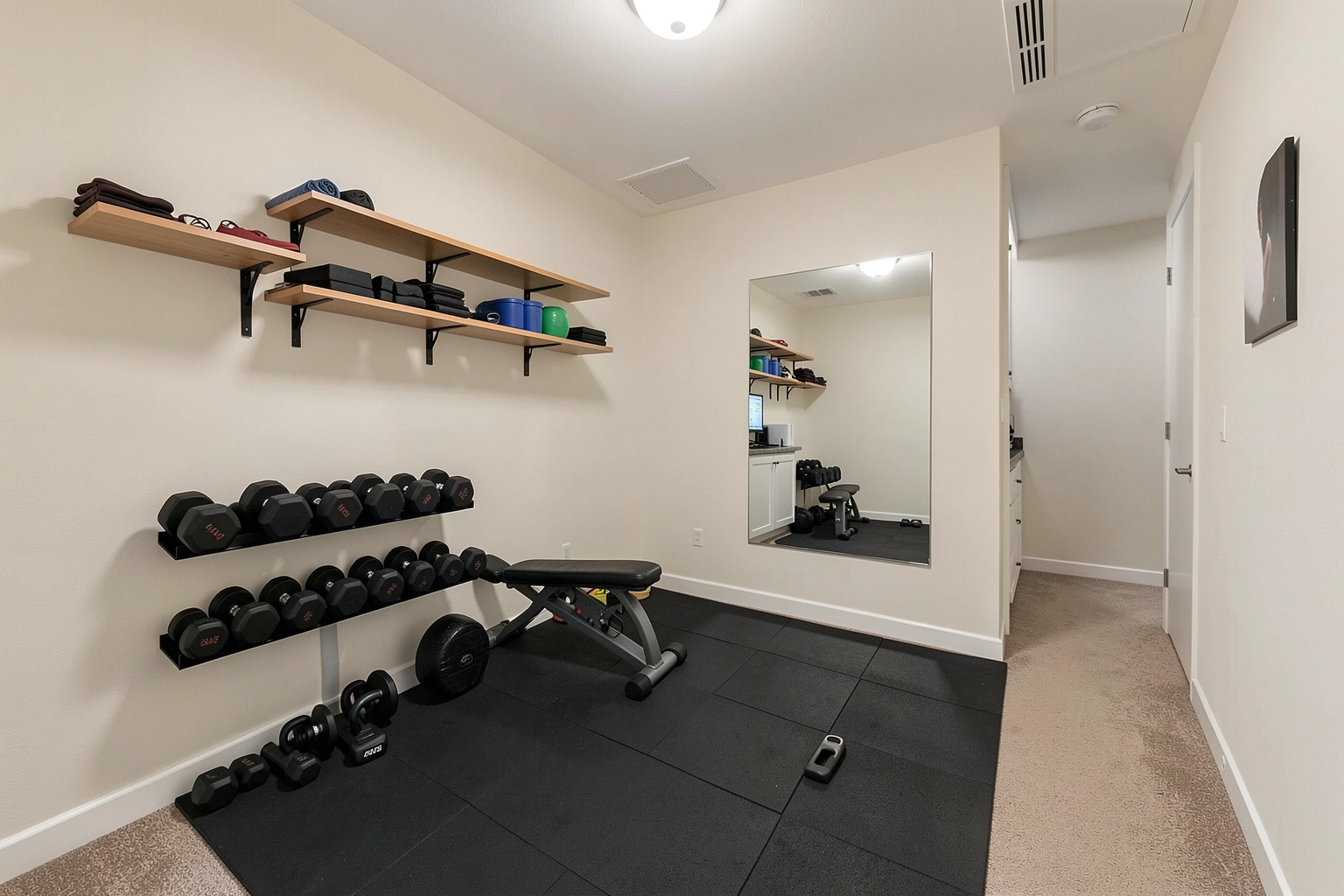
For a small room, one wall can hold storage while the center stays open. A mirror on the opposite wall can help with form checks and make the room feel less boxed in. In a garage or larger room, leave a clear lane for loading weights and moving between exercises.
If you use a rack or bench, leave enough room to work from both sides when possible. Crowding one corner may save floor space on paper, but it can make the room harder to use in practice.
Select Flooring, Wall Protection, and Noise Control
Flooring is one of the smartest early investments because it protects the room and improves usability at the same time.
Rubber gym flooring is common for a reason: it helps protect floors from impact, reduces slipping, and gives equipment a more stable base. For apartments or shared homes, thicker rubber mats or layered flooring can be a better renter-friendly choice than permanent changes. If you are trying to reduce noise, choose the thickest practical option for your space and use controlled movements where possible.
If you are lifting weights, placing equipment directly on hardwood, laminate, or carpet is usually not ideal. Floors can dent, equipment can shift, and the room may feel less stable. Even a simple mat under a bench or dumbbell area can make the space more practical.
For renters, it helps to avoid anything that could leave marks or require permanent installation. Interlocking rubber tiles, large mats, and freestanding storage are often easier to live with than glued-down flooring or wall-mounted systems. If you need to protect shared floors, use mats under the heaviest equipment and add felt pads or protective feet where appropriate.
Wall protection matters too. A mirror, rack, or bench placed too close to the wall can cause scuffs over time. If you are using wall-mounted equipment, follow the manufacturer’s anchoring instructions carefully. That is one place where guessing is not worth the risk.
For powered cardio machines, check electrical access and ventilation before buying. A treadmill tucked into a corner with poor airflow may be less comfortable than a bike or rower in the same space. If a machine produces heat, noise, or vibration, the room needs to handle that without becoming unpleasant to use.
Add Storage and Organization So the Gym Stays Usable
A home gym becomes dysfunctional when gear starts living on the floor. Storage is not an afterthought; it is what keeps the room workable.
A simple storage plan usually includes:
- A rack or shelf for weights
- Hooks or bins for bands and accessories
- A place for mats to stand or roll
- A designated spot for smaller items like collars, handles, or jump ropes
If you have adjustable dumbbells, keep the base in the same place every time. If you use bands, store them where they are visible and easy to grab. The more steps it takes to start a workout, the less likely the space is to get used.
Vertical storage is especially helpful in small rooms. Wall-mounted hooks, narrow shelving, and compact storage racks free up floor area. Just be sure anything mounted to the wall is installed properly and can handle the load.
A cluttered gym also creates safety issues. Loose plates, cords, and accessories become tripping hazards. A room that looks “almost set up” is often the one people avoid.
Improve Lighting, Ventilation, and Comfort
People usually focus on equipment first, but environmental details often determine whether a home gym gets used consistently.
Lighting should be bright enough that the room feels intentional, not like a storage closet. Natural light helps, but even a simple overhead upgrade or a well-placed lamp can improve the space.
Ventilation matters more during workouts than many people expect. A fan, open window, or better airflow can make the room more comfortable, especially in small or enclosed areas. If the room gets stuffy, workouts feel longer and less inviting.
Comfort also includes the small things: a mirror for feedback, a clock or timer, and enough room to place a water bottle without it being in the way. These details do not make a gym “fancier,” but they do make it easier to return to.
Build the Gym in Phases If Needed
A phased approach is often the smartest path for renters, beginners, or anyone working with a limited budget.
Phase 1: Make the space usable
Focus on flooring or a mat, one primary training tool, and basic storage. For many people, that means adjustable dumbbells, resistance bands, and a bench or open floor space.
Phase 2: Add versatility
Once the core setup gets used consistently, add the next most useful item. That might be a kettlebell, a second set of bands, a mirror, or a more stable bench.
Phase 3: Specialize if needed
Only after the room is proven should you consider larger or more specialized equipment such as a rack, barbell, or cardio machine.
This order prevents a common problem: building a gym around what seems impressive rather than what gets used. If your training changes later, the room can change with it.
A simple buying order for very small spaces
If you are starting from almost nothing, a practical order is:
- Mat or flooring
- Adjustable dumbbells or resistance bands, depending on budget
- Bench only if your workouts truly need one
- Storage
- Bigger equipment only after the space is working well
That order is especially useful for renters and apartment users because it keeps the setup compact, quiet, and easy to move if needed.
If multiple people share the gym
When more than one person uses the same home gym, the best setup is usually the one that supports overlapping needs without crowding the room. In that case, prioritize:
– adjustable equipment over duplicated fixed pieces
– storage that keeps each person’s items organized
– a layout that leaves enough open space for different workouts
– equipment that can serve strength, mobility, and basic cardio needs without taking over the room
If one person lifts and another prefers bodyweight training or mobility work, shared equipment like adjustable dumbbells, bands, a bench, and a mat can cover both without requiring a full commercial-style setup.
Avoid the Most Common Home Gym Mistakes
The biggest home gym mistakes are usually planning mistakes, not equipment failures.
Common errors to avoid
- Buying too much before defining your training style
- Choosing bulky gear that makes the room feel crowded
- Ignoring ceiling height and door clearance
- Skipping flooring and damaging the room
- Leaving no storage plan
- Prioritizing trends over usability
- Spending the whole budget on one item
- Forgetting about noise in apartments or shared homes
A simple rule helps: if an item does not improve how often or how safely you train, it is probably not a first-round purchase.
Keep the Space Functional Over Time
A home gym stays functional when it is easy to reset. Put equipment back in the same place after every workout. Keep the floor clear. Reassess the room every few months and remove anything that is not being used.
If your routine changes, let the gym change with it. A room that once supported strength training might later become more cardio- or mobility-focused. That is normal. The best setups are flexible enough to adapt without starting over.
Check equipment stability, storage, and flooring periodically. Not because the gym needs constant maintenance, but because small issues become clutter and inconvenience if ignored.
When to Consult a Professional
If you are installing wall-mounted racks, handling heavy loads, modifying electrical access for cardio equipment, or making structural changes to a garage or basement, consult a qualified professional or follow the manufacturer’s installation requirements closely. That is especially important when anchoring equipment into walls or planning a setup that affects building safety, flooring, or shared walls.
FAQs
What equipment do I actually need for a functional home gym?
Most people can build a useful setup with a mat or flooring, adjustable dumbbells, resistance bands, and a bench. Add a rack, barbell, or cardio machine only if your training style truly needs them.
How much space do I need?
A functional gym can fit in a spare corner, a section of a bedroom, or a garage bay if the equipment is chosen carefully. The real question is not just floor size, but whether you have enough clearance to move safely and store gear without clutter.
What is the best layout for a small home gym?
Keep the center open for movement, place storage against one wall, and keep the most-used equipment easiest to reach. In small rooms, vertical storage and compact gear matter more than trying to fit everything in.
Should I buy a rack or adjustable dumbbells first?
For most small-space setups, adjustable dumbbells come first because they cover more exercises with less footprint. A rack makes more sense when you lift heavy often and have the room, budget, and flooring to support it.
Is compact cardio equipment worth it?
Only if you will use it regularly. If you enjoy indoor cardio and have the space, a bike, rower, or treadmill can be useful. If not, a no-cardio setup may be the better use of space and money.
How do I keep a home gym from becoming cluttered?
Give every item a storage place, keep the floor clear, and avoid buying accessories without a clear purpose. A room that can be reset in a minute or two is much easier to use consistently.
Can I build a functional gym in an apartment?
Yes. Focus on quiet, compact, and easy-to-store equipment such as bands, adjustable dumbbells, a mat, and a small storage solution. Flooring, noise control, and renter-friendly setup choices matter more in apartments than in detached homes.
The best home gym is the one that fits your space, supports your actual training, and stays simple enough to use without friction.