
How Accurate Are Smart Scales? Body Fat Readings Explained

How accurate are smart scales? What bioelectrical impedance measures, why body fat readings jump around, and simple habits that make your trend more useful.
This article may contain affiliate links. If you buy through them, we may earn a small commission at no extra cost to you. Learn more.
Disclosure: Lilac Reviews is reader-supported. As an Amazon Associate we earn from qualifying purchases, at no extra cost to you. We don’t list prices because they change often; check Amazon for the current price.
You step on your smart scale on Monday and it says 28% body fat. Tuesday, 26.5%. Wednesday, 29%. You didn’t gain or lose fat overnight, so what’s going on? And can you trust the thing at all?
This guide answers how accurate are smart scales in plain language: what they really measure, why body fat readings jump around, how they compare with other methods, and the simple habits that turn a noisy number into a useful trend.
The short answer
Smart scales are accurate for weight. Their body fat, muscle and water numbers are estimates. Compared with lab methods, a home scale’s body fat reading can be off by several percentage points for an individual, and it can swing from day to day with hydration. But if you weigh under the same conditions, the trend over weeks is often useful.
How a smart scale estimates body fat
Smart scales use bioelectrical impedance analysis (BIA). Metal pads on the scale send a tiny, harmless electrical current up one leg and down the other. Water-rich tissue like muscle conducts it easily; fat resists it more. The scale measures that resistance, then plugs it, along with the height, age and sex you entered, into a prediction formula to estimate your body fat.
Two weaknesses come straight from that design:
- Foot-to-foot scales mostly “see” your lower body. The current takes the shortest path, through your legs and hips. Your upper body is largely estimated.
- Water changes the reading. Because BIA really measures how water conducts electricity, anything that shifts your hydration shifts your body fat number.
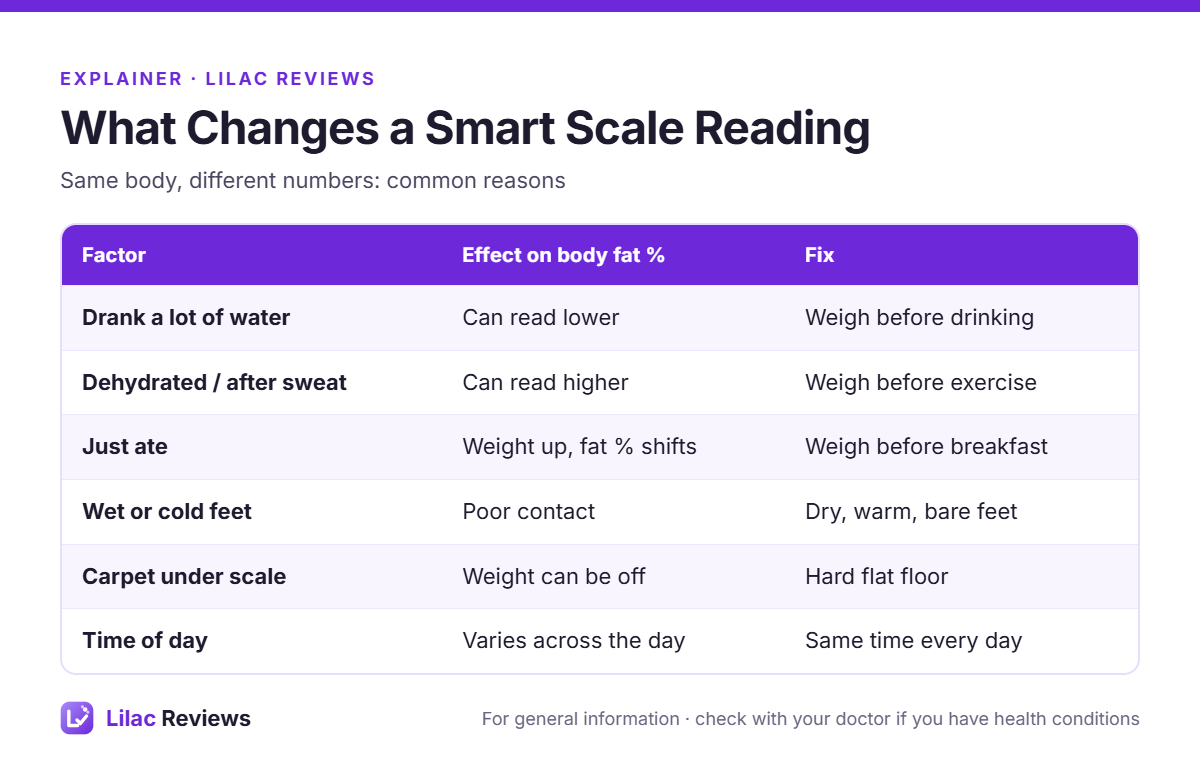
Why your readings jump around
Most day-to-day swings come from things that have nothing to do with fat:
- Hydration: a big glass of water or a salty dinner changes the reading.
- Exercise: right after a workout, blood flow and sweat change the signal.
- Food: a meal adds weight in your stomach and gut.
- Time of day: morning and evening readings usually differ.
- Skin contact: dry, cold or calloused feet conduct less well. So do socks.
- Floor: carpet or an uneven floor can throw off the weight itself.
- Your profile: wrong height or age in the app means wrong estimates. “Athlete mode” changes the formula too.
How smart scales compare with other methods
- DEXA scan: often used as a reference in research. Expensive and not something you do weekly.
- Hydrostatic (underwater) weighing and Bod Pod: accurate but limited to labs and some gyms.
- Skinfold calipers: cheap, but accuracy depends heavily on the person measuring.
- Hand-to-foot BIA devices: some clinic and gym machines use hand and foot electrodes, which read the whole body better than foot-only scales.
- Tape measure: waist circumference is simple, cheap and a good health marker. The CDC and many doctors use it alongside weight.
The takeaway: a home scale won’t match a DEXA scan, and it isn’t meant to. Its job is to give you a consistent number you can watch over time.
How to get the most useful readings
- Same time, same conditions: morning, after the bathroom, before food, drink and exercise.
- Bare, dry feet placed squarely on the pads.
- Hard, flat floor. Don’t move the scale around the house.
- Correct profile: update your age and height. Use athlete mode only if you really train a lot, since it changes the formula.
- Look at weekly averages. Most apps show a trend line; use that, not today’s number.
- Add a tape measure and photos once a month. Our guide to tracking workout progress shows a simple setup.
Which smart scales are worth buying?
Accuracy differences between popular brands are smaller than the differences caused by how you weigh yourself. So pick for app support and convenience. Our best smart scales guide has picks for Apple Health, Google, Fitbit and Garmin users, and our RENPHO Elis 1 review covers a popular budget option.


Who shouldn’t use body fat mode
People with a pacemaker, implanted defibrillator or other implanted electronic medical device should not use BIA. Most manufacturers also advise caution during pregnancy. Many scales offer a weight-only mode; check the manual and ask your doctor.
FAQ
How accurate is smart scale body fat?
For an individual, it can be off by several percentage points compared with lab methods. It’s more useful for tracking change over time than for an exact number.
Why does my smart scale give different readings?
Mostly hydration, food, exercise and time of day. Weigh under the same conditions every time.
Are expensive smart scales more accurate?
Not by much for body fat. More expensive scales usually have better apps, Wi-Fi sync and design rather than dramatically better accuracy.
Is muscle mass on a smart scale accurate?
It’s also an estimate based on the same signal. Treat it as a rough trend.
Bottom line
Trust your smart scale for weight and for trends. Don’t trust any single body fat reading. Weigh at the same time each day, watch the weekly line, and back it up with a tape measure and how your clothes fit.
This article is for general information and is not medical advice.
This guide is for general information only and is not medical advice. Talk to a qualified professional before starting a new exercise program, especially if you have an injury or health condition.