
RENPHO Elis 1 Smart Scale Review: Budget Body Composition, Explained

RENPHO Elis 1 smart scale review: 13 body metrics, 396 lb capacity, Apple Health and Fitbit sync, how accurate body fat estimates are and who should buy.
This article may contain affiliate links. If you buy through them, we may earn a small commission at no extra cost to you. Learn more.
As an Amazon Associate, we earn from qualifying purchases. If you buy through a link on this page we may earn a small commission at no extra cost to you. It never changes what we write.
Smart scales promise more than a number. Step on, and the scale estimates body fat, muscle mass, water and more, then sends it to your phone. The RENPHO Elis 1 is one of the best-selling ways to get that for not much money.
The important thing is understanding what those numbers mean. Here is what the Elis 1 offers, how to read its results sensibly, and who will find it useful.
The short version
The RENPHO Elis 1 is a good-value smart scale that makes tracking weight trends effortless and syncs with the major health apps. Its body composition numbers are estimates from bioelectrical impedance, so treat them as trends rather than exact values. For weight tracking and long-term direction it is excellent value.
- Best for: people who want effortless weight-trend tracking synced to their phone.
- Skip it if: you need clinical-grade body fat measurements or Wi-Fi syncing.
- Standout spec: 13 body metrics and sync with Apple Health, Google Fit, Fitbit and Samsung Health.

How we put this review together
We did not run a long-term lab test on this one, and we are not going to pretend we did. This review of the RENPHO Elis 1 is built from published specifications and independent reviews from established fitness publications. Where sources disagree on a number, we say so. Prices change constantly, so we don’t list them here; check the current price on Amazon before you buy.
RENPHO Elis 1 Smart Scale specs at a glance
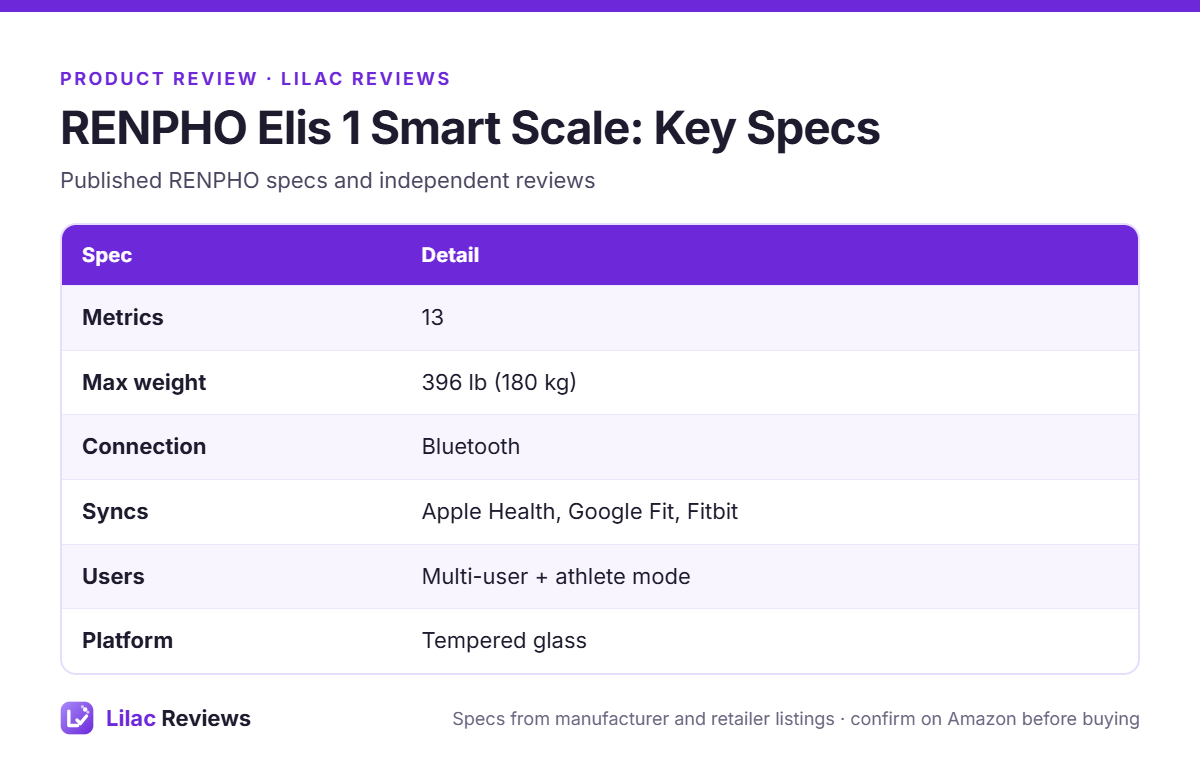
| Spec | Detail |
|---|---|
| Metrics | 13, including weight, BMI, body fat %, muscle mass and body water |
| Max weight | 396 lb (180 kg) |
| Connectivity | Bluetooth (no Wi-Fi) |
| App | RENPHO Health app |
| Syncs with | Apple Health, Google Fit, Fitbit, Samsung Health |
| Users | Multiple users, plus athlete mode |
| Platform | Tempered glass |
RENPHO sells several Elis versions, including battery and rechargeable models. Check the Amazon listing to see which power option you’re getting.
What we like about the RENPHO Elis 1
Effortless trend tracking
Step on each morning and the reading lands in your phone. That consistency is what makes a smart scale useful. Daily weight jumps around; the weekly trend is what matters. Our guide on tracking progress explains why trends beat single readings.
Plays well with other apps
Syncing with Apple Health, Google Fit, Fitbit and Samsung Health means your weight shows up next to your steps and workouts. That’s a big deal if you already use a tracker like the Fitbit Charge 6.
Whole-household use
Multiple users can share it, and the app sorts readings by person. Athlete mode is there for people with high muscle mass, since standard formulas tend to overestimate their body fat.
Lots of data for little money
Thirteen metrics at this price is generous. Even if you only care about weight and body fat trends, the extra numbers can help you notice patterns.
What could be better
Body fat is an estimate
Bioelectrical impedance sends a small current through your feet. The result shifts with hydration, meals, exercise and time of day. Two scales can give very different body fat numbers for the same person. Use it for direction, not exact percentages.
Bluetooth only
Without Wi-Fi, your phone needs to be nearby to sync. If you weigh without your phone, readings sync later, but it is less seamless than Wi-Fi scales.
Not for everyone
Smart scales that send a current through the body are usually not recommended for people with pacemakers or other implanted electronic devices, or during pregnancy. Check the manual and ask your doctor.
Pros and cons
Pros
- 13 metrics at a budget price
- Syncs with major health apps
- Multi-user with athlete mode
- Clean tempered-glass design
Cons
- Body composition is an estimate
- Bluetooth only, no Wi-Fi
- Not suitable for people with implanted electronic devices
Who should buy the RENPHO Elis 1 (and who shouldn’t)
Buy the RENPHO Elis 1 if you want to track weight trends automatically and see them in the health app you already use.
Skip it if you have a pacemaker or other implanted medical device, if you are pregnant, or if you need precise body fat numbers for medical reasons. A clinical measurement such as a DEXA scan is the better tool for that.
How to get consistent readings
Weigh at the same time every day, ideally in the morning after the bathroom and before eating, barefoot, on a hard floor. Carpet makes many scales read inaccurately.
Look at the weekly average, not the daily number. Water alone can move your weight by a couple of pounds in a day.
Alternatives to consider
- Fitbit Charge 6: a tracker that pairs with the scale for a fuller picture.
- WalkingPad C2 Folding Walking Pad: a simple way to add daily movement at home.
- BowFlex SelectTech 552 Adjustable Dumbbells: strength training is one of the best ways to change body composition.
FAQ
How accurate is the RENPHO Elis 1?
Weight readings are generally consistent. Body fat and other composition numbers are estimates and are best used to watch trends over time.
Does the RENPHO Elis 1 work with Apple Health?
Yes, as well as Google Fit, Fitbit and Samsung Health.
What is the weight limit?
396 lb (180 kg).
Can I use it with a pacemaker?
Smart scales that use bioelectrical impedance are generally not recommended for people with implanted electronic devices. Check the manual and ask your doctor.
Bottom line
For the price, the RENPHO Elis 1 does exactly what most people need: it makes weighing in effortless and puts the data where you already look. Read the body fat numbers as trends and it is a genuinely useful tool.
Smart scale body composition readings are estimates and are not a medical assessment.
This guide is for general information only and is not medical advice. Talk to a qualified professional before starting a new exercise program, especially if you have an injury or health condition.