
Best Ellipticals for Seniors: Low-Impact, Easy to Step On

The best ellipticals for seniors: standing ellipticals with low step-up and steady handles, seated recumbent cross trainers, and under-desk options, with safety tips and a starter routine.
This article may contain affiliate links. If you buy through them, we may earn a small commission at no extra cost to you. Learn more.
As an Amazon Associate, we earn from qualifying purchases. If you buy through a link on this page we may earn a small commission at no extra cost to you. We do our best to keep that from influencing what we recommend.
Ellipticals are a favorite for older adults because there is no pounding. Your feet stay on the pedals, the motion is smooth, and you can use your arms as well as your legs. But a standing elliptical still asks for decent balance and a step up onto the pedals. For some seniors, a seated version is the better fit.
This guide covers three types of elliptical-style machines and helps you pick the right one.
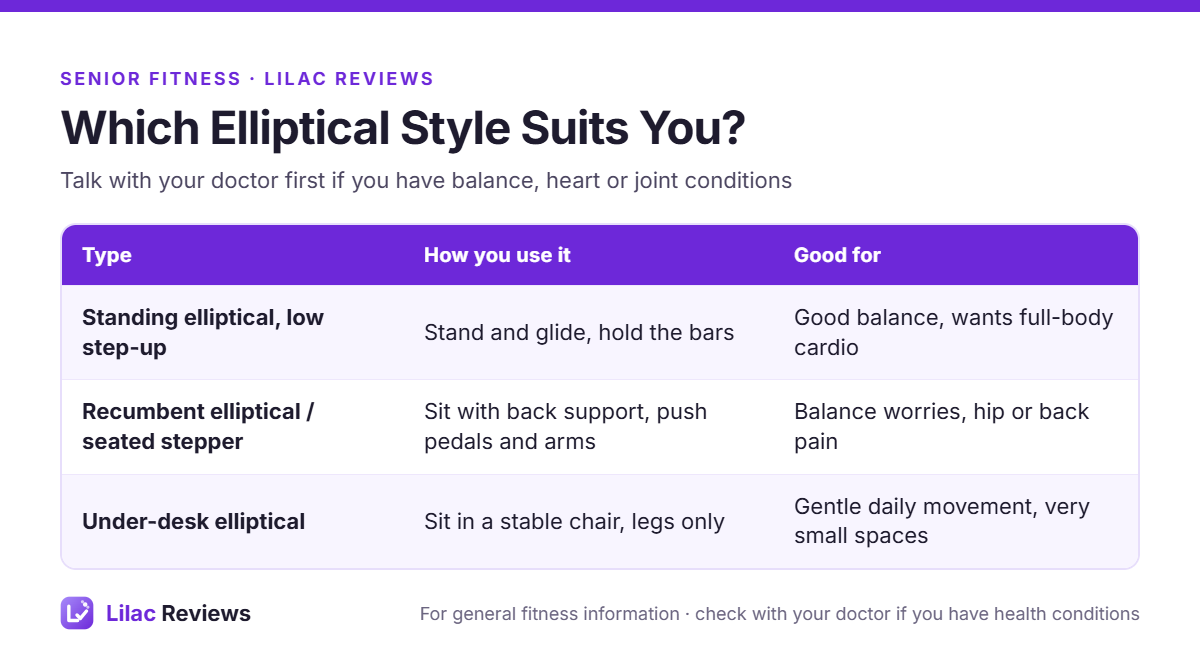
Three types to consider
Standing elliptical
The classic design. Best for seniors with good balance who want a full-body workout. Look for a low step-up height, long fixed handles to hold while getting on, and a stable, heavy frame.
Recumbent elliptical or seated cross trainer
You sit in a supportive seat and push pedals forward while moving arm handles, similar to the seated steppers used in rehab clinics. There is no balance demand and the seat supports your back. Best for people with balance concerns, hip or back pain, or limited mobility.
Under-desk elliptical
A small seated pedal unit you use from a chair. Very gentle and very small. Best for daily light movement rather than a workout.
What to look for
- Step-up height: lower is safer. Ask the seller if it is not listed.
- Handles: fixed handles near the pedals for getting on and off, plus moving arms for the workout.
- Stride length: shorter users may prefer 18 inches; most adults like 20.
- Light starting resistance: level 1 should feel easy.
- Large pedals with a raised edge: keep feet secure.
- Simple controls: large buttons and a readable display.
The best ellipticals for seniors
We have not lab-tested these ourselves. Picks are based on published specifications and consistent feedback from independent reviewers and owners. Check the current listing for exact specs.
Best seated option: Teeter FreeStep Recumbent Cross Trainer
The FreeStep gives you an elliptical-style, arms-and-legs workout while seated with back support. The stepping motion is smooth and low impact, and getting on is as easy as sitting in a chair. For seniors with balance or joint concerns, this is the type we would try first.
Best standing elliptical: Sole E35
For seniors with steady balance who want a full standing workout, the Sole E35 offers a very stable frame, a 350 lb user limit and cushioned, adjustable pedals that Sole designs to reduce knee and ankle strain. It is large and heavy, so measure first. See our Sole E35 review.

Best value standing elliptical: Schwinn 430
The Schwinn 430 is lighter and less expensive than the Sole, with a 20-inch stride and plenty of resistance levels and programs. It suits seniors who want a standing elliptical at a moderate price and mostly work at easy to moderate effort.
Best for gentle daily movement: Cubii Move
A seated under-desk elliptical you can use from an armchair. It is quiet and light. It will not replace a workout, but it is an easy way to keep legs moving through the day. Read our Cubii Move review and our under-desk elliptical guide.

Safety tips
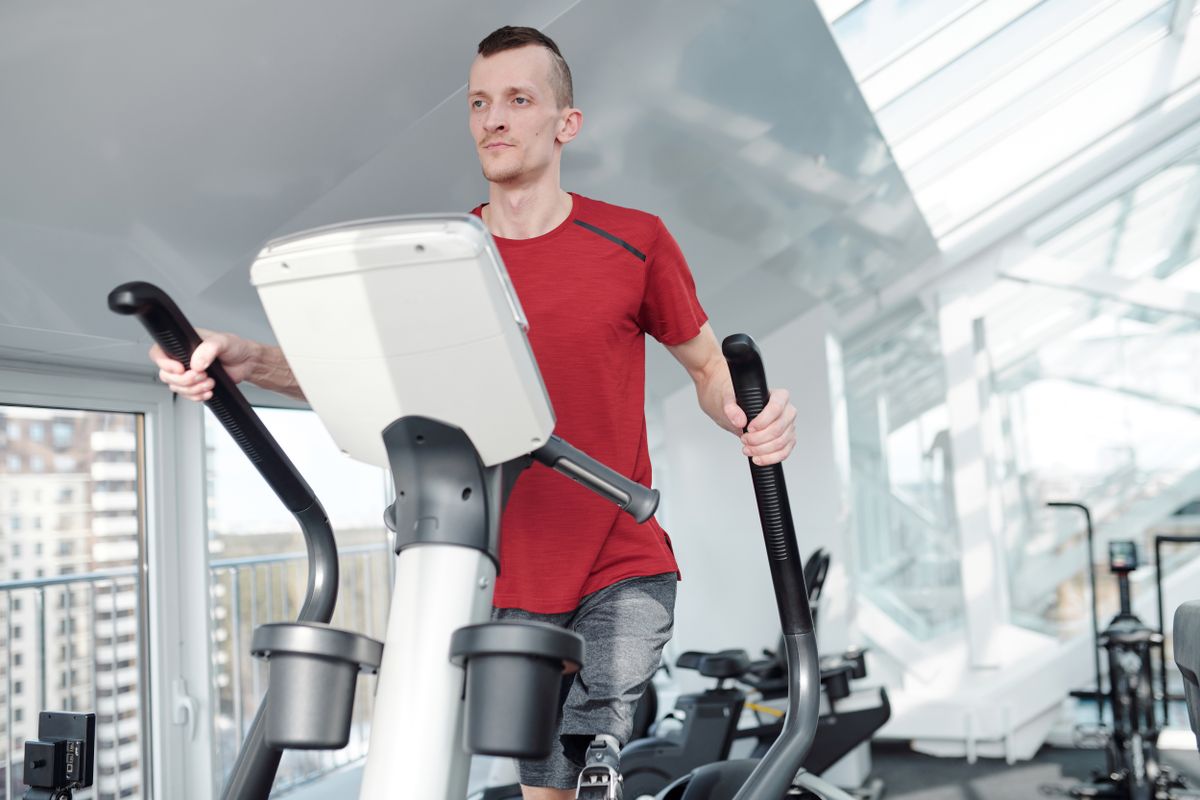
- Hold the fixed handles when stepping on and off, and step on when the pedals are at their lowest point.
- Start at the lowest resistance and keep it there for the first few sessions.
- Keep your feet flat and your knees soft.
- Stop if you feel dizzy, short of breath or pain in your chest or joints.
A gentle starting routine
Begin with 10 minutes at an easy level, three times a week, and add a few minutes each week. Our low-impact elliptical workouts for seniors has three routines with effort levels. The CDC recommends 150 minutes of moderate activity a week for adults 65 and older, plus strength and balance training.
FAQ
Is an elliptical good for seniors with bad knees?
Often, yes, because it is low impact. Keep resistance moderate, and stop if pain increases.
Elliptical or recumbent bike for seniors?
A recumbent bike is the easiest to get on and needs no balance. An elliptical works more muscles. Seated cross trainers sit in between. See recumbent bikes for seniors.
How long should a senior use an elliptical?
Start with 10 minutes and build to 20 to 30 minutes, at an effort where you can still talk.
Bottom line
If balance is good, a stable standing elliptical like the Sole E35 or Schwinn 430 gives a great full-body workout. If balance or back pain is a concern, choose a seated cross trainer like the Teeter FreeStep. For light daily movement, an under-desk elliptical is enough.
Check with your doctor before starting a new exercise routine, especially if you have heart, joint or balance conditions.
This guide is for general information only and is not medical advice. Talk to a qualified professional before starting a new exercise program, especially if you have an injury or health condition.