
Low-Impact Elliptical Workouts for Seniors (3 Easy Routines)

Three gentle elliptical workouts for seniors, how hard to work using the 1-10 effort scale, safety tips and a sample week for adults over 60.
This article may contain affiliate links. If you buy through them, we may earn a small commission at no extra cost to you. Learn more.
If you’re over 60 and want cardio that doesn’t hurt, the elliptical is hard to beat. Your feet never leave the pedals, so there’s no impact, the handles let you bring your arms in, and you can go as slowly as you need to. Plenty of people who can’t jog anymore can still put in a strong 20 minutes on an elliptical.
The trouble is that most elliptical workouts online are written for 30-year-olds chasing calorie burn. This guide is different. It gives you three low-impact elliptical workouts for seniors, a simple way to judge effort without a heart-rate monitor, and the safety habits that matter most at this stage of life.
Why the elliptical suits older adults
- Zero impact. Your feet glide instead of landing, which is kinder to hips, knees and ankles than walking on a hard surface, let alone running.
- Upper and lower body together. Pushing and pulling the moving handles gets your arms, shoulders and back involved.
- Easy to control. You set the pace. Many machines also let you pedal backward, which shifts the work to different muscles.
- It counts. The CDC’s guidelines for older adults recommend 150 minutes of moderate activity a week, plus strength and balance work. Twenty to thirty minutes on the elliptical most days covers the cardio part.
Before your first session
A short checklist goes a long way:
- Get medical clearance if you have heart disease, high blood pressure, diabetes, osteoporosis, recent surgery or you’ve been inactive for a long time.
- Check the step-up height. Some ellipticals have pedals a long way off the floor. If stepping on feels awkward, put the machine next to a wall or sturdy rail you can hold, or consider a recumbent elliptical or bike.
- Getting on and off: hold the stationary handles (not the moving ones), put your strongest foot on the lowest pedal first, and wait until the pedals have stopped completely before you step off.
- Clear the space. No rugs, cords or pets near the machine. Our home gym safety checklist is a good five-minute walk-through.
How hard should it feel? Use the 1 to 10 scale
Heart-rate formulas like “220 minus your age” are rough at the best of times, and they don’t work at all if you take blood pressure medicine such as beta-blockers, which keep your heart rate low no matter how hard you work. A simpler method is rate of perceived exertion (RPE), a 1 to 10 scale:
- 1 to 2: resting, very easy
- 3 to 4: easy. You could chat comfortably for an hour.
- 5 to 6: moderate. Breathing harder, you can talk in sentences but wouldn’t want to sing.
- 7: somewhat hard. A few words at a time.
- 8 to 10: hard to all-out. Not needed for these workouts.
For most of the sessions below, you’ll stay between 3 and 6. The CDC’s page on measuring intensity has more on the talk test.
Three elliptical workouts for seniors
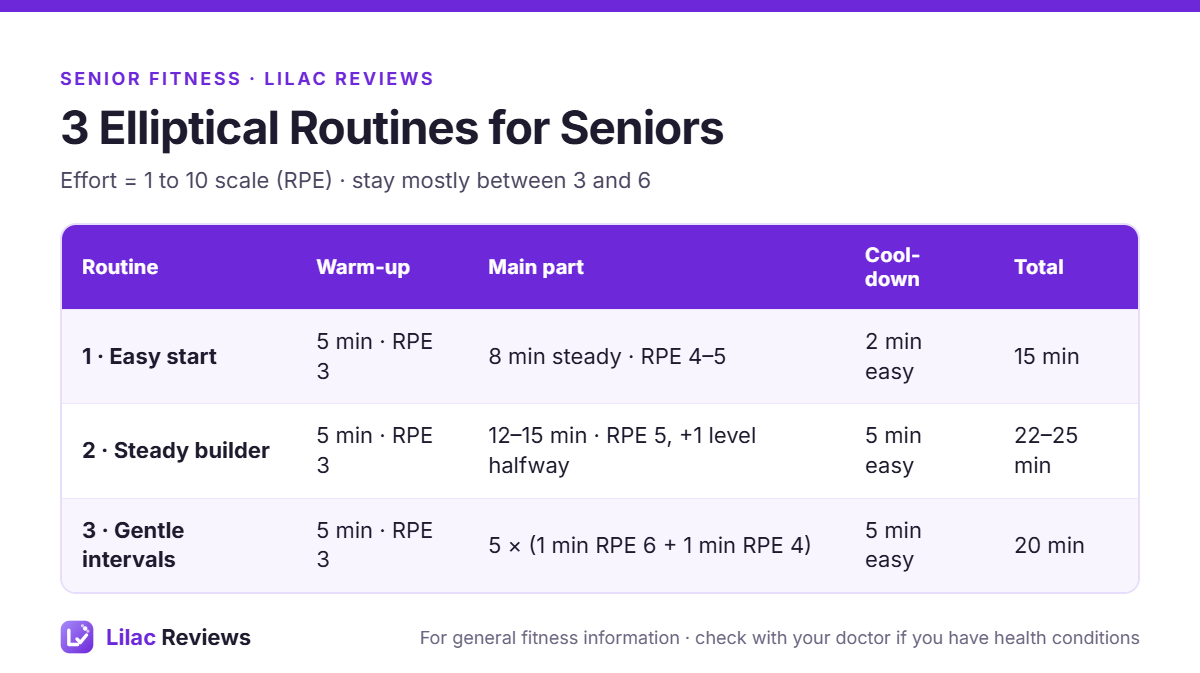
Each one includes its own warm-up and cool-down. Start with Routine 1 for the first two weeks, then rotate through all three.
Routine 1: Easy start (15 minutes)
Five minutes very easy (RPE 3), eight minutes at a comfortable steady pace (RPE 4 to 5), then two minutes easy to cool down. Use low resistance. This is your “learning the machine” routine, and there’s nothing wrong with staying here for a month.
Routine 2: Steady builder (20 to 25 minutes)
Five minutes easy, then 12 to 15 minutes at RPE 5, raising resistance by one level halfway through. Finish with five minutes easy. This builds endurance, the ability to keep going without feeling wiped out.
Routine 3: Gentle intervals (20 minutes)
Five minutes easy, then repeat five times: one minute a little harder (RPE 6) followed by one minute easy (RPE 4). Finish with five minutes easy. The harder minute can come from slightly more speed, one or two resistance levels, or pedaling backward. Short, gentle intervals are a safe way to improve fitness without long periods of hard effort.
A sample week
- Monday: Routine 2
- Tuesday: light strength work (chair squats, wall push-ups, band rows) and balance practice
- Wednesday: Routine 1 or a walk
- Thursday: strength and balance
- Friday: Routine 3
- Saturday: a walk outdoors or easy elliptical
- Sunday: rest
Strength and balance work matter just as much as cardio after 60, mainly to keep you steady on your feet. Our guide to easy home exercises for seniors has a simple routine for those days.
Technique tips
- Stand tall with your weight over your feet, not leaning on the console.
- Keep your whole foot on the pedal. If your toes go numb, push through your heels a bit more and wiggle your toes now and then.
- Push and pull with your arms on the moving handles, but let your legs do most of the work.
- Look ahead, not down at your feet.
- Breathe steadily. Holding your breath raises blood pressure.
When to stop
Stop right away if you notice chest pain or pressure, dizziness or light-headedness, unusual shortness of breath, an irregular heartbeat, or sudden joint pain, and get medical help if it doesn’t settle quickly. Feeling tired and a bit out of breath is normal; feeling unwell is not.
Progressing safely
After two to three weeks of consistent sessions, add about five minutes to one workout a week, or add one resistance level, but not both at once. Most people do well building toward 25 to 30 minutes, four or five days a week. Keep a simple log of time and resistance so you can see the progress; it’s surprisingly motivating. If you’re still deciding which cardio machine to get for home, our guide on how to choose an exercise bike covers recumbent bikes, which are another excellent option for seniors.
FAQ
Is an elliptical good for seniors?
Yes. It’s low-impact, works the upper and lower body, and is easy to adjust. Older adults with poor balance should choose a model with a low step-up and stable handles, or a recumbent machine.
How long should a senior use an elliptical?
Start with 10 to 15 minutes and build to 20 to 30 minutes, most days of the week, as your fitness allows.
Is the elliptical better than walking for seniors?
Not better, just different. Walking also builds bone and balance. The elliptical is a great choice on bad weather days or when joints are sore.
What resistance level should I use?
Whatever lets you keep a smooth, steady stride at RPE 4 to 5. On most machines that’s a low level to begin with.
This guide is for general information only and is not medical advice. Talk to a qualified professional before starting a new exercise program, especially if you have an injury or health condition.