
How to choose an exercise bike

Choosing an exercise bike gets easier when you treat it like a fit-and-use decision, not a feature hunt. The best bike is the one that matches your main workout style, fits your body, fits your space, and is built well enough for how often you plan to use it. That order matters. If you choose the style first, then compare build quality and features within that category, you’re less likely to end up with a bike that looks good on paper but feels wrong in daily use.
Quick Answer: How to Choose the Right Exercise Bike
If you want the shortest path to a good choice, use this sequence:
- Pick the bike style based on your goal.
- Upright bike for general cardio in a smaller footprint
- Recumbent bike for more back support and a relaxed riding position
- Spin bike for harder rides, intervals, and a more road-bike-like feel
-
Air bike for intense, interval-focused training and full-body effort
-
Choose the resistance system that fits your home.
- Magnetic resistance if quiet operation and smooth feel matter most
- Friction resistance if you want a simpler, often lower-cost setup and do not mind more noise
-
Air resistance if you want a harder, more variable effort and can tolerate noise
-
Check fit before features.
Seat height, handlebar adjustment, and reach matter more than a large screen or app membership. -
Measure your space.
Look at the footprint, but also leave room to mount, dismount, and move around the bike. -
Buy for your usage level.
A bike used a few times a week can be simpler than one used daily. More frequent use usually justifies better adjustability, stability, and support.
A practical rule: if you are a beginner who wants quiet, low-stress cardio at home, a magnetic upright or recumbent bike is usually the easiest place to start. If your goal is harder intervals, a spin bike or air bike makes more sense.
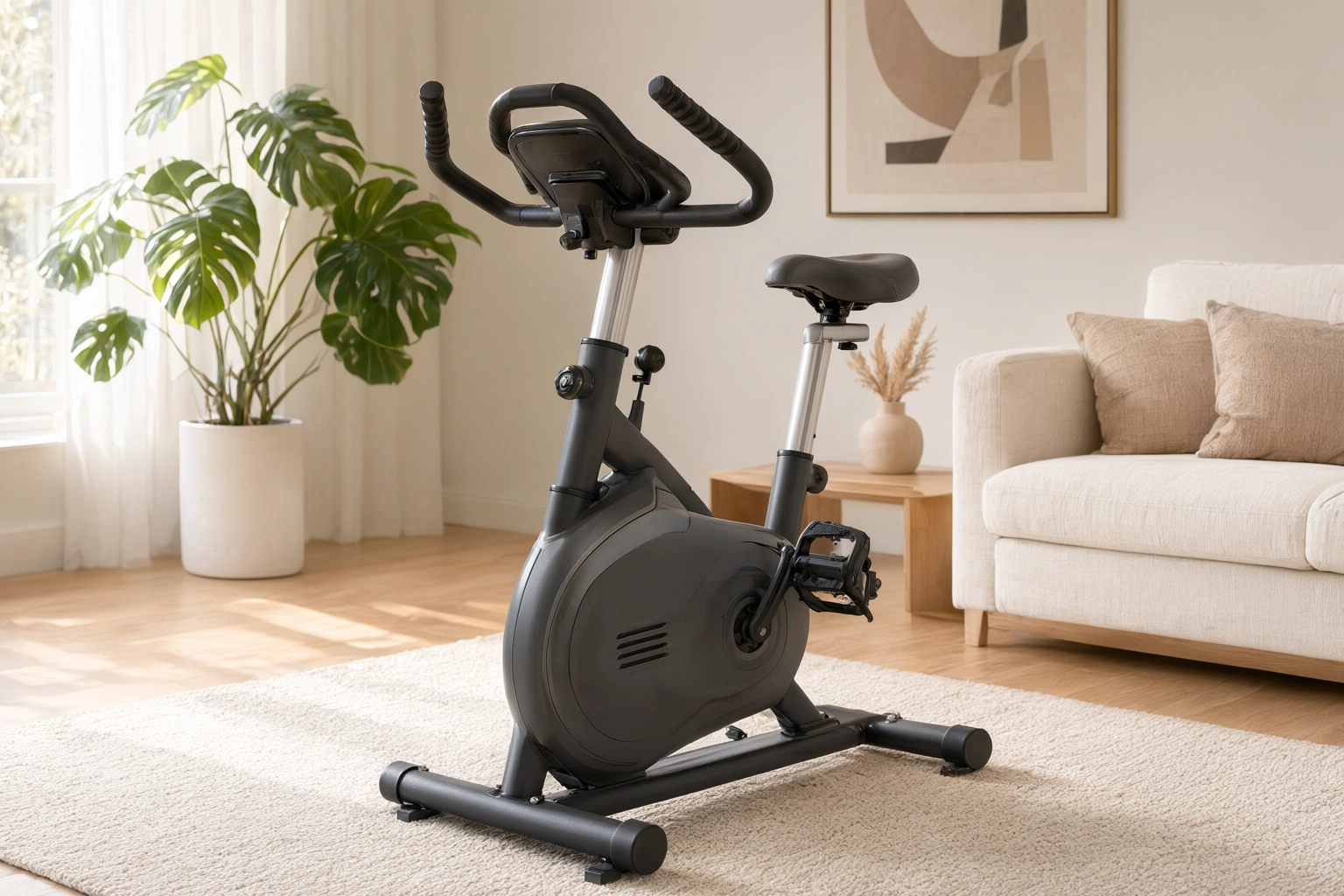

Start With Your Main Goal
The first buying decision should be your workout goal, because that determines the type of bike that will feel natural enough to use consistently.
Low-impact cardio and general fitness
If you want steady cardio, light calorie burn, or a simple way to stay active, an upright bike often works well. It takes up less space than a recumbent bike and feels familiar to most people. The riding position is more upright, so it suits short-to-moderate sessions and everyday use.
Comfort-first riding or joint-friendly support
A recumbent bike places you in a seated position with back support and pedals in front of you. That can make the ride feel easier on the back and hips, especially if comfort is a priority. It is also a common choice for people who want a less aggressive position or who know they prefer a more supported setup.
Harder cardio and interval work
A spin bike is usually the better match if you want a more intense workout feel, higher cadence work, or standing efforts. These bikes are designed to feel more like a studio cycling setup, with a more forward riding position and a heavier training emphasis.
Fast-paced interval training
An air bike is often chosen for short, hard bursts rather than relaxed riding. Because resistance rises with effort, it can feel demanding quickly. That makes it useful for interval-style workouts, but it is usually less comfortable for casual, steady rides.
A simple decision rule helps here: if your goal is comfort and consistency, lean toward a recumbent or upright bike. If your goal is harder training, look at a spin bike or air bike.
Compare the Main Exercise Bike Types
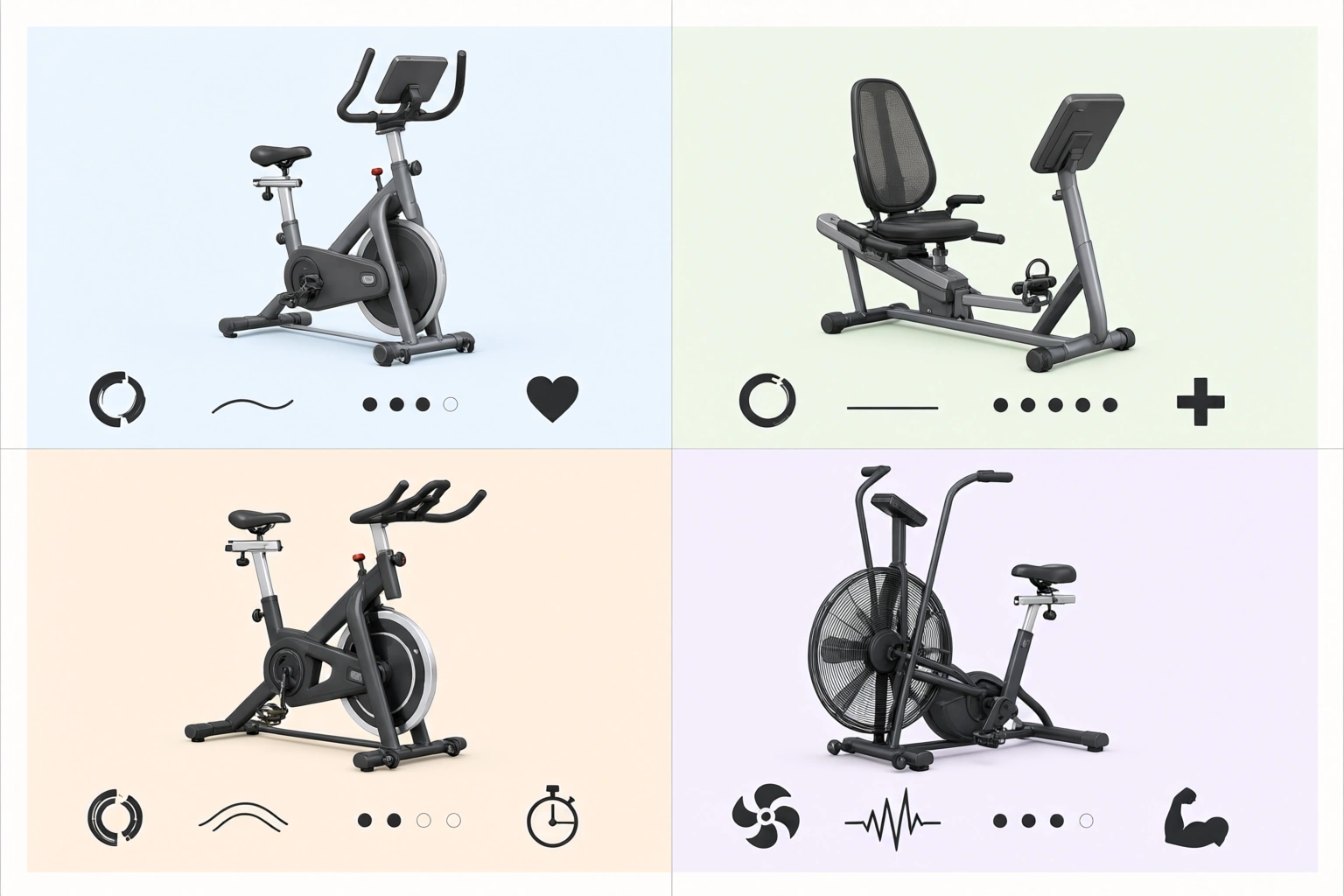
The four main bike styles look similar in product listings, but they feel very different in use.
| Bike type | Best for | Main trade-off | Typical buyer fit |
|---|---|---|---|
| Upright bike | General cardio, smaller spaces | Less back support than a recumbent bike | Beginners, casual users, apartment buyers |
| Recumbent bike | Comfort, low-impact riding | Larger footprint and less aggressive ride feel | Users who want support or easier mounting |
| Spin bike | Interval work, higher-intensity training | Can be less comfortable for casual riders | Buyers who want a more performance-focused feel |
| Air bike | Hard intervals, full-body effort | Louder and less relaxed for steady rides | Users who want intense, short workouts |
Upright bike
An upright bike is the most versatile starting point for many home users. It usually balances size, simplicity, and price better than the more specialized categories. If you want a bike for regular cardio and do not need a very relaxed position, this is often the most practical option.
Recumbent bike
A recumbent bike is worth serious consideration if comfort is a deciding factor. The seat is usually larger, and the back support can make longer rides feel more manageable. The trade-off is space: these bikes often take up more room than upright models.
Spin bike
A spin bike is better if you care about ride feel and workout intensity more than comfort. Many buyers compare them to studio bikes because they support a more athletic position. If you plan to ride hard and often, the firmer setup may be an advantage rather than a drawback.
Air bike
An air bike is less about comfort and more about effort. It is a strong fit for interval training, but the fan-driven resistance usually means more noise. If you live with others or ride near bedrooms, that matters.
If you are deciding between an upright bike and a spin bike, ask one question: do you want a comfortable cardio machine, or do you want a harder training tool? That answer usually separates the two.
Choose the Right Resistance System
Resistance changes both the workout feel and the day-to-day experience of owning the bike.
Magnetic resistance
Magnetic resistance is often the best all-around choice for home use because it tends to be smooth and quiet. That makes it especially appealing in apartments or shared spaces. It also usually requires less upkeep than systems that rely more on friction.
Friction resistance
Friction resistance can deliver a strong ride feel and may appear in more budget-friendly bikes, but it is generally noisier and can wear more over time because parts physically contact each other. If lower upfront cost matters more than quiet operation, it can still be a reasonable option.
Air resistance
Air resistance rises as you pedal harder, which makes it useful for interval work and high-effort training. The trade-off is noise. If you want a bike for early-morning workouts without disturbing others, this system may be less suitable.
A useful way to compare them is not by “which is best” overall, but by which one matches your home:
- Quiet home use: magnetic
- Lower-cost, simpler setup: friction
- Hard intervals and rapid effort changes: air
For a general consumer buying a bike for home use, Consumer Reports’ exercise bike buying guide is a helpful reference point on fit and adjustability, especially if you are comparing models in person or trying to narrow down a shortlist.
Check Fit, Comfort, and Adjustability
A bike can have good specs and still be a poor purchase if it does not fit your body. Fit matters more than flashy extras, especially if you plan to ride regularly.
Practical fit checklist
Use this quick checklist before you buy:
- Measure your inseam in bare feet or thin socks, from the floor to the crotch.
- Compare it to the bike’s seat-height range. The saddle should be able to adjust high enough that your leg is not fully straight at the bottom of the pedal stroke, but not so high that your hips rock side to side.
- Check the minimum and maximum saddle height. A good fit usually requires the seat to land comfortably within the bike’s stated range, not at the extreme end of it.
- Test handlebar reach. You should be able to hold the bars with relaxed shoulders and a slight bend in the elbows, not a stretched or cramped upper body.
- Look for enough handlebar adjustment for your body type. Small to moderate fore-aft or up-down adjustment is usually enough for many riders; very tall, very short, or mobility-limited users should pay closer attention to the full adjustment range.
- Sit and pedal for a few minutes if possible. If you feel pressure points, overreaching, or constant shifting, the fit is probably off.
Seat height and range
You should be able to adjust the seat so your legs can move through the pedal stroke without feeling cramped or overextended. If the seat only moves in large jumps, that can make it harder to find a comfortable position. This is one reason adjustment range matters as much as the bike type itself.
Handlebar position and reach
Handlebar adjustability matters because reach affects posture. If the bars are too far away, you may lean awkwardly. If they are too close, the ride can feel cramped. For most home users, the goal is a neutral position where your shoulders stay relaxed and your hands do not force you into a hunched posture.
Inseam and body proportions
Inseam is useful, but it is not the only measurement that matters. Torso length, arm reach, and hip comfort all affect how a bike feels. A taller user may fit one upright bike well and feel awkward on another with similar marketing specs.
Pedal access and mounting
If mobility is a concern, a recumbent bike can be easier to get on and off than a higher-step upright or spin bike. That is one reason fit should be considered alongside the bike style itself.
A good test is simple: if you cannot imagine sitting on the bike comfortably for 20 to 30 minutes without constantly shifting position, keep looking.
Measure Your Space Before You Buy
Many buyers focus on the bike itself and forget the space around it. That creates problems after delivery.
Look at footprint, not just photos
Product images can make a bike look smaller than it is. Check the listed length and width, then compare those numbers to the space available in your room.
Leave clearance
You need room to mount, dismount, and pedal without hitting furniture or walls. Even if the bike’s footprint looks acceptable, tight surrounding space can make daily use annoying.
Consider storage and moving
Transport wheels can help if you need to shift the bike after workouts. A lighter frame is easier to move, but very light bikes can sometimes feel less planted during harder sessions. That is a trade-off worth noticing, especially in compact homes.
Compact bike vs full-size bike
Compact bikes are usually easier to place in smaller rooms, but “compact” does not automatically mean “better for everyone.” Full-size bikes often offer a more stable feel, more adjustment, and a roomier ride position. If space is tight, a compact model may be the practical choice; if comfort and stability matter more, a larger bike may be worth the extra floor space.
Apartment living
If you live in an apartment, size is only part of the equation. Noise and vibration matter too. A compact magnetic bike often fits better than a louder, more aggressive training bike.
A measuring tape is one of the best buying tools you can use. Measure the floor space, then add buffer room around it.
Evaluate Stability, Weight Capacity, and Build Quality
Build quality affects both safety and how the bike feels over time. A bike that rocks, flexes, or feels unstable rarely improves with use.
Weight capacity
Weight capacity is not just a user limit. It can also be a rough signal of frame robustness. A higher limit does not automatically mean better quality, but a very low limit may indicate a lighter-duty build.
Frame and base stability
A stable bike should feel planted when you pedal, especially if you stand on a spin bike or push hard on an air bike. If the frame feels too light for the intended use, that can become obvious quickly.
Belt drive and ride feel
Many home bikes use a belt drive because it tends to feel smoother and quieter than some chain-driven systems. That matters in home settings where noise and maintenance are part of the ownership experience.
Build quality within the category
A well-made upright bike is still an upright bike. A well-made recumbent bike is still a recumbent bike. The point is to judge quality within the style you want, not to expect one category to behave like another.
If you want an example of long-term value thinking, Freedom Fitness Equipment’s guidance recommends deciding on the training style first, then matching the machine format to that style, and then evaluating build quality within that format. That order helps avoid buying a bike that is sturdy but wrong for your use.
Decide Which Console and Smart Features Are Worth Paying For
A bigger screen does not automatically mean a better bike. The useful question is whether the console helps you use the bike more often.
Essential tracking features
For most beginners and intermediate home buyers, the most useful console features are the basics:
– time
– speed
– distance
– cadence or RPM
– heart rate, if you plan to use it
If a console clearly shows those metrics, it may already cover what you need.
Nice-to-have connected features
Bluetooth connectivity, app integration, and subscription workouts can be helpful if you already use connected training and want your ride data in one place. They are convenience features, not requirements. If you will not use them regularly, they may add cost without much value.
Built-in workouts and screens
Preset workouts and large displays can be helpful, but they are not essential for a good home bike. In some cases, they are mostly convenience features. That is especially true if you already use a phone, tablet, or separate fitness app.
What to prioritize
Pay for features that solve a real problem:
– Want a quieter, simpler bike? Focus on resistance type and build.
– Want tracking without extra devices? A clear console may be enough.
– Want guided workouts? Then app compatibility matters.
Do not let marketing turn a basic cardio machine into a tech purchase unless you will actually use the tech.
Set a Realistic Budget and Compare Value
Budget matters, but price alone does not tell you whether a bike is a good value.
Budget bikes
Lower-priced bikes often keep the design simple. A typical budget setup may include:
– basic upright frame
– manual resistance
– simple display with core metrics
– limited seat and handlebar adjustment
– lighter-duty build
That can work if you want light-to-moderate use and do not need advanced adjustability or smart features. The trade-off is usually less refinement in ride feel, fit range, or stability.
Mid-range bikes
This is often the sweet spot for home buyers who want better comfort, more adjustment, and a sturdier frame without paying for premium extras. A typical mid-range setup may include:
– magnetic resistance
– better seat and handlebar adjustability
– sturdier frame and higher weight capacity
– clearer console with basic tracking
– optional Bluetooth or app compatibility
If you plan to use the bike regularly, mid-range models often make more sense than the cheapest option.
Premium bikes
Higher-end bikes usually bring better build quality, smoother resistance, stronger adjustability, and more polished consoles. A typical premium setup may include:
– more refined magnetic resistance or performance-focused drive system
– wider fit range
– heavier, more stable frame
– larger touchscreen or advanced console
– connected workouts, training programs, or app integration
– stronger warranty or support package
They can be worth it if you will ride often and care about long-term comfort. If you will only use the bike occasionally, some premium features may go unused.
A practical value question: will the extra money improve comfort, stability, or fit? If not, it may just be adding features you do not need.
New vs used
Buying used can save money, but it is worth being selective. Consider used if:
– the bike is from a reputable source
– the frame is solid and the bike feels stable
– the seat, pedals, and resistance system still work smoothly
– replacement parts are available if needed
Buying new may be the better choice if:
– you want a warranty
– you need reliable customer support
– the bike includes electronics or app features you expect to use often
– you are unsure about wear, missing parts, or hidden damage
Used bikes can be a good value, but only if fit, stability, and parts availability still check out.
Check Warranty, Parts Availability, and Customer Support
Warranty and support are part of the purchase, even though they are easy to ignore when comparing product pages.
Why warranty matters
A longer or clearer warranty can reduce risk, especially on a bike you expect to use often. It is also worth checking what is covered: frame, parts, electronics, and labor may all be treated differently.
Parts availability
If replacement parts are hard to find, a bike can become frustrating to own even if it works well at first. That is one reason support and documentation matter.
Customer support
Good support is not glamorous, but it can save time if something arrives damaged or a component fails. That matters more on bikes with electronics or app connections.
When comparing two similar bikes, the one with better support can be the better long-term value even if it costs slightly more upfront.
What Specs Matter Most vs What Is Mostly Marketing
Not every spec deserves equal attention. Some affect fit and daily use; others mainly help a product page look more impressive.
| Spec or feature | How much it matters | Why |
|---|---|---|
| Seat height range | High | Directly affects fit and pedaling comfort |
| Handlebar adjustability | High | Affects posture, reach, and comfort |
| Weight capacity | High | Often reflects frame robustness and intended use |
| Bike stability | High | Impacts safety and ride feel |
| Resistance type | High | Changes noise, smoothness, and workout style |
| Footprint | High | Determines whether the bike fits your room |
| Warranty and support | High | Important for long-term ownership |
| Console size | Medium | Useful if it improves readability, but not essential |
| Bluetooth/app features | Medium to low | Helpful only if you will actually use them |
| Number of preset workouts | Low to medium | Nice to have, but not a substitute for fit |
| Large touchscreen | Low to medium | Can be convenient, but often more marketing than necessity |
A good rule: if a spec does not affect fit, stability, noise, or comfort, treat it as secondary.
Factor in Noise, Apartment Living, and Shared Spaces
Noise can be the deciding factor in a home purchase, especially if you exercise early, late, or near other people.
Quietest options
Magnetic resistance bikes are usually the safer choice when quiet operation matters. Belt-driven designs can also contribute to a smoother, less noisy ride.
Louder options
Air bikes are typically louder because the fan creates resistance and airflow noise. Friction systems can also be noisier than magnetic setups.
Why noise matters beyond convenience
A noisy bike can limit when you use it. If you have to avoid certain hours, the bike may get used less often. That is a practical issue, not just a comfort issue.
If you live in a shared home or apartment, choose the quietest bike that still fits your workout goal. That usually means a magnetic upright or recumbent bike rather than an air bike.
Common Mistakes to Avoid When Buying an Exercise Bike
These are the buying mistakes that most often lead to regret:
- Choosing by price alone. Cheap can be fine, but only if it still fits your body and use case.
- Buying the wrong style. A spin bike is not a comfort-first bike, and a recumbent bike is not ideal if you want aggressive training.
- Ignoring adjustability. Seat and handlebar range matter more than many shoppers expect.
- Forgetting the footprint. A bike that fits online may not fit in your room.
- Underestimating noise. This is a common issue in apartments and shared homes.
- Paying for tech you will not use. A large screen does not replace good fit.
- Skipping warranty checks. Support matters once the bike is in your home.
If you avoid these mistakes, your shortlist usually gets much smaller and much better.
Final Buying Checklist
Before you buy, confirm these points:
- My main goal is clear: comfort, general cardio, intervals, or low-impact riding
- The bike style matches that goal
- The resistance system fits my noise and ride-feel preferences
- The seat and handlebars adjust enough for my body
- The footprint fits my room with clearance around it
- The bike feels stable enough for the way I plan to use it
- The console features are useful, not just flashy
- The budget matches the level of use I expect
- The warranty and support look reasonable
- I have compared new vs used only after checking fit and support
If a bike passes that list, it is much more likely to be a good home purchase.
When to Consult a Professional
If you have specific mobility limitations, balance concerns, or you are unsure whether a bike’s riding position is suitable for your body, it can help to speak with a qualified health or fitness professional before buying. That is especially useful if comfort, mounting, or posture are likely to affect whether you can use the bike safely and consistently.