
Barbell vs Dumbbells: Which Is Better for Home Strength Training?

Barbell vs dumbbells for a home gym: strength, muscle, safety when training alone, space, cost and learning curve, with clear advice on which to buy first for different people.
This article may contain affiliate links. If you buy through them, we may earn a small commission at no extra cost to you. Learn more.
Disclosure: As an Amazon Associate, we earn from qualifying purchases. If you buy through a link on this page, we may earn a small commission at no extra cost to you.
Ask ten lifters whether a home gym should start with a barbell or dumbbells and you’ll get a heated debate. The truth is that both build strength and muscle very well. The better choice depends on your goals, your space, whether you train alone, and how much you want to spend. This barbell vs dumbbells comparison lays out the trade-offs honestly.
The short answer
- Choose dumbbells first if you have limited space, train alone without a rack, are a beginner, or want the most exercise variety for the money.
- Choose a barbell first if your main goal is getting as strong as possible on squats, bench press and deadlifts, and you have room for a rack.
- Long term, many home gyms end up with both: a barbell and rack for the big lifts, adjustable dumbbells for everything else.
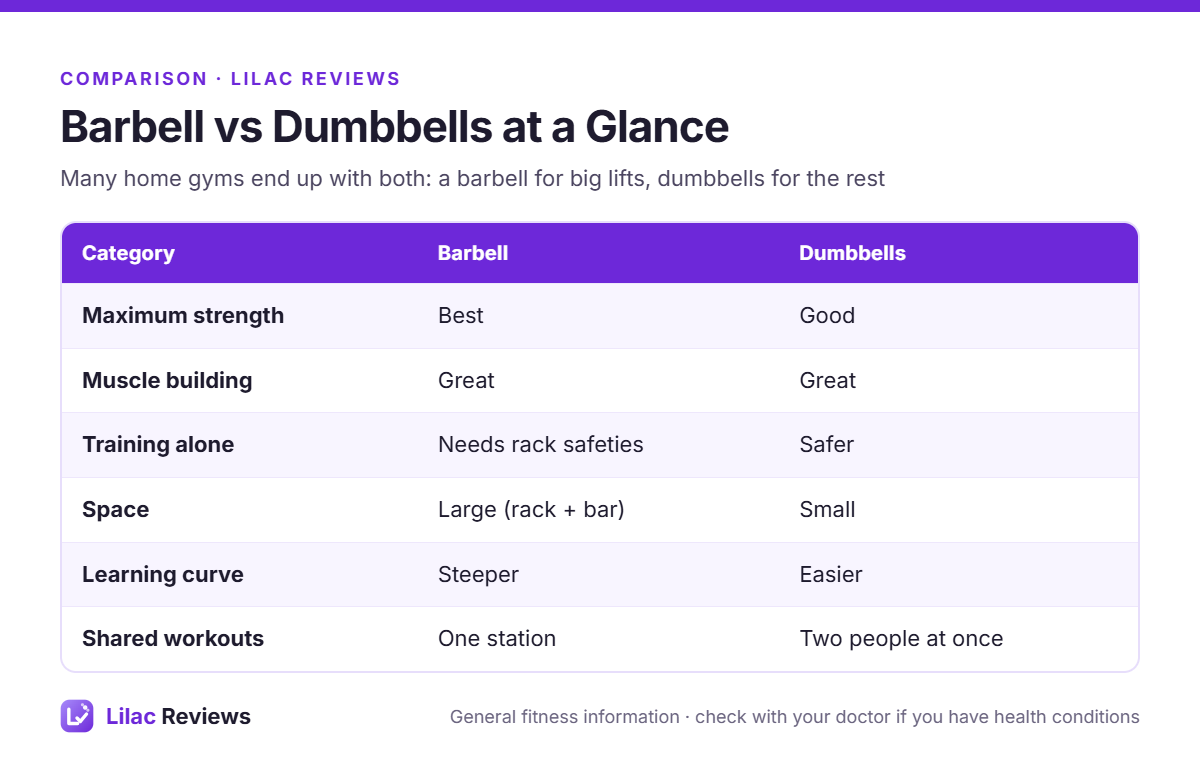
Barbell vs dumbbells, category by category
Maximum strength
Winner: barbell. You can load much more weight on a barbell, and the bar is stable, so you’ll lift more on squats, bench and deadlifts. Progress is easy to measure in small jumps.
Muscle building
Tie. Muscle growth comes mainly from training hard enough, often enough, with enough total sets. Both tools do that. Dumbbells allow a bigger range of motion on some moves and more isolation exercises.
Balance and stability
Winner: dumbbells. Each side works on its own, so weaker sides can’t hide and stabilizing muscles work harder.
Safety when training alone
Winner: dumbbells, unless you have a rack with safeties. If you fail a dumbbell bench press, you can drop the weights to the side. Failing a barbell bench without safety arms can be dangerous. Our guide to making a home gym safe explains how to set rack safeties.
Space
Winner: dumbbells, especially adjustable ones. A barbell setup needs a 7-foot bar, plates, a rack and a bench, plus clearance. Our article on how much space you need for a home gym covers footprints.
Cost
Depends. Adjustable dumbbells cost a moderate amount up front. A full barbell setup (bar, plates, rack, bench) usually costs more but lets you lift far heavier for the money per pound. See how much a home gym costs for budget ranges.
Learning curve
Winner: dumbbells. Most dumbbell moves feel natural. Barbell lifts benefit from learning good technique, ideally with video feedback or a coach.
Joint friendliness
Slight edge: dumbbells. Your hands can rotate naturally, which many people find kinder to the shoulders and wrists on pressing.
Who should buy which?
Beginners
Start with adjustable dumbbells and a bench. You can train the whole body, learn movement patterns safely, and add a barbell later.
Apartment and small-space lifters
Dumbbells, almost always. A barbell setup is hard to fit and loud.
Strength-focused lifters
A barbell and rack. If your goal is a big squat, bench and deadlift, nothing replaces it.
Seniors
Light dumbbells are usually the better start: simple, safe and easy to store. See our guide to the best dumbbells for seniors.
Couples and families
Dumbbells let two people train at once at different weights. A barbell is one station at a time.
Starting points
For dumbbells, an adjustable pair covers a wide range in a small space:

For a barbell, a solid 20 kg Olympic bar is the foundation; see our full guide to the best barbells for home gyms:

A simple combined plan
If you own both, a common approach is to start each session with one barbell lift (squat, bench or deadlift), then do two or three dumbbell exercises (rows, lunges, presses, curls). Training each muscle group twice a week meets the CDC’s muscle-strengthening guideline with room to spare.
FAQ
Can you build muscle with only dumbbells?
Yes. Many people build plenty of muscle with dumbbells and a bench, especially with an adjustable set that goes heavy enough.
Is a barbell necessary for strength?
Not necessary, but it’s the most efficient way to lift heavy loads and track strength progress.
Are dumbbells safer than barbells?
For people training alone without a rack, yes. With a rack and properly set safeties, barbell training is also safe.
Which is better for beginners?
Most beginners find dumbbells easier and safer to start with.
The bottom line
Dumbbells are the better first purchase for most home gyms: smaller, safer alone, more versatile and easier to learn. A barbell and rack become worth it when heavy compound lifts are your priority and you have the space. If you can, get both eventually and use each for what it does best.
Written by the Lilac Reviews Editorial Team. This article is general fitness information, not medical advice. Product details may change; check the retailer listing for current specifications.
This guide is for general information only and is not medical advice. Talk to a qualified professional before starting a new exercise program, especially if you have an injury or health condition.