
Treadmill Workouts for Seniors: Safe Settings and 4 Easy Routines

Four treadmill workouts for seniors with speeds, gentle inclines and times, plus how to get on and off safely, how to use the rails and a simple weekly plan.
This article may contain affiliate links. If you buy through them, we may earn a small commission at no extra cost to you. Learn more.
Disclosure: As an Amazon Associate, we earn from qualifying purchases. If you buy through a link on this page, we may earn a small commission at no extra cost to you.
A treadmill lets you walk in any weather, on a flat, predictable surface, with something to hold if you need it. For many older adults it’s the easiest way to keep a regular walking habit through winter, heat waves or icy sidewalks.
The key is setting it up safely and starting slowly. These four treadmill workouts for seniors go from a first 10-minute session to gentle hills and brisk intervals.
Treadmill safety basics
- Clip on the safety key. If you slip or drift back, it stops the belt.
- Start at the lowest speed while standing on the side rails, then step on once the belt is moving slowly. Or stand on the belt before starting if your model starts at 0.5 mph.
- Light touch on the rails is fine. Gripping hard and leaning on them changes your posture, but resting your hands lightly for balance is sensible, especially at first.
- Look ahead, not at your feet.
- Slow down before stopping, and stand on the side rails for a moment before stepping off. Some people feel unsteady right after walking.
- Leave space behind the treadmill, ideally about 6.5 feet (2 m), in case of a fall.
More setup tips are in our home gym safety guide.
The 4 workouts
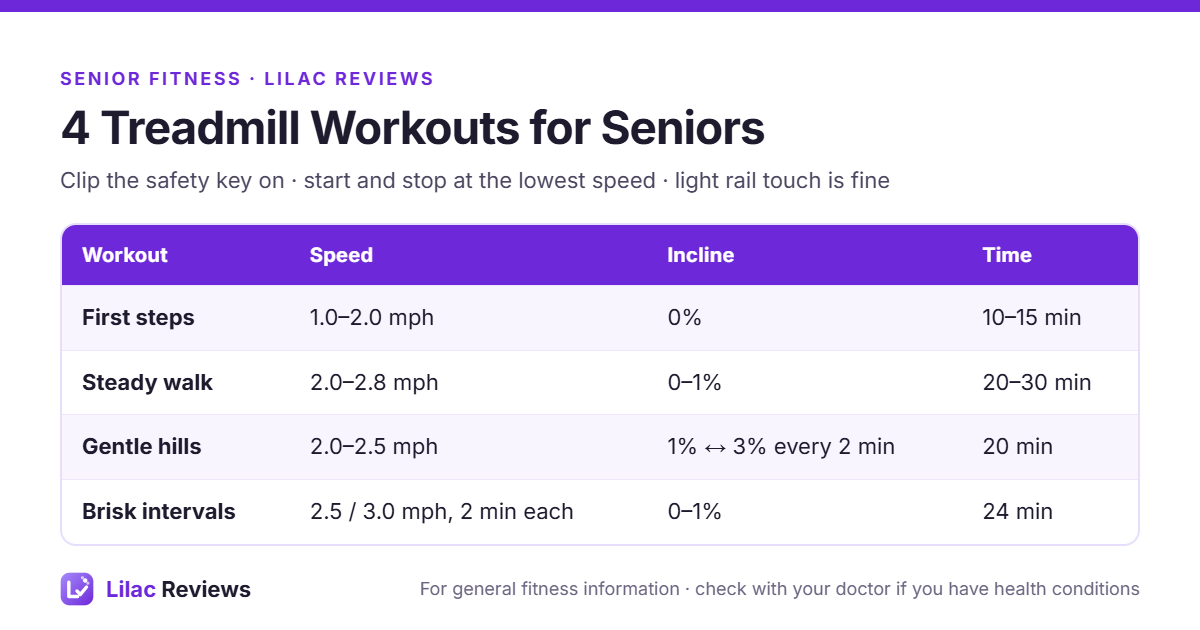
1. First steps (10–15 minutes)
Walk at 1.0–2.0 mph with no incline. Focus on getting comfortable with the moving belt, standing tall and swinging your arms naturally. Do this three to five times in the first week.
2. Steady walk (20–30 minutes)
Warm up 3–5 minutes at an easy pace, then walk at a pace that feels moderate, often 2.0–2.8 mph for older beginners. You should be breathing harder but able to talk. A 0–1% incline feels more like outdoor walking.
3. Gentle hills (20 minutes)
Warm up 5 minutes. Then alternate 2 minutes at 1% incline and 2 minutes at 3%, keeping the speed at 2.0–2.5 mph. Cool down 3–5 minutes flat. Hills raise the effort without needing to walk faster, which many seniors find more comfortable. For a longer progression, see our incline treadmill walking workout.
4. Brisk intervals (24 minutes)
Warm up 5 minutes, then alternate 2 minutes at 2.5 mph and 2 minutes at 3.0 mph (or your own easy and brisk pace) for 16 minutes. Cool down 3 minutes. Once a week is enough.
A sample week
- Mon: Steady walk
- Tue: Strength, such as our strength training plan for seniors
- Wed: Gentle hills
- Thu: Balance work
- Fri: Steady walk or brisk intervals
- Weekend: outdoor walk or rest
That gets you close to the 150 minutes of moderate activity a week recommended by the CDC for older adults.
Treadmill or walking pad?
If you need rails, a full treadmill with a low step-up height and long handrails is the safer choice. Walking pads are compact and fine for steady walkers, but most have no handrail. Our WalkingPad C2 review covers one folding option, and our walking pad workouts show how to use one.
Track your progress
Most treadmills show time, distance and speed. A fitness tracker adds daily steps and active minutes, which helps you see your weekly total at a glance. See our Fitbit Charge 6 review. If you take heart or blood pressure medication, ask your doctor what effort level is right for you.

Common mistakes
- Starting too fast. Speed can feel very different on a belt than outdoors.
- Holding the rails hard and leaning back. It strains shoulders and reduces the benefit.
- Steep incline too soon. Build up 1% at a time.
- Stepping off a moving belt. Always slow down and stop first.
FAQ
What speed should a senior walk on a treadmill?
Start between 1.0 and 2.0 mph and build to a moderate pace, often 2.0–3.0 mph. Use effort, not a number, as your guide.
Is it OK for seniors to hold the handrails?
Yes, lightly, for balance. Avoid gripping hard and leaning on them.
How long should a senior walk on a treadmill?
Begin with 10–15 minutes and build to 20–30 minutes on most days.
Is incline walking good for seniors?
Gentle inclines of 1–3% raise effort safely for many people. Go steeper only gradually.
Written by the Lilac Reviews Editorial Team. This article is general fitness information, not medical advice. If you have a health condition, recent injury or surgery, talk to your doctor or physical therapist before starting a new exercise routine.
This guide is for general information only and is not medical advice. Talk to a qualified professional before starting a new exercise program, especially if you have an injury or health condition.