
Resistance Band Colors and Levels Explained (Which One to Use)

Resistance band colors explained: what TheraBand colors mean, why loop and power band colors vary by brand, how to read pound ratings and how to pick the right level for each exercise.
This article may contain affiliate links. If you buy through them, we may earn a small commission at no extra cost to you. Learn more.
Disclosure: As an Amazon Associate, we earn from qualifying purchases. If you buy through a link on this page, we may earn a small commission at no extra cost to you.
You open a pack of resistance bands and there’s a rainbow inside: yellow, red, green, blue, black. Which one is light? Which one is heavy? And why does your friend’s red band feel completely different from yours? Resistance band colors are confusing because there’s no universal standard. This guide explains the most common systems and gives you a simple way to choose the right band for each exercise.
The short answer
- Most brands go from light colors to dark colors as resistance increases, often yellow or tan at the light end and black, silver or gold at the heavy end.
- Colors are not standardized between brands. Always read the chart that comes with your set.
- Pick by feel: a band is right if you can do 10 to 15 controlled reps and the last few are hard.
The TheraBand color system
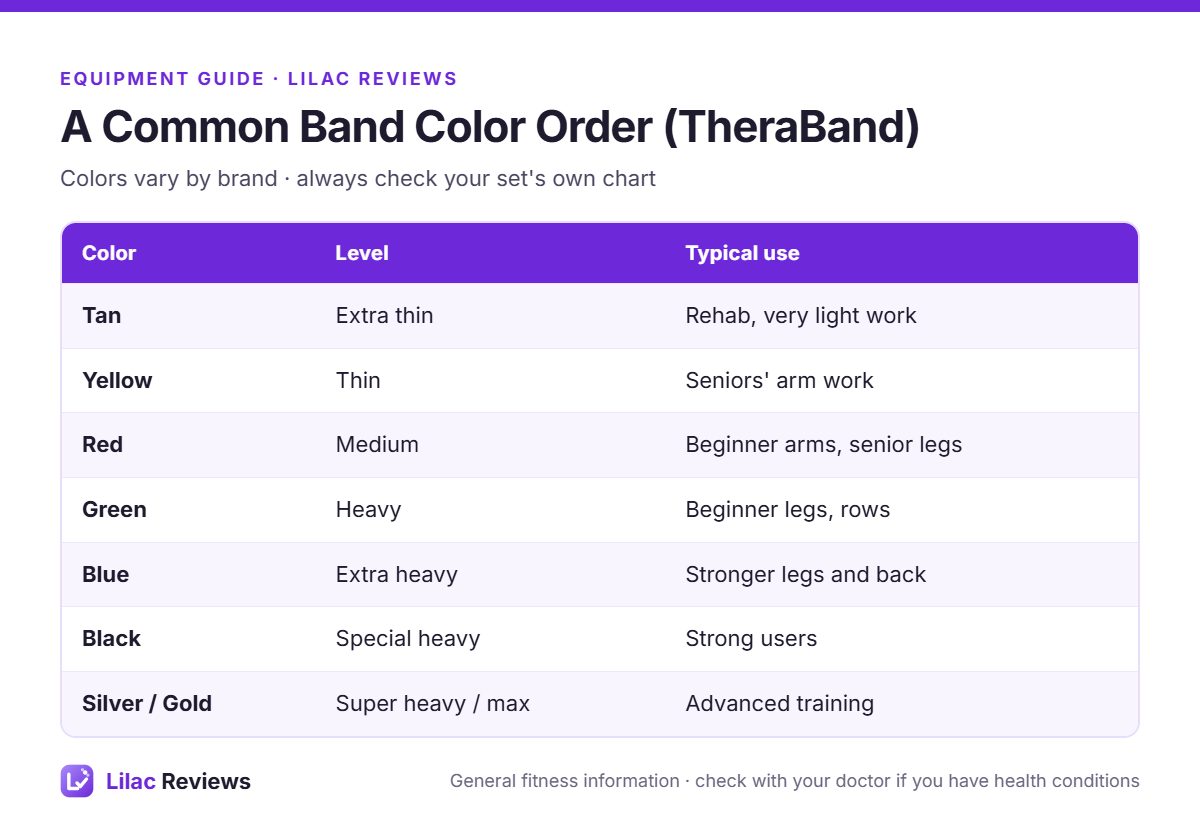
TheraBand, the brand many physical therapists use, has one of the best-known color progressions. From lightest to heaviest, its standard order is:
- Tan (extra thin)
- Yellow (thin)
- Red (medium)
- Green (heavy)
- Blue (extra heavy)
- Black (special heavy)
- Silver (super heavy)
- Gold (max)
Each step up is noticeably harder. Most beginners and older adults start with yellow or red for upper body and red or green for lower body. If a physical therapist gave you a band, this is likely the system they used.

Loop band colors
Mini loops (the small bands you put around your thighs) usually come in sets of four or five. Many sets go yellow, red, green, blue, black, but others use pink, purple or completely different orders. Some sets print the level directly on the band, which is helpful. Our Fit Simplify loop bands review covers one popular set.
Power band (long loop) colors
Long loop bands, often used for pull-up assistance and stretching, are usually sized by width as well as color. Wider bands are stronger. A typical set might go from a thin band rated roughly 5 to 15 pounds to a wide band rated 60 to 150 pounds or more, but the colors attached to each width vary by brand. Our guide on building strength without a gym shows how bands fit into a full routine.

Tube band colors
Tube bands with handles often have a pound rating printed on the handle or tube (for example, 10, 20, 30, 40 and 50 lb). These sets are usually designed so you can stack tubes on one handle to combine resistance.
What do the pound ratings mean?
Band resistance isn’t like a dumbbell. A band gets harder the further you stretch it. A rating of “15 to 35 lb” means it feels roughly like 15 pounds at a light stretch and closer to 35 pounds near full stretch. Manufacturers measure this in different ways, so pound ratings are best treated as a rough guide for comparing bands within the same brand.
How to choose the right band level
Use the rep test
Pick a band and do the exercise slowly. If you can’t do 8 reps with good form, go lighter. If you can do more than 15 easily, go heavier. The last two or three reps should feel challenging.
Different muscles need different bands
Your legs and back are stronger than your shoulders and arms. Most people use a heavier band for squats, rows and glute bridges and a lighter band for lateral raises and triceps work.
Change tension without changing bands
You can make any band harder by standing further from the anchor, shortening your grip, or doubling the band. That’s a handy way to progress between colors.
Typical starting colors (TheraBand-style)
- Older adults or rehab: yellow or red for arms, red or green for legs
- Beginner women: red for arms, green for legs
- Beginner men: red or green for arms, green or blue for legs
For a ready-to-follow program, see our guide to whether resistance bands are effective and our list of best resistance bands for seniors.
Band safety tips
- Check for nicks, thinning spots and stickiness before each use.
- Replace bands every few months if you use them a lot, or sooner if they show wear.
- Keep bands out of direct sunlight and away from heat.
- Never point a stretched band at your face.
- Choose fabric or latex-free bands if you have a latex allergy.
FAQ
What is the strongest resistance band color?
In TheraBand’s system, gold is the strongest, followed by silver and black. Other brands differ, so check the chart.
What color resistance band should a beginner use?
Usually a light to medium band, such as yellow or red in TheraBand’s system, for upper body, and one step heavier for legs.
Are all red resistance bands the same?
No. Colors vary between brands and even between product lines from the same brand.
Why does my band feel easier than its pound rating?
Ratings usually describe resistance near full stretch. At the start of the movement it will feel lighter.
The bottom line
Treat colors as labels, not universal measurements. Learn your own brand’s order, use the rep test to choose a band for each exercise, and move up a level when 15 reps feel easy. That’s all you need to train effectively with bands.
Written by the Lilac Reviews Editorial Team. This article is general fitness information, not medical advice. Product details may change; check the retailer listing for current specifications.
This guide is for general information only and is not medical advice. Talk to a qualified professional before starting a new exercise program, especially if you have an injury or health condition.