
Recumbent Bike Workouts for Seniors and Beginners (3 Easy Routines)

Three recumbent bike workouts for seniors and beginners, from 18-minute first rides to gentle intervals, plus seat setup, effort levels and a weekly plan.
This article may contain affiliate links. If you buy through them, we may earn a small commission at no extra cost to you. Learn more.
Disclosure: As an Amazon Associate, we earn from qualifying purchases. If you buy through a link on this page, we may earn a small commission at no extra cost to you.
A recumbent bike lets you pedal while sitting back in a chair-style seat with back support. That makes it one of the most comfortable cardio machines for older adults, people with sore knees or backs, and anyone who finds upright bikes awkward. It is low impact, easy to get on and off, and you can control the effort in small steps.
Here are three recumbent bike workouts that start very gently and build up, plus how to set up the bike so it feels right.
Set up the bike first
- Seat distance: at the furthest point of the pedal stroke your knee should be slightly bent, not locked. If your hips rock side to side, the seat is too far back.
- Back rest: sit all the way back so your lower back is supported.
- Pedal straps: tighten them so your feet can’t slide off.
- Handles: hold the side handles lightly. Many bikes read your pulse from the grips, though a chest strap is more accurate.
Shopping for a bike? Our guide to choosing an exercise bike and Schwinn 230 review cover the details.

How hard should you work?
These routines use a 1–10 effort scale, often called RPE (rate of perceived exertion):
- RPE 3: very easy, like a gentle stroll.
- RPE 4–5: moderate. Breathing harder, but you can hold a conversation.
- RPE 6–7: somewhat hard. You can speak in short sentences.
Aim for a smooth cadence of about 60–80 pedal turns per minute. If you can’t keep that, lower the resistance.
The 3 routines
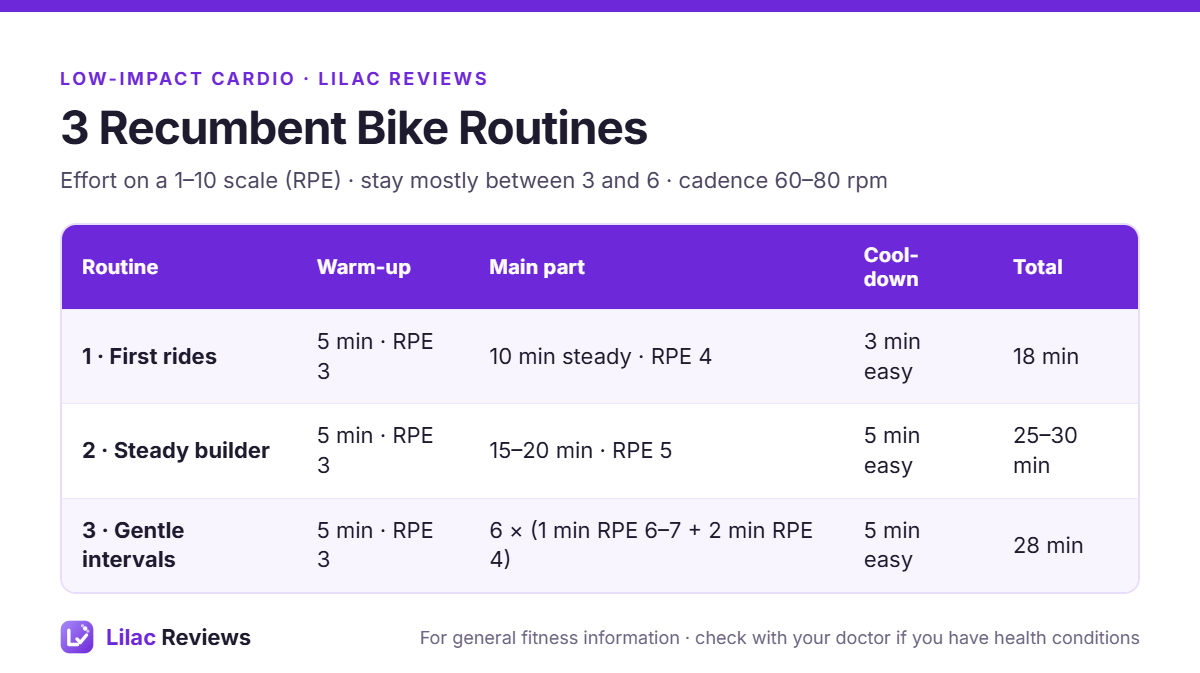
Routine 1: first rides (18 minutes)
Warm up for 5 minutes at the lowest or second-lowest level. Then ride 10 minutes at a steady RPE 4, and cool down with 3 easy minutes. Do this three times a week for the first two weeks. If 10 minutes is too much, start with 5 and add a minute each session.
Routine 2: steady builder (25–30 minutes)
After a 5-minute warm-up, ride 15–20 minutes at RPE 5. Raise the resistance one level halfway through if it feels easy. Cool down for 5 minutes. This is the workout most people come back to most often, and it fits well while watching a TV show.
Routine 3: gentle intervals (28 minutes)
Warm up 5 minutes. Then do six rounds of 1 minute at RPE 6–7 (raise the resistance a couple of levels or pedal faster) followed by 2 minutes at RPE 4. Cool down 5 minutes. Save this for once a week when routine 2 feels comfortable.
A sample week
- Mon: Routine 2
- Tue: strength, such as our resistance band exercises for seniors
- Wed: Routine 2
- Thu: balance work and a short walk
- Fri: Routine 3 (or Routine 1 if tired)
- Weekend: walk, rest or an easy ride
Three rides of 25–30 minutes plus a couple of walks gets you close to the 150 minutes a week the CDC recommends for older adults.
Track your heart rate (optional)
Grip sensors are handy but can be jumpy. If you want steadier numbers, a chest strap that pairs with your phone or bike console works well. Our Polar H10 review explains why chest straps tend to be more accurate. If you take blood pressure or heart medication, ask your doctor which heart rate range is right for you, as some medicines lower heart rate.

Common mistakes
- Seat too close: this puts extra bend in the knees and can cause knee pain.
- Too much resistance: grinding slowly strains joints. Spin faster with less resistance instead.
- Skipping the cool-down: stopping suddenly can make some people lightheaded.
- Slouching: sit back against the backrest and keep your shoulders relaxed.
FAQ
Is a recumbent bike good for seniors?
Yes. The supported seat, easy step-through frame and low impact make it one of the most comfortable cardio options for older adults.
How long should a senior ride a recumbent bike?
Start with 10–15 minutes and build to 20–30 minutes, three to five days a week.
Is a recumbent bike good for bad knees?
Often yes, because there’s no impact. Set the seat so your knee doesn’t bend too sharply at the top of the stroke and keep resistance moderate.
Does a recumbent bike work your core?
Only a little, because the backrest supports you. Add separate core and strength work for a balanced routine.
Written by the Lilac Reviews Editorial Team. This article is general fitness information, not medical advice. If you have a health condition, recent injury or surgery, talk to your doctor or physical therapist before starting a new exercise routine.
This guide is for general information only and is not medical advice. Talk to a qualified professional before starting a new exercise program, especially if you have an injury or health condition.