
Polar H10 Review: The Chest Strap Heart Rate Monitor to Beat

Polar H10 review: Bluetooth and ANT+ at the same time, 400-hour battery, strap sizes, app compatibility and why chest straps beat wrist sensors.
This article may contain affiliate links. If you buy through them, we may earn a small commission at no extra cost to you. Learn more.
As an Amazon Associate, we earn from qualifying purchases. If you buy through a link on this page we may earn a small commission at no extra cost to you. It never changes what we write.
Wrist-based heart rate is convenient, but it struggles during intervals, weightlifting and anything with lots of wrist movement. A chest strap reads the electrical signal from your heart directly, which is why serious athletes and coaches still rely on them.
The Polar H10 is the strap most people end up recommending. It has been around for years, works with a huge range of apps and devices, and runs for hundreds of hours on a coin-cell battery.
The short version
The Polar H10 is a reliable, long-lasting chest strap that connects to almost everything. Bluetooth and ANT+ work at the same time, the battery lasts about 400 hours, and the soft strap is comfortable once wet. It isn’t a fitness tracker on its own, and you need to wash the strap regularly, but for accurate workout heart rate it is hard to beat.
- Best for: people who want accurate heart rate during cardio, intervals or cycling.
- Skip it if: you want all-day tracking, sleep data or step counts from one device.
- Standout spec: Bluetooth and ANT+ simultaneously, about 400 hours of battery.

How we put this review together
We did not run a long-term lab test on this one, and we are not going to pretend we did. This review of the Polar H10 is built from published specifications and independent reviews from established fitness publications. Where sources disagree on a number, we say so. Prices change constantly, so we don’t list them here; check the current price on Amazon before you buy.
Polar H10 Heart Rate Sensor specs at a glance
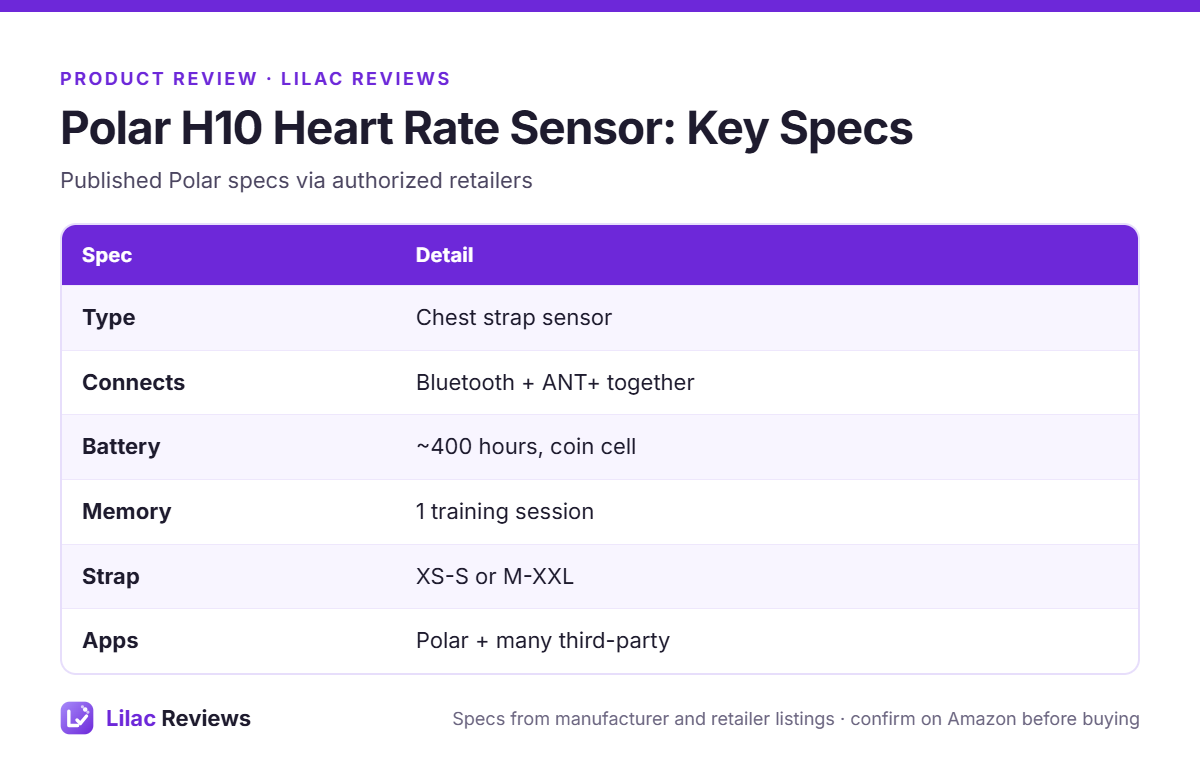
| Spec | Detail |
|---|---|
| Sensor type | Chest strap (ECG-style electrical signal) |
| Connectivity | Bluetooth Low Energy and ANT+ at the same time |
| Battery | Coin cell, about 400 hours of use |
| Memory | Stores one training session |
| Water resistance | Water resistant to 30 m |
| Strap sizes | XS-S (51-66 cm) and M-XXL (65-93 cm) |
| Apps | Polar Flow, Polar Beat and many third-party apps and devices |
The Amazon link below goes to the XS-S strap size. If your chest is larger than about 66 cm, switch to the M-XXL option on the listing.
What we like about the Polar H10
Accuracy where wrist sensors struggle
Interval training, rowing and strength work are tough for optical sensors. A chest strap picks up quick changes in heart rate much better. If you train by heart rate zones, or use the intensity guidance from the CDC, accurate numbers make that much easier.
Connects to almost anything
Bluetooth and ANT+ run together, so the H10 can talk to your phone and a bike computer or gym machine at the same time. It works with Polar’s apps and a long list of third-party apps, watches and equipment.
Battery you forget about
About 400 hours on a coin cell means many months of normal training for most people. Swapping the battery takes a coin and a minute.
Comfortable strap
The soft strap has silicone dots to stop it sliding. Moisten the electrodes before you start and most people forget it’s there after a few minutes.

What could be better
Only one stored session
The H10 stores one training session internally. Usually it streams live to your phone or watch, so this rarely matters, but it isn’t a standalone recorder for multiple workouts.
Straps need care
Sweat and salt build up. Rinse the strap after every session and machine-wash it regularly, or readings can get spotty and the strap wears out faster.
Not an all-day tracker
It doesn’t track sleep, steps or daily heart rate. Pair it with a tracker like the Fitbit Charge 6 if you want both.
Pros and cons
Pros
- Accurate heart rate during intervals and lifting
- Bluetooth and ANT+ at once
- About 400-hour battery
- Works with many apps and machines
Cons
- Stores only one session
- Strap needs regular washing
- Not an all-day tracker
- Pick the right strap size
Who should buy the Polar H10 (and who shouldn’t)
Buy the Polar H10 if you train with heart-rate zones, use a bike or rower with app support, or are frustrated by your watch’s heart-rate readings during workouts.
Skip it if you only want step counts and sleep data, or if you don’t like the idea of wearing a strap. A wrist tracker is more convenient for everyday use.
Tips for clean readings
Wet the electrode area before putting it on, and wear the strap just below the chest muscles, snug but not tight. Most early-workout dropouts are caused by dry electrodes.
Detach the sensor after each workout so the battery doesn’t drain, rinse the strap in clean water and let it air dry.
Alternatives to consider
- Fitbit Charge 6: an all-day tracker that can also broadcast heart rate to gym machines.
- Concept2 RowErg: the PM5 monitor pairs with chest straps for accurate rowing heart rate.
- Schwinn 230 Recumbent Bike: a bike where accurate heart rate makes training zones easy.
FAQ
Is the Polar H10 more accurate than a wrist tracker?
During workouts, chest straps generally track quick heart rate changes better than wrist sensors.
How long does the Polar H10 battery last?
About 400 hours on a coin cell battery.
Does the Polar H10 work with Peloton or Zwift?
It connects over Bluetooth and ANT+, which most apps and machines support. Check your device’s list of compatible sensors.
Can I swim with the Polar H10?
It is water resistant to 30 m, but Bluetooth doesn’t work well underwater. Check Polar’s guidance for swimming use.
Bottom line
The Polar H10 is a boring device in the best way: you put it on, it connects, and the numbers are right. If heart rate data matters to your training, it is one of the safest purchases in fitness tech.
Heart-rate monitors are training tools, not medical devices. Talk to a doctor about any unusual heart rhythms or symptoms.
This guide is for general information only and is not medical advice. Talk to a qualified professional before starting a new exercise program, especially if you have an injury or health condition.