
Pedal Exerciser Workouts for Seniors: 5 Seated Routines

Five pedal exerciser workouts for seniors, from a 12-minute easy start to TV intervals and arm cycling, plus chair setup, resistance tips and safety notes.
This article may contain affiliate links. If you buy through them, we may earn a small commission at no extra cost to you. Learn more.
Disclosure: As an Amazon Associate, we earn from qualifying purchases. If you buy through a link on this page, we may earn a small commission at no extra cost to you.
A pedal exerciser is a small set of bike pedals on a frame that sits on the floor in front of your chair. Some are simple mechanical pedals with a tension knob; others, like under-desk bikes and under-desk ellipticals, are quieter and smoother. They let you get gentle cardio while sitting, which is ideal if standing exercise is tiring, if you’re rebuilding after illness, or if you want to move while watching TV.
Here are five pedal exerciser workouts for seniors, along with setup tips that keep the pedals from sliding away from you.
Setup: the part most people skip
- Use a chair without wheels. A heavy dining chair or armchair is ideal. Office chairs roll backward as you pedal.
- Put the pedals on a non-slip mat. Many models creep forward on hard floors.
- Set the distance: at the furthest point, your knee should still be slightly bent.
- Start with low resistance. You should be able to pedal smoothly without straining.
- Check with your doctor first if you have heart problems, blood clots, or recent hip or knee surgery.
Looking for a quiet model? See our DeskCycle 2 review and Cubii Move review.

The 5 workouts
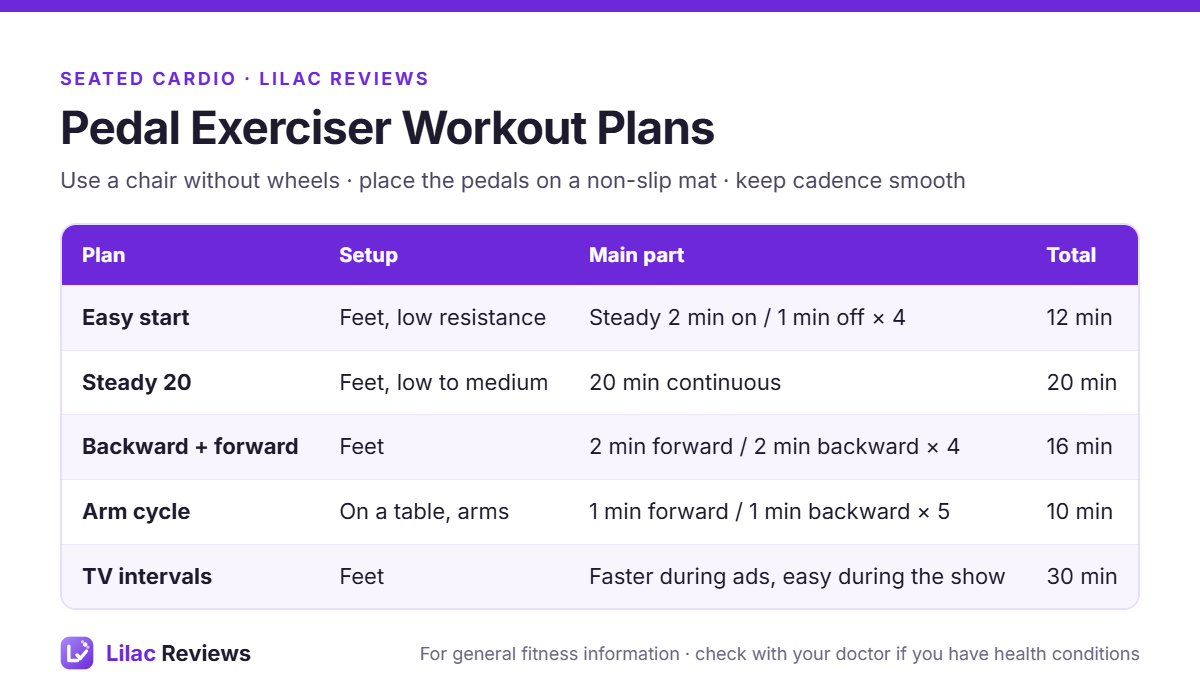
1. Easy start (12 minutes)
Pedal steadily for 2 minutes, rest 1 minute, and repeat four times. Use the lowest resistance. This is the place to begin if you’re new to exercise or coming back after a hospital stay. Do it daily or every other day for the first two weeks.
2. Steady 20 (20 minutes)
Pedal continuously for 20 minutes at low to medium resistance. Aim for an effort around 4–5 out of 10: breathing a little harder, still able to talk. Two of these a day adds up to a solid amount of weekly activity.
3. Backward and forward (16 minutes)
Alternate 2 minutes forward and 2 minutes backward, four times. Pedaling backward uses the muscles slightly differently and keeps things interesting. Not all models allow backward pedaling, so check yours.
4. Arm cycle (10 minutes)
Put a basic pedal exerciser on a sturdy table and turn the pedals with your hands: 1 minute forward, 1 minute backward, five times. This works shoulders and arms and is a good option if leg exercise is limited. Under-desk ellipticals and many under-desk bikes aren’t designed for this, so only use models that say they support arm use.
5. TV intervals (30 minutes)
Pedal at an easy pace during a show and pick up the pace during ad breaks or between episodes. It sounds simple, but it’s one of the easiest ways to build a daily habit.
How much should you pedal?
The CDC recommends older adults aim for about 150 minutes a week of moderate activity. Pedaling at a moderate effort counts. Very light pedaling still helps break up long periods of sitting, which is also good for health. Build up gradually: add 2–5 minutes to your sessions each week.
Under-desk elliptical vs pedal exerciser
An under-desk elliptical moves your feet in a smooth, gliding path and tends to be gentler on knees and quieter. A pedal exerciser moves in a bike-like circle and usually costs less. Under-desk bikes like the DeskCycle sit in between, with smooth magnetic resistance. All three are good choices for seated cardio.

Make it part of a full routine
Pedaling is great cardio, but it doesn’t replace strength and balance work. Pair it with our chair exercises for seniors for strength and our balance exercises once you’re ready to stand.
Common problems and fixes
- Pedals sliding: use a rubber mat or a strap attached to the chair leg.
- Knee discomfort: move the pedals further away and lower the resistance.
- Feet slipping off: wear shoes with grip and use the pedal straps.
- Noisy: magnetic resistance models are much quieter than friction-belt ones.
FAQ
Are pedal exercisers good for seniors?
Yes. They’re low impact, can be used seated, and make it easy to add daily movement at home.
How long should a senior use a pedal exerciser?
Start with 5–10 minutes and build to 20–30 minutes, once or twice a day.
Can a pedal exerciser help circulation?
Moving your legs helps keep blood flowing, which is one reason doctors encourage movement after long periods of sitting. If you have a circulation condition, ask your doctor for advice.
Can I use a pedal exerciser while watching TV?
Absolutely. That’s one of the best ways to make it a habit.
Written by the Lilac Reviews Editorial Team. This article is general fitness information, not medical advice. If you have a health condition, recent injury or surgery, talk to your doctor or physical therapist before starting a new exercise routine.
This guide is for general information only and is not medical advice. Talk to a qualified professional before starting a new exercise program, especially if you have an injury or health condition.