
Massage Gun Attachments Explained: Which Head to Use and When

Massage gun attachments explained: ball, flat, bullet, fork, cushion and thumb heads, which muscles each suits, and the ones beginners should skip.
This article may contain affiliate links. If you buy through them, we may earn a small commission at no extra cost to you. Learn more.
Disclosure: Lilac Reviews is reader-supported. As an Amazon Associate we earn from qualifying purchases, at no extra cost to you. We don’t list prices because they change often; check Amazon for the current price.
Open a new massage gun box and you’ll find a handful of plastic heads: a ball, a flat disc, something that looks like a fork, a pointy bullet. The leaflet rarely explains which to use, so most people either stick with whatever came attached or try the bullet on their neck and regret it.
Here’s a simple guide to massage gun attachments: what each head does, which muscles it suits, which ones beginners should skip, and how to keep them clean.
The short version
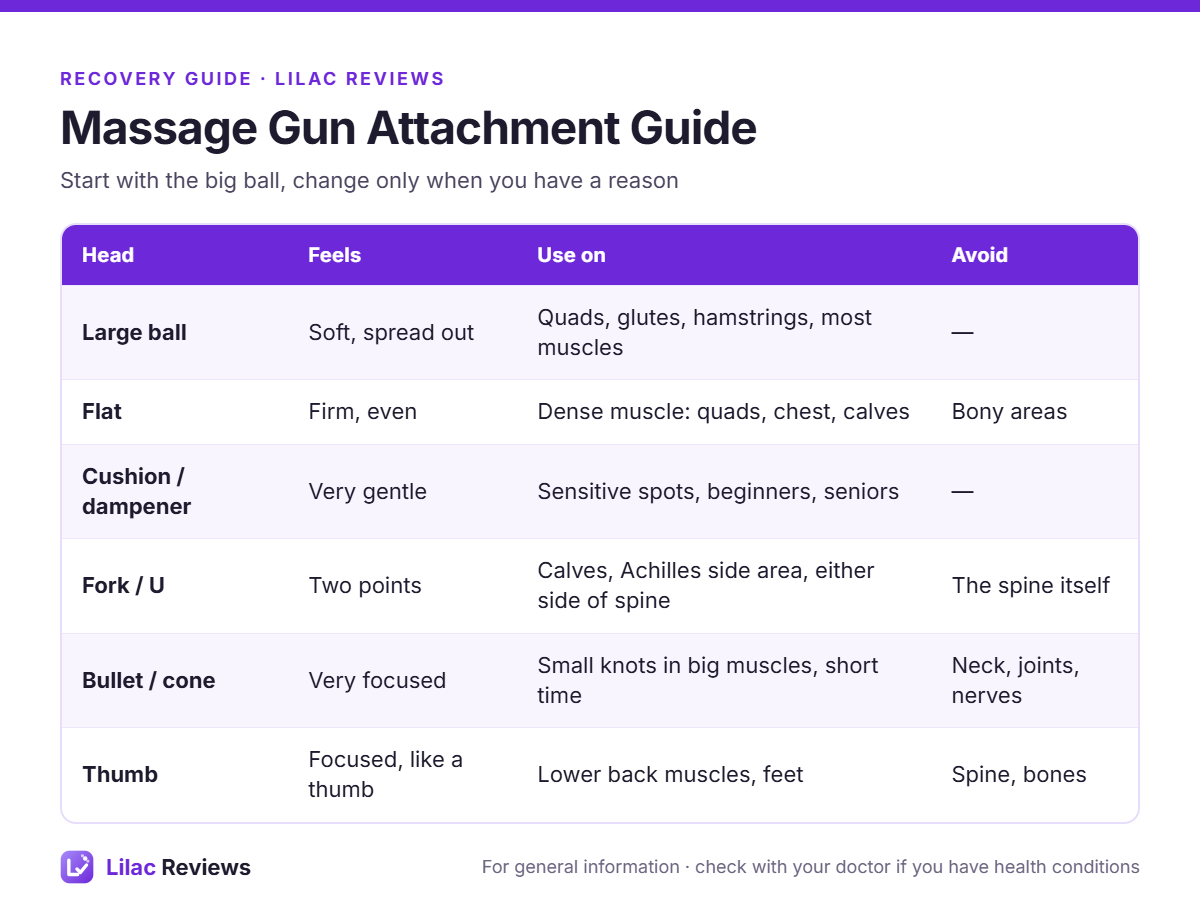
Start with the large ball for almost everything. Use the flat head for dense muscles like quads, the cushion or dampener for sensitive areas, and the fork for either side of the spine and around the calves. Save the bullet for brief, gentle work on small knots in big muscles, if you use it at all.
Each attachment explained
Large round ball
The default head on most guns. It spreads the force over a wide area, so it feels comfortable and works on most muscles: quads, hamstrings, glutes, calves, chest and upper back. If you only ever use one head, use this.
Flat head
A firm, flat disc. It feels more intense than the ball because the surface is harder and flatter. Good for big, dense muscles like quads, glutes and chest. Avoid bony areas.
Cushion or dampener
A soft, squishy head (Theragun calls it the dampener). It takes the edge off the percussion. Ideal for beginners, older adults, sensitive areas and anyone who bruises easily.
Fork or U-shape
Two prongs with a gap in the middle. The gap lets you work the muscles running beside the spine without hitting the spine itself, and it can wrap around the calves and the sides of the Achilles area. Go gently.
Bullet or cone
A pointed tip for very focused pressure. It can help on a small knot in a large muscle such as the glute, but only briefly (10 to 15 seconds) and on low speed. Never use it on the neck, joints, bones or over nerves, like the inner elbow or the back of the knee.
Thumb
A rounded point that mimics a thumb. Good for the muscles of the lower back (beside, not on, the spine) and the soles of the feet.
Others
Some guns add heat heads, cold heads, wedge or “scraper” heads. They’re fun extras, but not essential. Don’t buy a gun just for the number of heads.
Which head for which body part
- Quads: large ball or flat
- Hamstrings: large ball
- Glutes: large ball, flat, or bullet briefly on a knot
- Calves: large ball, cushion or fork
- Feet: thumb or ball, low speed
- Chest: large ball, low speed
- Upper back: large ball or fork beside the spine
- Shoulders and traps: large ball or cushion
- Forearms: cushion or small ball
Rules for any attachment
- Turn the gun on before it touches your skin, starting on the lowest speed.
- Float it over the muscle and keep moving; don’t press hard.
- Spend 30 seconds to 2 minutes per muscle group.
- Avoid the front of the neck, spine, joints, bones, bruises and injuries.
- Ask your doctor first if you take blood thinners, have osteoporosis, a history of blood clots or are pregnant.
For a full routine, see how to use a massage gun after a workout.
Guns with useful attachment sets
You don’t need dozens of heads. A good gun with four or five well-designed heads covers everything. Our best massage guns and best mini massage guns guides go deeper.
Theragun Prime

Cleaning and replacing heads
- Wipe heads with a damp cloth and mild soap, or a disinfecting wipe, after use. Don’t submerge them unless the maker says it’s safe.
- Let foam heads dry fully before storing.
- Replace any head that cracks or tears. Big brands sell replacements; for budget guns, check compatibility before ordering.
- Don’t swap heads while the gun is running.
FAQ
Which massage gun attachment is best?
The large ball for most people and most muscles.
What is the bullet attachment for?
Very focused pressure on small knots in big muscles. Use it briefly, on low speed, and avoid it on the neck and joints.
Which attachment is best for the back?
The fork for the muscles beside the spine, or the large ball for the shoulder blades. Never use any head on the spine itself.
Which attachment for sore calves?
The cushion or large ball, or the fork to wrap around the calf. Keep it light.
Bottom line
Most people only need two heads: the large ball and the cushion. Add the flat or fork for specific muscles, and treat the bullet with respect.
This article is for general information and is not medical advice.
This guide is for general information only and is not medical advice. Talk to a qualified professional before starting a new exercise program, especially if you have an injury or health condition.