
Best Treadmills for Home Use: Walking, Running and Incline Picks

The best treadmills for home use, picked by how you will actually use one: walking, running, incline walking or small spaces, plus the motor, belt and weight specs to check.
This article may contain affiliate links. If you buy through them, we may earn a small commission at no extra cost to you. Learn more.
As an Amazon Associate, we earn from qualifying purchases. If you buy through a link on this page we may earn a small commission at no extra cost to you. It never changes what we write.
Most people who regret buying a treadmill did not pick a bad brand. They picked the wrong kind of treadmill for how they actually use it. A walker paid for a running motor they never needed, or a runner bought a small folding deck that shook under every stride.
So this guide starts with your use, not with a list of models. Decide whether you mostly walk, jog, run or climb, then match the motor, belt and incline to that. The picks further down follow the same logic.
The short version
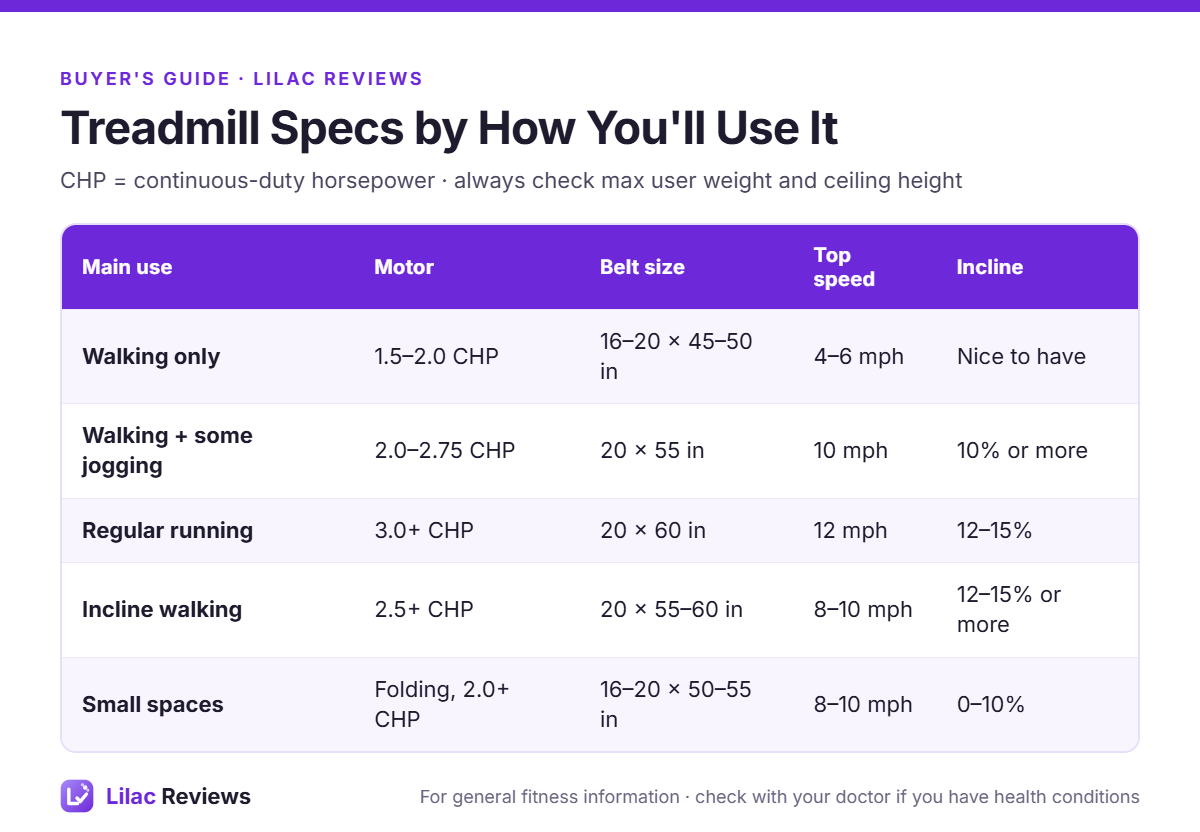
- Mostly walking: a 2.0 to 2.5 CHP motor and a 20-inch wide belt are plenty. A walking pad works if space is tight.
- Walking plus some jogging: look for 2.5 CHP or more, a 20 x 55 inch belt and 10 mph top speed.
- Regular running: 3.0 CHP or more and a 20 x 60 inch belt, so your stride never runs out of room.
- Incline walking: 12 to 15 percent incline and a solid frame, because steep walking loads the motor more than you think.
- Always: check the max user weight, your ceiling height and the floor space behind the deck before you order.
What to check before you buy a home treadmill
1. Motor: look at continuous horsepower
Treadmill listings often show a big “peak horsepower” number. Ignore it. The figure that matters is continuous-duty horsepower (CHP), which is what the motor can hold for a whole workout. For walking, 2.0 CHP is fine. For jogging, aim for 2.5. For regular running or heavier users, 3.0 CHP or more keeps the belt from hesitating under each footstrike.
2. Belt size: width and length
A 20-inch wide belt feels normal to most people. Narrower 16-inch belts are common on folding and budget models and are fine for steady walking, but they feel tight if you drift side to side. Length matters more for runners: 55 inches works for walking and light jogging, 60 inches is the safe choice for running.
3. Max user weight
Leave a margin. If you weigh 220 lb, a treadmill rated for 300 lb will feel steadier and usually last longer than one rated for 250. A higher rating often goes with a thicker frame, bigger rollers and a stronger motor. Our home gym space guide covers the room side of the equation.
4. Incline and decline
Incline is the cheapest way to make walking harder without running. Most mid-range treadmills go to 10 or 12 percent; incline-focused models go to 15 percent or more. If you want structure, our incline treadmill walking workout gives a four-week plan with exact settings.
5. Space, ceiling and power
A full treadmill is usually 6 to 7 feet long, and you need clear space behind it. ASTM safety guidance for treadmills calls for about 2 meters (roughly 6.5 feet) clear behind the deck and about half a meter on each side. Your ceiling matters too: add the deck height to your own height and leave headroom for the bounce of a running stride. Many treadmills also want a dedicated outlet, not a power strip, so check the manual before you pick a spot.
The best treadmills for home use, by type
We have not lab-tested these machines ourselves. The picks below are based on published specifications, manufacturer documentation and consistent feedback from independent reviewers and owners. Prices change often, so check current pricing on Amazon.
Best for runners: Sole F63
The Sole F63 is the treadmill many reviewers point to when someone asks for a folding machine that still feels solid when you run. Sole lists a 3.0 HP motor, a 20 x 60 inch belt, speeds up to 12 mph, power incline up to 15 levels and a 325 lb user limit. The deck is cushioned and the frame is heavier than most folding treadmills, which is exactly why it does not shake as much at speed.
The trade-off is weight and size. It is a big machine to move upstairs, and the console is basic compared with touchscreen models. If you want to run three or more times a week, that is a fair trade.

Best for walking and easy jogging: Horizon T101
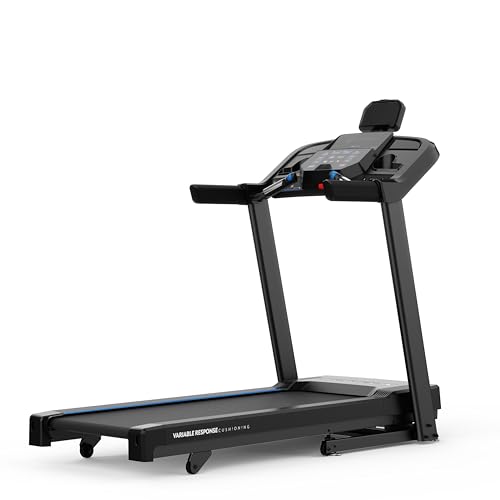
The Horizon T101 is a popular starter treadmill for good reason. It covers 0.5 to 10 mph, inclines to 10 percent, uses a 20 x 55 inch belt and carries a 300 lb user limit. One-touch speed and incline buttons make it simple to use, and the deck folds up when you are done.
Independent reviewers describe the motor as roughly 2.5 HP, which is fine for walking and jogging but not for frequent hard running. If running is your main goal, go with a 60-inch belt and a stronger motor instead.
Best for incline training: NordicTrack Commercial 1750
If incline walking is your main workout, the NordicTrack Commercial 1750 is built around it. It offers both incline and decline, a 22 x 60 inch belt, speeds to 12 mph and a large touchscreen designed for iFIT classes that adjust the machine for you. It suits people who like guided workouts and want hills without going outside.
Two things to know first: the best features need an iFIT subscription, and it is a large, heavy treadmill. Measure your room and your doorway before you order (our door clearance guide shows how).

Best budget folding treadmill: XTERRA Fitness TR150
The XTERRA TR150 is a compact folding treadmill for people who mainly walk and want something they can fold away after each session. It has a 16 x 50 inch belt, a top speed of 10 mph, three manual incline positions and a 250 lb user limit. It folds flat enough to roll against a wall.
It is not a runner’s machine. The narrow belt and lighter motor are best for walking and the occasional short jog. Think of it as a step up from a walking pad rather than a smaller full-size treadmill.
Best for small spaces and standing desks: WalkingPad C2
If you have no room for a full treadmill, a walking pad is the honest answer. The WalkingPad C2 folds in half, slides under a bed or sofa, and tops out at walking speeds. It has no handrail, so it suits people with steady balance. We cover the details in our WalkingPad C2 review.
Folding vs non-folding treadmills
Folding treadmills save floor space, but the hinge and lighter frame usually mean a little more flex and shake. If the treadmill will live in a garage or spare room and you run often, a non-folding or heavy-duty folding model is the better bet. If it lives in a living room or bedroom and gets folded every day, choose one with soft-drop hydraulics so it lowers slowly and does not slam.
Noise and flooring
Treadmills are noisier than most people expect, especially for downstairs neighbors. A dense rubber mat under the treadmill cuts vibration and protects the floor. Walking is far quieter than running, and a cushioned deck helps. Our home gym flooring guide and apartment home gym ideas go deeper on keeping the peace.
Safety basics
- Clip the safety key to your clothing every time. If you slip back, the belt stops.
- Straddle the side rails when you start the belt, then step on once it is moving slowly.
- Keep kids and pets away, and unplug or remove the key when you are done.
- Do not hold the handrails tightly on an incline. It takes the work away from your legs and throws off your posture.
More tips are in our home gym safety guide.
How much treadmill time do you need?
The CDC recommends at least 150 minutes of moderate activity a week for adults, such as brisk walking. That is 30 minutes, five days a week, which is very doable on a home treadmill. Steady brisk walking counts; you do not have to run to get the benefit.
FAQ
What size motor do I need for walking?
For walking, 2.0 CHP is enough for most people. If you are over about 220 lb or plan to walk on steep inclines, go for 2.5 CHP or more.
Is a 55-inch belt long enough?
For walking and light jogging, yes. For regular running, choose a 60-inch belt so a longer stride never reaches the end of the deck.
Can I put a treadmill on carpet?
Yes, but put a treadmill mat underneath. It keeps carpet fibers out of the motor area, stops the machine from creeping and protects the carpet.
Are walking pads as good as treadmills?
For slow, steady walking at a desk, they are great. They do not replace a treadmill for running, steep incline or people who need handrails.
Bottom line
Pick the treadmill for the workout you will actually do. Walkers can save money on the motor and spend it on a wider belt and easier controls. Runners should not compromise on a 60-inch belt and 3.0 CHP. And if space is the real limit, a walking pad that gets used every day beats a big treadmill that turns into a clothes rack.
Check with your doctor before starting a new exercise routine, especially if you have heart, joint or balance conditions.
This guide is for general information only and is not medical advice. Talk to a qualified professional before starting a new exercise program, especially if you have an injury or health condition.