
Best Elliptical Machines for Home: What to Buy and What to Skip

The best elliptical machines for home: stride length, flywheel, drive type, ceiling height and footprint explained, plus picks from compact budget ellipticals to heavy-duty models.
This article may contain affiliate links. If you buy through them, we may earn a small commission at no extra cost to you. Learn more.
As an Amazon Associate, we earn from qualifying purchases. If you buy through a link on this page we may earn a small commission at no extra cost to you. It never changes what we write.
Ellipticals are the quiet achievers of home cardio. They are gentle on joints, work your arms and legs together, and you can watch TV without being thrown off balance. The problem is that the cheap end of the market is full of machines with short, choppy strides that feel nothing like walking or running.
This guide explains the few specs that separate a good home elliptical from a frustrating one, then suggests models at different levels.
The specs that matter
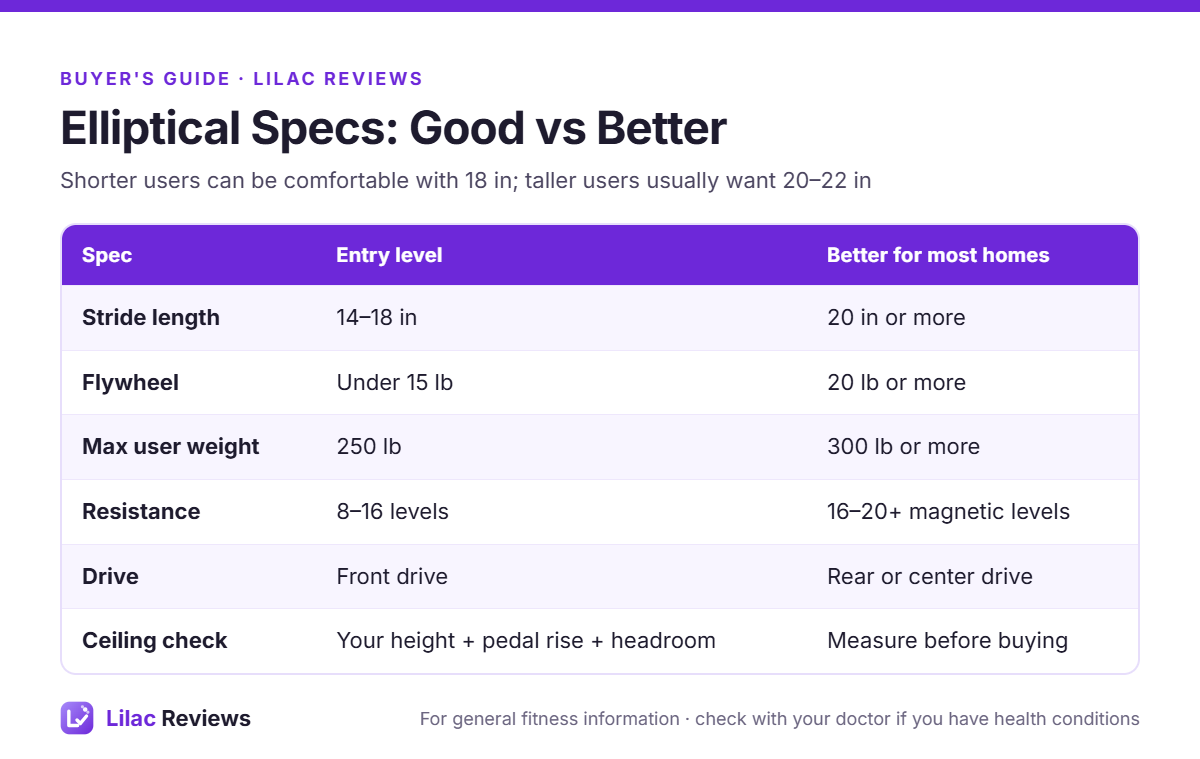
Stride length
Stride length is how far the pedals travel front to back. It is the single biggest factor in how natural an elliptical feels. Most adults are comfortable at 20 inches; people over about 6 feet often prefer 20 to 22 inches. Shorter users can be fine on 18. Strides of 14 to 16 inches, common on budget machines, feel short and bouncy for most people.
Flywheel
A heavier flywheel generally gives a smoother motion with less jerk at the top and bottom of each stride. Around 20 lb or more is a good sign on a full-size machine, though design matters too.
Drive position: front, rear or center
Front-drive ellipticals (flywheel at the front) are often more compact and cheaper, with a slightly more uphill, stair-like feel. Rear-drive machines tend to feel flatter and more like walking. Center-drive designs are the most compact front to back. None is “wrong”; try each if you can.
Max user weight and frame
A max user weight of 300 lb or more usually means a sturdier frame that wobbles less. Leave at least 50 lb of margin above your own weight.
Ceiling height
You stand on pedals that rise above the floor. Add your height to the highest pedal height and leave a few inches of headroom. This catches many basement buyers out.
The best elliptical machines for home
We have not lab-tested these ourselves. Picks are based on published specifications and consistent feedback from independent reviewers and owners. Confirm details on the current listing, as specs change by model year.
Best overall: Sole E35
The E35 has a 20-inch stride, a 25 lb flywheel, a 350 lb user limit and cushioned, adjustable pedals. It is heavy, stable and built for regular use. Our full Sole E35 review covers the size and ceiling considerations.

Best value: Schwinn 430 Elliptical
The Schwinn 430 has been a popular mid-priced elliptical for years. It offers a 20-inch stride, a wide range of magnetic resistance levels and built-in programs, plus Bluetooth for app tracking. It is lighter than the Sole and feels less solid at high effort, but for walking-pace and moderate workouts it covers what most people need for much less.
Best for guided workouts: NordicTrack FreeStride Trainer
NordicTrack’s FreeStride machines blend an elliptical, stepper and treadmill-style motion with an adjustable stride that can lengthen as you speed up. Paired with an iFIT subscription, the screen runs classes that change resistance and incline for you. It is a good fit if you like guided workouts and want variety, as long as you are happy with a subscription.

Best compact budget pick: Sunny Health & Fitness SF-E905
The Sunny SF-E905 is a small, low-cost magnetic elliptical for tight spaces. Its stride is short and the frame is light, so it will not feel like a gym machine. For light daily movement in an apartment, though, it is an affordable entry point. Taller users should expect a cramped stride.
How much space do you need?
Full-size ellipticals are typically 6 to 7 feet long and 2 to 2.5 feet wide. Add about 1.5 to 2 feet around the sides and back for getting on and off. Our home gym space guide has layout examples.
Elliptical or something else?
If you mainly want to walk or run, a treadmill is a better fit; see elliptical vs treadmill. If balance or back pain is a concern, a recumbent bike is easier; see recumbent bikes for seniors. If you only want light seated movement, an under-desk elliptical takes almost no space.
Getting started
Start with 15 to 20 minutes at low resistance, three to five days a week. Stand upright, keep your heels down and use the handles lightly. Add time before adding resistance. The CDC recommends 150 minutes of moderate activity a week; five 30-minute elliptical sessions get you there.
FAQ
What stride length do I need?
About 20 inches suits most adults. Under about 5’3″, 18 inches can be fine. Over about 6 feet, look for 20 to 22 inches.
Are cheap ellipticals worth it?
Only if your space is small and your use is light. Short strides and light frames make budget ellipticals feel awkward for regular workouts.
Is an elliptical good for bad knees?
Often, yes, because there is no impact. Keep the resistance moderate and your knees tracking over your toes.
Bottom line
Prioritize stride length, stability and ceiling height over screens and programs. The Sole E35 is the long-term pick, the Schwinn 430 is the value pick, NordicTrack suits guided-workout fans, and the Sunny SF-E905 is for tight spaces and light use.
Check with your doctor before starting a new exercise routine, especially if you have heart, joint or balance conditions.
This guide is for general information only and is not medical advice. Talk to a qualified professional before starting a new exercise program, especially if you have an injury or health condition.