
Rowing Machine Workout for Beginners: Learn the Stroke + 4-Week Plan

A beginner rowing machine workout: how to row with good form, damper and stroke rate settings, and a 4-week plan from short intervals to 20 minutes of steady rowing.
This article may contain affiliate links. If you buy through them, we may earn a small commission at no extra cost to you. Learn more.
Disclosure: As an Amazon Associate, we earn from qualifying purchases. If you buy through a link on this page, we may earn a small commission at no extra cost to you.
A rowing machine works your legs, hips, back and arms in one smooth movement, with very little impact on your joints. It’s also one of the easiest machines to use badly. Most beginners pull too much with their arms, row too fast, and crank the damper to the top, then wonder why their back hurts after ten minutes.
This rowing machine workout for beginners starts with the stroke itself, then gives you a 4-week plan that builds to 20 minutes of steady rowing.
Learn the stroke: legs, body, arms
Every stroke has two halves, the drive (pulling) and the recovery (returning). The order matters.
The drive
- Catch: sit tall at the front, shins roughly vertical, arms straight, leaning slightly forward from the hips.
- Legs: push through your feet. Your arms stay straight while your legs do most of the work.
- Body: as your legs straighten, swing your upper body back slightly, to about “11 o’clock”.
- Arms: finally pull the handle to just below your ribs, elbows close to the body.
The recovery
Reverse the order: arms extend, body hinges forward, then knees bend and you slide back to the catch. The recovery should take about twice as long as the drive. Think “push quick, come back slow”.
Concept2, the best-known rower brand, has a free rowing technique guide with videos that’s worth watching before your first session.
Settings that matter
- Damper (air rowers): 3–5 for most people. Higher isn’t “harder” in a useful way, it just feels heavier and tires you faster.
- Resistance level (magnetic rowers): start low to medium.
- Stroke rate: 20–24 strokes per minute is a good beginner range. Faster isn’t better if your form breaks down.
- Foot straps: across the widest part of your foot.

The 4-week plan
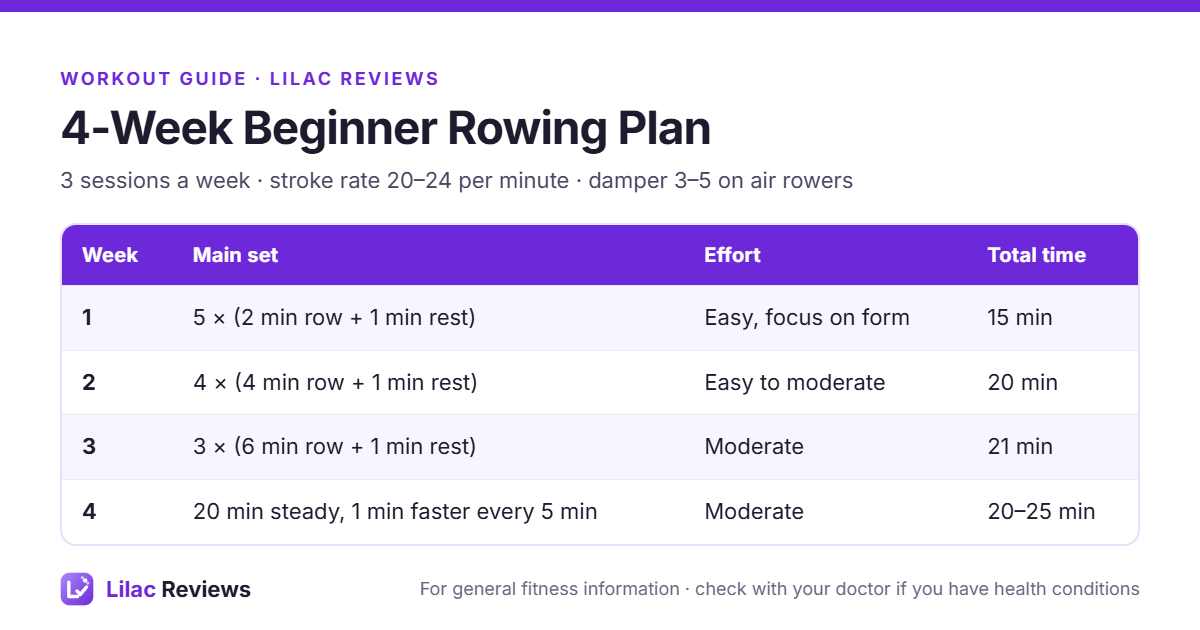
Row three times a week on non-consecutive days. Always start with 3–5 minutes of very easy rowing and end with 3 minutes easy plus a few stretches for hips and hamstrings.
Week 1: 5 × 2 minutes
Row 2 minutes easy, rest 1 minute, five times. Spend this week getting the legs-body-arms order automatic. Effort should feel like 3–4 out of 10.
Week 2: 4 × 4 minutes
Row 4 minutes, rest 1 minute, four times. Aim for a steady stroke rate of 20–22.
Week 3: 3 × 6 minutes
Longer pieces, still at a conversational effort (about 5 out of 10). Watch your split time (time per 500 m) and try to keep it consistent across all three.
Week 4: 20 minutes steady
Row 20 minutes without stopping. Every 5 minutes, row 1 minute a little harder, then settle back. If you need to stop briefly, that’s fine.
Common beginner mistakes
- Arms first: pulling before your legs push. Keep your arms straight until your legs are nearly flat.
- Rounding the back: hinge from the hips and keep your chest proud.
- Rushing the slide: slamming back to the front tires you out and ruins rhythm.
- Damper on 10: turn it down.
- Knees up too early on the recovery: let your hands pass your knees before bending them.
Is rowing good for beginners and older adults?
For many people, yes. It’s low impact and works most major muscles. You do need to get down to the seat and back up, and to hinge at the hips comfortably. If you have back problems, start with very short sessions and check with your doctor or physical therapist. If getting low is hard, a recumbent bike may be easier; see our recumbent bike workouts.
Track your effort
Most rowers show split time and stroke rate, which is plenty. If you like heart rate data, many rower monitors and apps pair with a chest strap. Our Polar H10 review covers one that works with most equipment.

After week 4
Keep three sessions a week and change one variable at a time: row longer (up to 30 minutes), add a day of short intervals, or try to lower your average split slightly. Combine rowing with two days of strength training for a balanced week. Our Concept2 RowErg review has more on the machine many gyms and home rowers use.
FAQ
How long should a beginner row?
10–15 minutes of actual rowing is enough at first, building to 20–30 minutes over a month.
What is a good stroke rate for beginners?
About 20–24 strokes per minute. Focus on power and rhythm rather than speed.
Is rowing better than cycling?
Rowing uses more upper body and back, while cycling is easier to learn and gentler on the lower back. Both are good low-impact cardio.
Does rowing hurt your back?
Poor form can. Using your legs first, hinging from the hips and keeping the damper moderate protects your back.
Written by the Lilac Reviews Editorial Team. This article is general fitness information, not medical advice. If you have a health condition, recent injury or surgery, talk to your doctor or physical therapist before starting a new exercise routine.
This guide is for general information only and is not medical advice. Talk to a qualified professional before starting a new exercise program, especially if you have an injury or health condition.