
Stair Stepper Workout for Beginners: A Simple 20-Minute Plan

A beginner stair stepper workout with a 20-minute interval plan, proper form, a 4-week progression and tips for mini steppers at home.
This article may contain affiliate links. If you buy through them, we may earn a small commission at no extra cost to you. Learn more.
The stair stepper has a reputation as the machine nobody wants to get on. It’s sweaty, it’s relentless, and five minutes feels like twenty. But that’s also why it works. Climbing is a natural movement, it’s low-impact, and it trains your legs and your heart at the same time, all in a small footprint.
This guide covers a stair stepper workout for beginners: a 20-minute plan, how to use the machine with good form, the difference between a full stair climber and a compact mini stepper, and how to progress without wrecking your knees.
Stair climber vs mini stepper: which one do you have?
People use “stair stepper” for a few quite different machines, and the workout changes a bit depending on which you’re on.
- Stair climber (revolving stairs): the big gym machine with a rotating staircase. You actually climb real steps. It’s the toughest of the three and needs a lot of ceiling height.
- Stepper with pedals: two pedals that move up and down. Common in gyms and homes. Shorter range of motion, easier to learn.
- Mini stepper: a compact, low-cost home version with short pedals, sometimes with resistance bands for your arms. Fits under a desk or in a closet, but the step is shallow so it’s less intense.
The plan below works on all three. On a mini stepper, you’ll simply step faster and for longer to get the same effort.
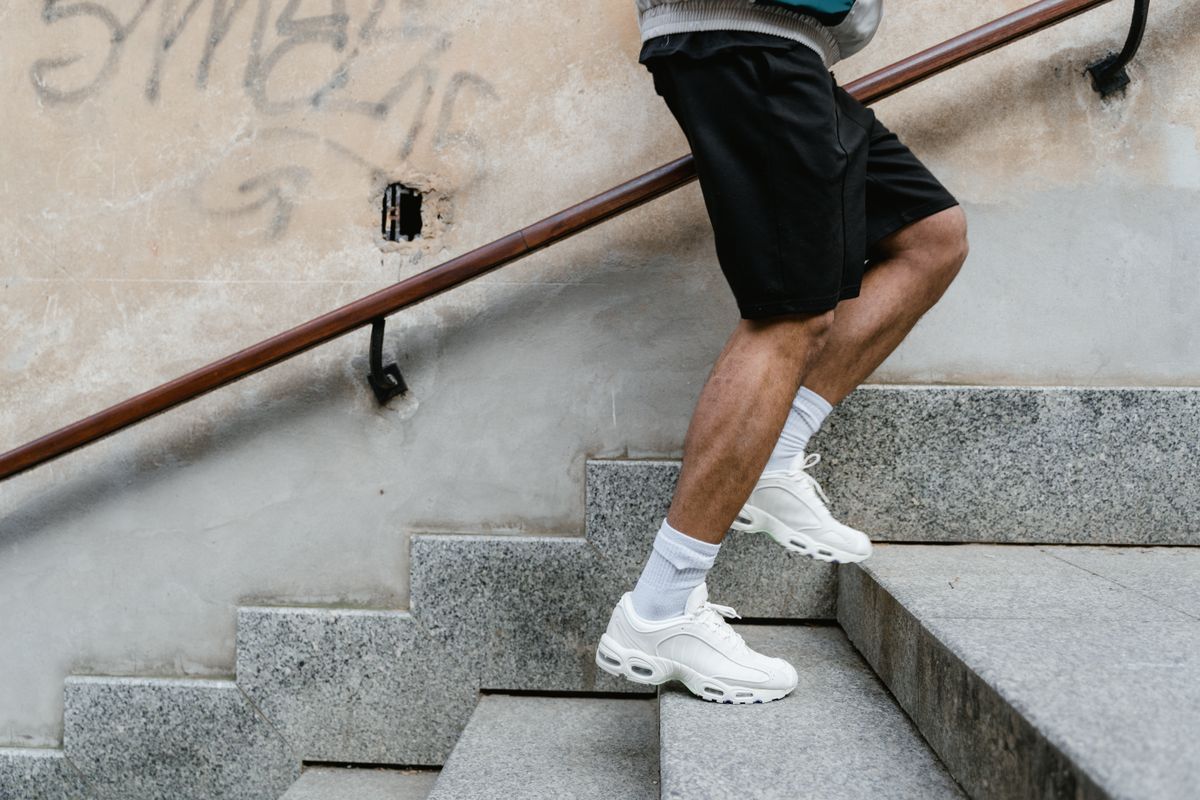
How to use a stair stepper with good form
Stand tall
Keep your chest up and your hips under your shoulders. The classic mistake is folding forward and hanging over the console. It takes work away from your glutes and puts strain on your lower back.
Light hands, not a death grip
Rest your fingertips on the rails for balance. If you’re leaning your body weight on your arms, the speed is too high. Slow it down.
Use the whole foot
Press through your whole foot, especially your heel, rather than stepping only on your toes. Heel pressure brings your glutes and hamstrings into play; toe-only steps overload your calves.
Full but controlled steps
Avoid tiny, rapid half-steps. Move through a comfortable range and keep the rhythm smooth.
The 20-minute beginner stair stepper workout
Do this two or three times a week. Effort is described on a 1 to 10 scale where 1 is resting and 10 is all-out. “Easy” is around 3 to 4, “moderate” 5 to 6 and “push” 7.
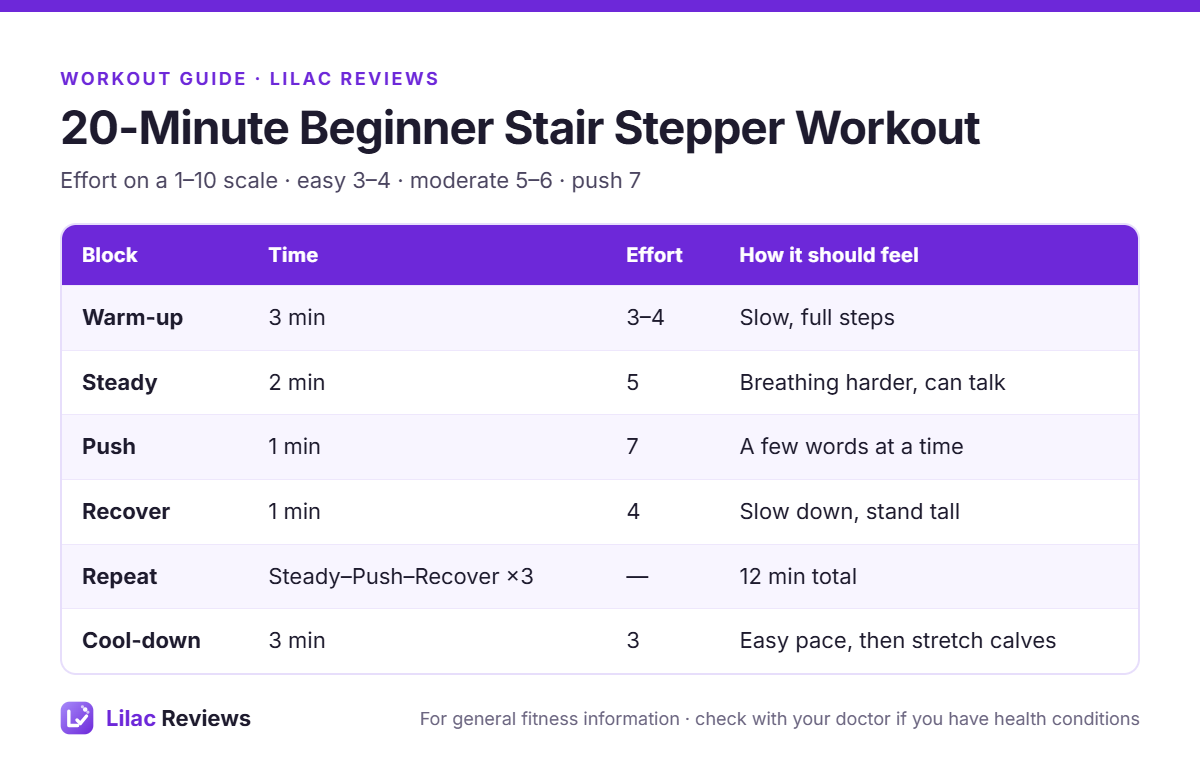
Not ready for 20 minutes? Do the warm-up, two rounds of the intervals and the cool-down. That’s about 12 minutes and still counts.
A 4-week progression
- Week 1: 12 to 15 minutes, mostly easy to moderate. Learn the form.
- Week 2: the full 20-minute plan, twice.
- Week 3: the full plan three times; make the “push” blocks 90 seconds.
- Week 4: 25 minutes, or add a fourth round of intervals.
Change one thing at a time: duration, speed or the number of sessions. Our guide on how many days beginners should work out is a helpful reference for fitting stepper sessions around strength days.
A sample beginner week with the stepper
Here’s how the stepper can sit inside a realistic week without taking over your life:
- Monday: 20-minute stepper plan
- Tuesday: 20 to 30 minutes of simple strength work (squats, push-ups against a counter, rows with a band)
- Wednesday: rest or an easy walk
- Thursday: 20-minute stepper plan
- Friday: strength session
- Saturday: a longer, easy session: 25 to 30 minutes at a steady moderate pace
- Sunday: rest
That adds up to roughly 70 to 80 minutes of cardio plus two strength days, which is a solid first step toward the 150 minutes a week most health guidelines recommend.
How many calories does a stair stepper burn?
Machine displays will happily give you a number, but treat it as a rough guess. Calorie burn depends on your body weight, the step height, your speed and whether you’re leaning on the rails. A heavier person stepping steadily without holding on burns noticeably more than a lighter person hanging on to the console at the same setting. Instead of chasing calories, track minutes, average speed and how hard the session felt. Those numbers tell you whether you’re actually getting fitter. Our guide on tracking workout progress shows a simple way to log them.
Three variations to try once you’re comfortable
Glute-focused steps
Hinge slightly forward from the hips (not hunching), push through your heels and squeeze your glute at the top of each step. Go slower than normal.
Skip-a-step (stair climbers only)
Step up two stairs at a time at a slow speed. It’s a bigger range of motion and feels like a lunge. Hold the rails lightly and keep it controlled.
Lateral steps
Turn sideways and step with the trail leg crossing over. This only works on slow speeds and full-size climbers. Hold the rail and keep it short, 30 seconds per side.
How the stepper fits into a home gym
Full stair climbers need a lot of vertical space, often a ceiling well over 8 feet once you account for your height plus the top step. Pedal steppers and mini steppers are much easier to fit in a spare room or apartment home gym, and they’re quieter. Put any stepper on a firm mat so it doesn’t creep across the floor.
Cardio on the stepper and two short strength sessions a week is a well-rounded plan for most beginners. If you don’t have weights yet, see how to build strength without a gym.
Mistakes that make the stepper harder (or riskier)
- Going too fast too soon. Speed isn’t the goal. Steady, full steps beat frantic ones.
- Leaning on the rails. It looks easier because it is. You lose a big part of the workout.
- Letting knees cave in. Keep knees in line with your toes. If they drift inward, slow down.
- Looking down at your feet. Eyes forward keeps your posture upright.
- Skipping the cool-down. A couple of easy minutes helps your heart rate settle.
Who should take it slower
If you have knee pain on stairs, hip or ankle problems, or a heart condition, talk to your doctor or a physiotherapist first. A recumbent bike or elliptical may be a gentler starting point; our guide on how to choose an exercise bike can help. General guidance on how much activity adults need is in the CDC physical activity guidelines.
FAQ
How long should a beginner use a stair stepper?
Start with 10 to 15 minutes and build to 20 to 30 minutes over a few weeks.
Is the stair stepper good for beginners?
Yes, as long as you keep the speed low and focus on form. It’s low-impact and easy to scale.
What muscles does a stair stepper work?
Mainly your glutes, quads, hamstrings and calves, plus your core for balance. It’s also solid cardio.
Is a mini stepper as good as a stair climber?
It’s less intense because the step is shorter, but it’s much cheaper, quieter and fits almost anywhere. For beginners it’s a reasonable start.
Stair stepper or treadmill?
Both are good. The stepper is more leg-focused and takes less floor space; the treadmill is more versatile. If you have a treadmill, try our incline treadmill walking workout for a similar effect.
This guide is for general information only and is not medical advice. Talk to a qualified professional before starting a new exercise program, especially if you have an injury or health condition.