
Jump Rope Workout for Beginners: 4-Week Plan to 15 Minutes

A beginner jump rope workout that builds from short sets to 15 minutes in 4 weeks, with rope sizing, technique tips and common mistakes.
This article may contain affiliate links. If you buy through them, we may earn a small commission at no extra cost to you. Learn more.
A jump rope costs less than a gym day pass, fits in a drawer, and gives you one of the most efficient cardio workouts there is. It’s also harder than it looks. Most beginners trip within ten seconds, decide they’re “bad at it,” and put the rope away for good.
You’re not bad at it; you just need a plan that builds the skill and the fitness at the same time. This jump rope workout for beginners gets you from a few clumsy minutes to a confident 15-minute session in four weeks.
Get the rope length right first
A rope that’s the wrong length is the number-one reason beginners keep tripping. To check:
- Stand on the middle of the rope with one foot.
- Pull the handles straight up.
- For beginners, the tops of the handles (or where the cable meets the handles) should reach around your armpits.
A slightly longer rope is more forgiving while you learn. As you improve, you can shorten it to around chest height for faster spins. Most adjustable ropes let you trim or tuck the extra cable.
Rope type: beaded or thicker PVC ropes are easiest to learn with because you can feel and hear the rhythm. Thin, fast “speed ropes” are for later. A weighted rope is great for conditioning but can tire your shoulders quickly.
Where to jump
Surface matters for your joints and your rope. Wood floors, rubber gym flooring or a dedicated jump rope mat are all good. Avoid concrete (hard on joints and shreds ropes) and thick carpet (catches the rope and your toes). Our guide to home gym flooring compares the options.
Check your ceiling too. You’ll need clearance above your head for the rope’s arc, which is usually fine in a garage or a room with standard ceilings but tight under low basement beams. If you live upstairs, read our apartment home gym ideas for noise tips, and consider a mat; your neighbors will appreciate it.
Basic technique
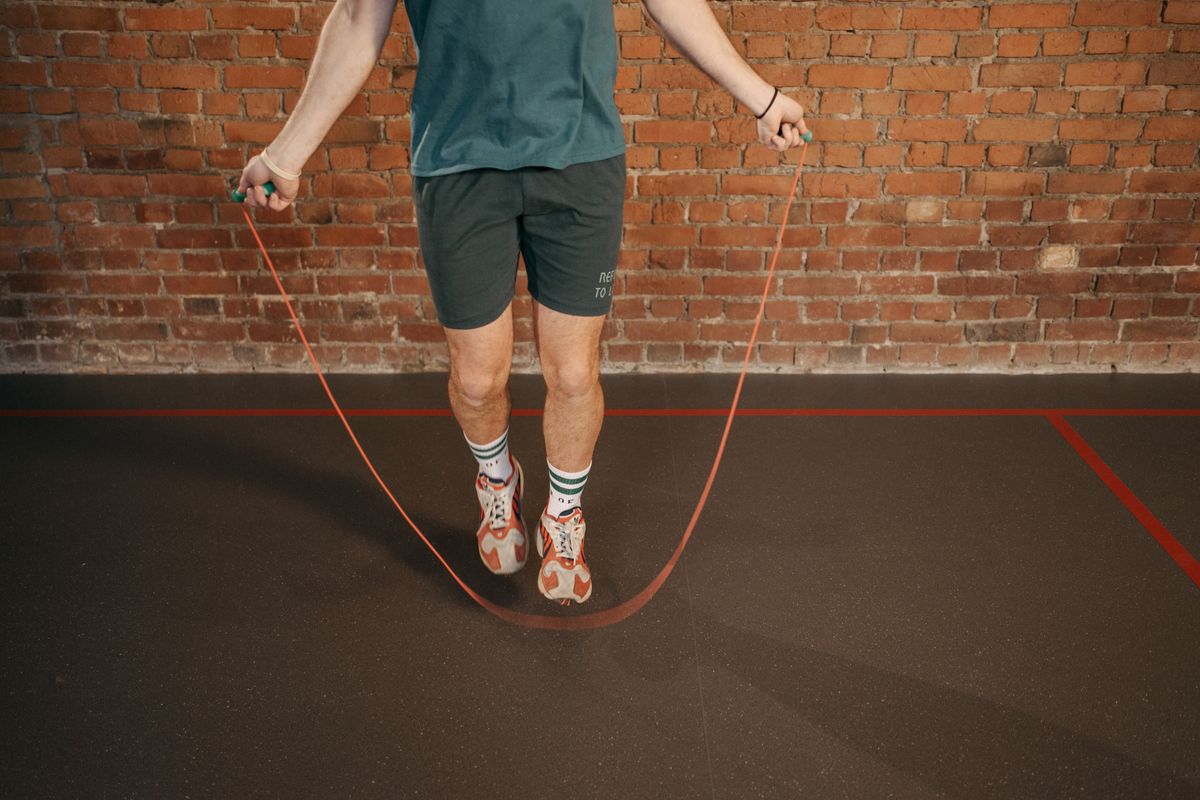
- Turn from your wrists, not your shoulders. Elbows stay close to your sides, hands about hip height.
- Jump just high enough to clear the rope, about an inch or two. Big jumps tire you out fast.
- Land softly on the balls of your feet, knees slightly bent. Heels hover just above the floor.
- Look ahead, not at your feet.
- Relax. Tense shoulders and a death grip make everything harder.
Can’t get the timing? Try this
Hold both handles in one hand and swing the rope at your side while you hop. You get the rhythm without tripping. Then try one single jump with the rope, stop, reset, and repeat. Link two jumps, then three. Most people get there within a session or two.
The 4-week beginner jump rope plan
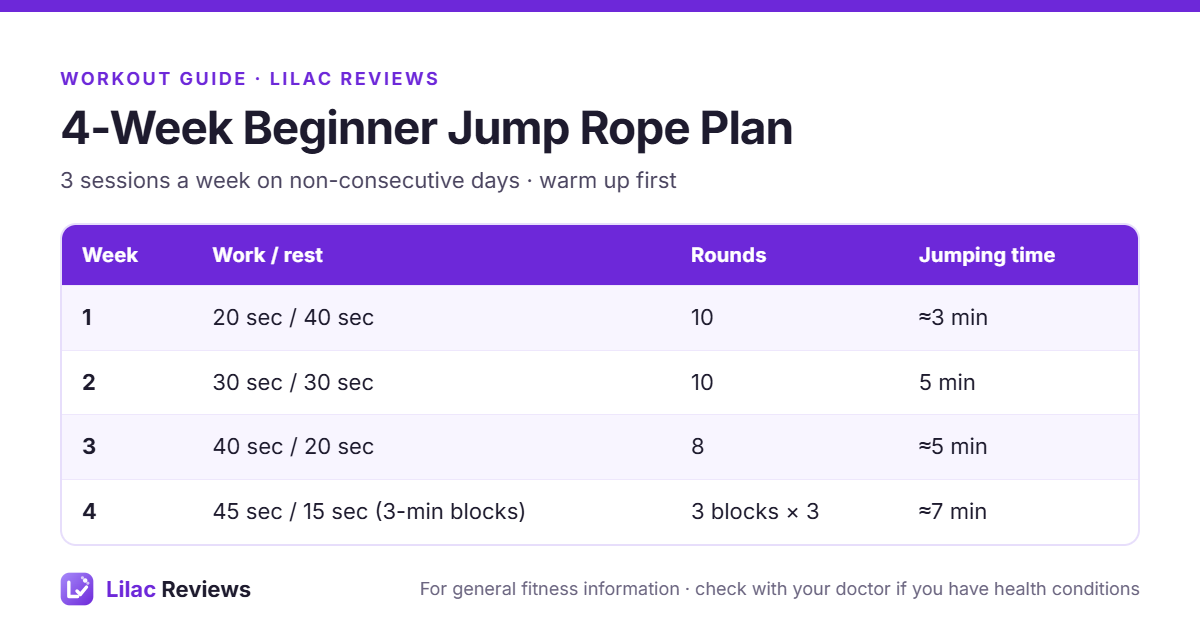
Do this three times a week on non-consecutive days. Every session starts with 3 to 5 minutes of easy warm-up (marching, arm circles, ankle bounces) and ends with a short calf and hip stretch.
Week 1: learn the bounce
10 rounds of 20 seconds jumping, 40 seconds rest. Missing is fine; just restart. Total jumping time is only a few minutes, and that’s enough while your calves and Achilles adapt.
Week 2: longer sets
10 rounds of 30 seconds on, 30 seconds off. Try to keep each set going without stopping.
Week 3: add a second move
8 rounds of 40 seconds on, 20 seconds off. Alternate the basic bounce with the “boxer step” (shifting your weight from one foot to the other with each turn) or alternate-foot jogging.
Week 4: build the finisher
Three blocks of 3 minutes: within each, jump 45 seconds, rest 15 seconds. Rest one minute between blocks. That’s about 11 minutes, or roughly 15 with your warm-up and cool-down, and close to 7 minutes of actual jumping. That’s a solid cardio session.
Beginner moves to add once the basic bounce is easy
- Boxer step: a light side-to-side shift. Easier on the calves and great for longer sets.
- Alternate-foot step: like jogging in place over the rope.
- Side-to-side hops: small hops left and right.
- High knees: jogging with your knees lifting higher. Tiring, so keep it short.
Double-unders (the rope passes twice per jump) are a fun goal, but give yourself a couple of months of regular practice first.
Avoid these common mistakes
- Doing too much too soon. Jumping is hard on the calves and Achilles. Shin or calf soreness that lingers means you should cut back.
- Jumping too high or kicking your heels back.
- Swinging with your whole arms. Keep it in the wrists.
- Training on concrete. It’s tough on joints and destroys PVC ropes.
- Skipping rest days. Three sessions a week is plenty to start. See how many days beginners should work out.
Is jump rope good for you?
Jumping rope is a vigorous activity for most people, so it counts strongly toward weekly activity targets; the CDC says adults can meet the weekly target with either 150 minutes of moderate activity or 75 minutes of vigorous activity. It also builds coordination, footwork and calf strength. Because it’s high-impact, it isn’t right for everyone. People with knee, ankle or Achilles problems, significant extra body weight, osteoporosis, pelvic floor issues, or heart conditions should get medical advice first and might do better starting with mini trampoline exercises or incline walking.
Track your progress
Count the longest set you can do without a miss, or the total number of jumps in a session. Writing that number down each week is simple and motivating. Our guide on how to track workout progress shows an easy way to do it.
FAQ
How long should a beginner jump rope?
Start with 3 to 5 minutes of total jumping, split into short sets with rest. Build to 10 to 15-minute sessions over a month.
Is 10 minutes of jump rope a day enough?
Ten minutes of well-paced jumping is a good workout, especially with intervals. Combine it with strength training for a balanced routine.
Why do I keep tripping?
Usually the rope is too short, you’re jumping too early, or turning from your shoulders. Check the length, keep elbows in, and jump only when the rope is about to reach your feet.
What’s the best rope for beginners?
A beaded or thicker PVC rope with comfortable handles and adjustable length. Save speed ropes for later.
This guide is for general information only and is not medical advice. Talk to a qualified professional before starting a new exercise program, especially if you have an injury or health condition.