
Mini Trampoline Exercises for Beginners (15-Minute Rebounder Workout)

10 easy mini trampoline exercises for beginners, a 15-minute rebounder routine, safety checks and how to progress without sore ankles.
This article may contain affiliate links. If you buy through them, we may earn a small commission at no extra cost to you. Learn more.
A mini trampoline (also called a rebounder) is a small, round fitness trampoline, usually about 36 to 48 inches across, that fits in a living room and slides under a bed. It’s one of the more fun ways to get your heart rate up at home, and because the mat gives under your feet, landings feel softer than jumping on a hard floor.
The catch is that most beginners either bounce aimlessly for five minutes and get bored, or go too hard and feel it in their ankles the next day. This guide fixes both problems with 10 mini trampoline exercises for beginners and a simple 15-minute routine you can repeat three times a week.
Before you start: three quick safety checks
- Ceiling height. You’ll be taller than usual at the top of a bounce. Raise your arms overhead while standing on the rebounder; you want a good hand’s width of clearance, more if you’re tall. If your room is tight, read our tips on home gym ideas for high ceilings and choose a different room if needed.
- Floor and space. Put it on a flat surface with a meter (about 3 feet) of clear space around it. No furniture corners, no rugs that slide.
- Weight limit and frame. Check the maximum user weight on the label and squeeze-test the legs before every session. Bungee-cord models usually feel softer and quieter than steel-spring ones.
If balance is a concern, use a rebounder with a stability handle bar. It makes a real difference for older adults and anyone coming back from an injury.
How to do a basic bounce properly
Almost every move below builds on the basic “health bounce,” so get this one right first.
- Stand in the center with feet hip-width apart, knees soft.
- Press down through your whole foot without leaving the mat. Your heels may lift slightly.
- Keep your chest up, core lightly braced and arms relaxed by your sides.
- Breathe normally. You should be able to talk easily.
Your feet don’t need to leave the mat to get a workout. Beginners often do best spending the first week entirely on low bounces.
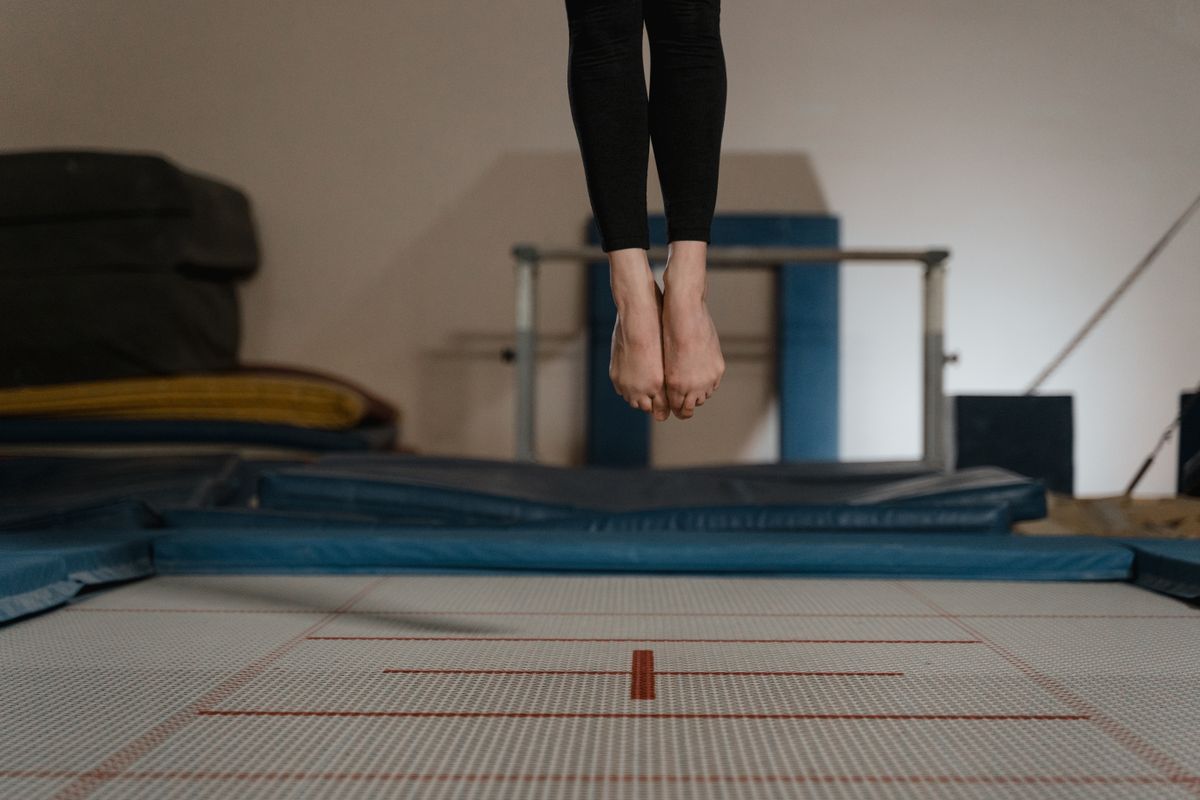
10 mini trampoline exercises for beginners
1. Health bounce
The move described above. Use it to warm up, to recover between harder moves, and to cool down.
2. Light jog
Jog in place on the mat, lifting your feet only a few centimeters. Pump your arms as you would on a slow run. This is the easiest way to raise your heart rate without jumping.
3. High knees (march version first)
March with your knees lifting toward hip height. Once that’s easy, speed it up into a light high-knee jog. Keep your torso upright rather than leaning back.
4. Jumping jacks
Small jacks work better than big ones on a rebounder. Step or hop your feet a little wider than hips, then back. Arms can go to shoulder height instead of overhead if your shoulders are stiff.
5. Twist
Bounce gently while rotating your hips one way and your shoulders the other. It feels like a dance move, and it gets your obliques working.
6. Heel taps
Bounce and tap one heel forward on the mat, then switch. Alternate at a steady rhythm. This one’s good for coordination and calves.
7. Side-to-side shuffle
Take small hops from the left side of the mat to the right, staying away from the frame edge. Keep the movement small and controlled.
8. Squat bounce
Lower into a shallow squat and do small bounces from there. Your thighs will feel this within 20 seconds. Keep your knees tracking over your toes.
9. Front kick
Bounce and kick one foot forward to about knee height, then switch. Hold the handle bar if your balance is wobbly.
10. Seated bounce
Sit on the edge of a stable chair, put your feet on the mat, and press down with your feet so the mat moves. It sounds silly, but it’s a genuinely useful option on low-energy days or for people who can’t stand for long.
A 15-minute beginner rebounder routine
Use this three times a week with a rest day in between. Work at a pace where you’re breathing harder but could still say a sentence.
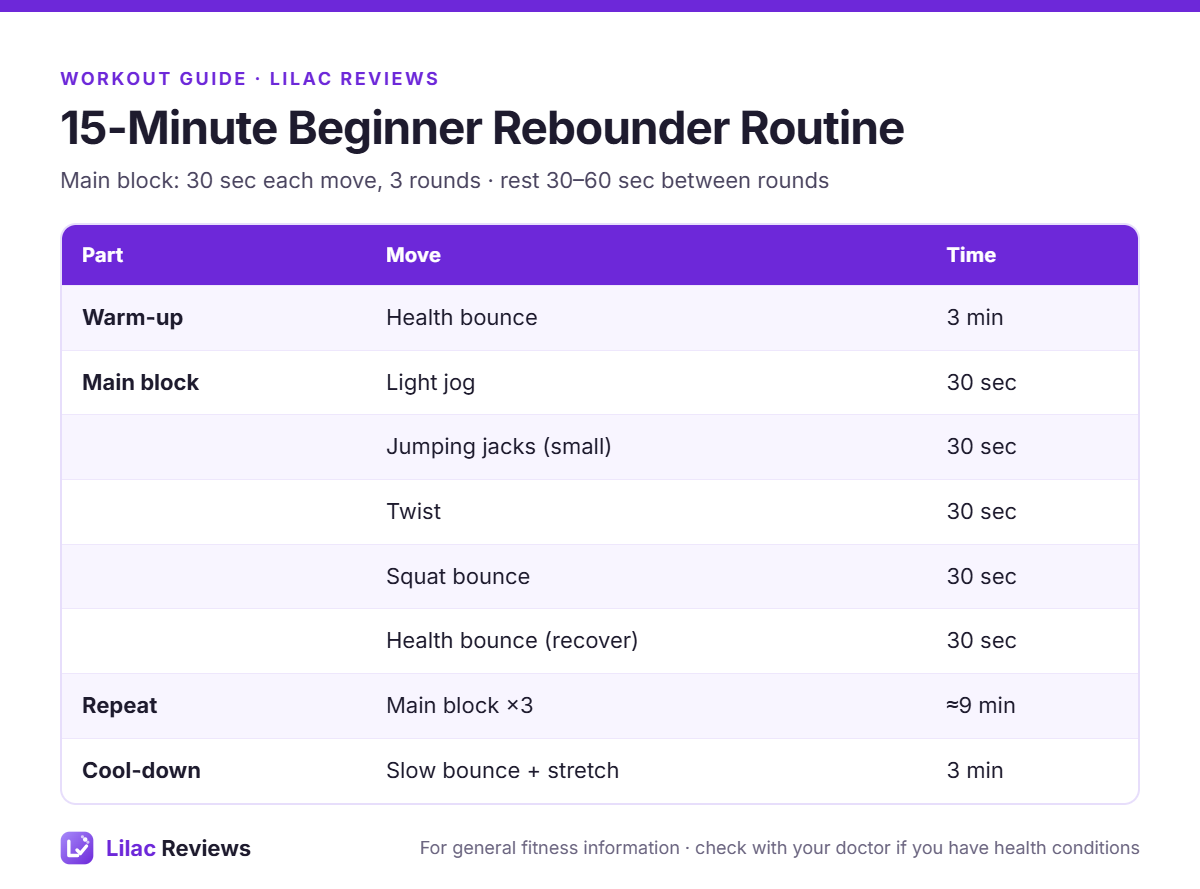
If 15 minutes is too much at first, do two rounds of the main block instead of three. If it’s easy, add a fourth round or swap the light jog for high knees.
How to progress over the next few weeks
- Weeks 1 to 2: mostly health bounce, light jog and marching moves. Feet barely leave the mat.
- Weeks 3 to 4: add jumping jacks, shuffles and squat bounces. Extend the main block to 40 seconds per move.
- Week 5 onward: increase to 20 to 25 minutes, or add light hand weights (1 to 2 kg / 2 to 5 lb) to the jog and twist. Skip the weights if your shoulders complain.
Rebounding pairs well with simple strength work on the other days. Our guide to building strength without a gym has an easy routine you can combine with it.
Fitting rebounding into your week
Rebounding works best as one part of a routine, not the whole thing. Three short sessions a week get you a good way toward the 150 minutes of moderate activity the CDC recommends for adults. A simple beginner week might look like this:
- Monday: 15-minute rebounder routine
- Tuesday: 20 minutes of strength work with bands or dumbbells
- Wednesday: rest or a walk
- Thursday: 15-minute rebounder routine
- Friday: strength work
- Saturday: 20 minutes of easy bouncing while you watch something, plus some stretching
- Sunday: rest
Keep at least one day between your harder sessions in the first month. If your ankles, calves or knees feel achy rather than just tired, take an extra rest day. Our guide on how many days beginners should work out explains why recovery matters as much as the workout.
Is the rebounder quieter and easier on joints than the floor?
Generally, yes. The mat flexes when you land, so there’s less of a jolt than jumping on concrete or a hardwood floor, and bungee-cord models in particular make much less noise than spring models. That said, “softer” isn’t “no impact.” Your ankles and knees still work, and your pelvic floor still feels the bounce. Start low and build up.
What about the “lymphatic drainage” claims?
You’ll see a lot of bold claims online about rebounding and the lymphatic system, detox and so on. The honest answer is that research in this area is limited and many of the claims go well beyond what studies show. Rebounding is a good low-impact cardio workout. That’s reason enough to do it; you don’t need the hype. If you have lymphedema or a related condition, follow your doctor’s or physiotherapist’s advice.
Mistakes to avoid
- Jumping too high. Height adds risk, not much benefit. Keep bounces low and controlled.
- Locking your knees. Soft knees absorb the bounce; straight legs send it into your joints.
- Bouncing near the edge. Stay in the middle third of the mat.
- Wearing socks only. Barefoot or grippy trainers are safer than slippery socks.
- Using it in an upstairs apartment at 6 a.m. Bungee models are fairly quiet, but there’s still some thud. Our apartment home gym guide has more noise-reduction ideas.
Who should be careful
Check with a doctor before rebounding if you’re pregnant, have osteoporosis, a history of falls, pelvic floor problems, recent joint surgery, or balance issues. A stability bar and very small bounces (or the seated version) are good ways to start if you get the go-ahead.
FAQ
How long should I bounce on a mini trampoline?
Beginners can start with 10 to 15 minutes, three times a week. Build to 20 to 30 minutes as your fitness improves.
Is a mini trampoline good exercise?
Yes. It raises your heart rate, challenges balance and works your legs and core, with softer landings than jumping on the floor.
Can seniors use a mini trampoline?
Many can, with a stability handle and low bounces. Older adults should get medical advice first, especially if they have balance problems or osteoporosis.
Do I need shoes on a rebounder?
Barefoot is fine on most models and many people prefer it. If you wear shoes, choose flat, grippy trainers.
This guide is for general information only and is not medical advice. Talk to a qualified professional before starting a new exercise program, especially if you have an injury or health condition.