
How to Turn a Spare Room Into a Gym

A spare bedroom, office, or bonus room can work well as a home gym if you plan it around your actual workouts instead of collecting equipment first. The goal is not to recreate a commercial gym. It is to build a room that is safe, comfortable, and easy to use often.
A good place to start is with three decisions: which room to use, what kind of training it needs to support, and how much of the space you want to keep open. Once those are clear, the rest becomes much easier: flooring, storage, lighting, and equipment choices all follow from that foundation.
Quick checklist: from empty room to finished gym
- Measure the room, including ceiling height, door swing, outlets, vents, and window placement.
- Choose the room based on your workout goals and any renter restrictions.
- Sketch a layout with clear walking space and training zones.
- Set a budget and decide what to buy first.
- Choose flooring that protects the room and fits your training style.
- Buy the most versatile equipment first.
- Add storage so the room stays usable.
- Improve lighting, airflow, and temperature control.
- Reduce noise and protect shared spaces.
- Finish with mirrors, cleaning supplies, and a simple maintenance routine.
Start With the Right Room and a Clear Goal
A spare bedroom is often a practical choice because it already has privacy, a door, and a finished interior. That said, “ideal” is situational. A room with low ceilings, limited ventilation, or thin shared walls may still need compromises.

Before moving anything in, define the workout style the room should support:
- Strength training: dumbbells, bench work, maybe a rack later
- Cardio: bike, treadmill, rower, or jump rope space
- Mobility and floor work: mat space, bands, light accessories
- Mixed-use training: a little of everything, with foldable gear
That choice affects almost every purchase. A room built for yoga and dumbbells generally needs less clearance than one meant for a power rack or treadmill.
If you rent, check what changes are allowed before you buy. Non-permanent flooring, freestanding storage, and removable mirrors are usually easier to manage than wall-mounted systems or heavy fixtures.
[IMAGE_PLACEHOLDER_1]
Measure the Space and Plan Your Layout
Measure the room before shopping. You need more than wall-to-wall dimensions. Track:
- floor length and width
- ceiling height
- door swing
- closet depth
- window placement
- any vents, outlets, or built-ins
Then map where your body will move. A compact gym can feel cramped if the equipment fits but the workout does not. For example, a dumbbell area needs room to step, hinge, and lower weights safely. A treadmill needs more than just the machine footprint; you also need comfortable entry, exit, and maintenance access.
A simple rule helps: leave enough open space to perform your main movements without turning or shuffling around furniture. If you need to sidestep a bench, avoid placing it against a wall so tightly that plates, dumbbells, or elbows hit the surface.
For awkward rooms, plan around the obstacle instead of fighting it:
- Narrow room: run the open training lane lengthwise and keep storage on one wall only.
- Room with sloped ceilings: place standing exercises in the highest-clearance area and use the lower side for mats, storage, or a bench.
- Limited outlets: keep cardio equipment near the outlet wall and use battery-powered or rechargeable lighting where needed.
- Window in the middle of a wall: split storage to either side and keep the center open for movement.
For small rooms, think in zones:
- one wall for storage
- one open training area
- one corner for accessories or cardio
For a larger spare room, you may be able to separate strength and floor work more clearly. In a smaller room, the same space may need to serve both.
Example floor plan: small room
In a small bedroom, a practical layout might look like this:
- Door wall: low storage rack or bins near the entry
- Long wall 1: mirror or open wall space for form checks
- Long wall 2: folded bench or compact cardio machine when not in use
- Center of the room: open mat area for dumbbells, stretching, and floor work
That setup keeps the middle open and prevents the room from feeling blocked.
Example floor plan: medium room
In a medium spare room, you can separate the space more clearly:
- One end of the room: strength zone with dumbbells, bench, or rack
- One side wall: storage shelves, bands, towels, and cleaning supplies
- Opposite wall: mirror and open floor area
- Near the window or outlet: cardio machine if you use one
This arrangement gives you dedicated zones without making the room feel crowded.
Set a Realistic Budget and Decide What to Buy First
A home gym gets expensive when you buy too many specialized pieces too early. A better approach is to spend in stages.
Tier your purchases
Phase 1: essentials
– floor protection
– one mat or flooring solution
– adjustable dumbbells or a basic dumbbell set
– resistance bands
– one bench if your training needs it
Phase 2: upgrades
– storage rack
– mirror
– better lighting
– additional weights or cardio equipment
Phase 3: larger investments
– power rack
– barbell and plates
– treadmill, bike, or rower
– wall systems or custom storage
This approach keeps the room usable while you learn what you actually use. It also reduces the risk of filling a spare room with bulky gear that never gets touched.
Example budget ranges
These are broad planning ranges, not fixed prices. Actual costs depend on brand, room size, and whether you buy new or used.
- Budget setup: about $200 to $600
- Example purchases: foam tiles or a basic rubber mat, resistance bands, a used or entry-level dumbbell set, and a simple storage bin or shelf
-
Best for: bodyweight work, mobility, light strength training, and testing the room before investing more
-
Mid-range setup: about $600 to $1,500
- Example purchases: rubber flooring, adjustable dumbbells, foldable bench, mirror, freestanding storage, and one compact cardio option such as a bike or rower
-
Best for: a regular all-around home gym in a spare bedroom or medium room
-
Premium setup: about $1,500 and up
- Example purchases: higher-quality rubber flooring, power rack, barbell and plates, adjustable bench, dumbbells, storage system, mirror, and possibly a treadmill or rower
- Best for: a room that will stay a dedicated gym and has enough size and ceiling height for larger equipment
If you are comparing options, start with the cheapest version that still supports your main workouts. You can always upgrade later.
Choose Equipment That Matches Your Goals and Room Size
The most efficient home gym equipment tends to be versatile. If space is limited, prioritize items that support multiple exercises.
Best first purchases for most spare rooms
- Adjustable dumbbells: replace an entire rack of fixed weights in a smaller footprint
- Resistance bands: useful for warmups, assistance work, and mobility
- Foldable bench: supports pressing, seated work, and step-ups while storing more easily than a fixed bench
- Exercise mat: helpful for floor work and to define the training area
If your goal is strength training and the room can handle it, a power rack may make sense later. But it is a commitment. It takes space, needs solid clearance, and works best when you are sure the room will stay a gym long term.
Goal-based setup examples
- Yoga and mobility: mat, blocks, bands, foam roller, small shelf
- Dumbbell-focused strength training: adjustable dumbbells, foldable bench, mirror, rubber flooring
- Cardio-first setup: bike or compact treadmill, fan, mat under the machine, storage for accessories
- Mixed-use setup: adjustable dumbbells, bench, bands, mat, and a small storage rack
Free weights vs. machines
Free weights usually give you more flexibility per square foot. Machines can feel more guided and stable, but they often take up more room and are less adaptable if the room also needs to serve another purpose. In a spare room, that trade-off matters. A pair of adjustable dumbbells and a bench often does more for less space than a single large machine.
Foldable equipment vs. fixed equipment
Foldable gear is usually the better fit for renters and multipurpose rooms. Fixed equipment can feel sturdier and more permanent, but it reduces flexibility. If the room may later return to guest-room or office use, foldable items and freestanding storage are easier to live with.
Pick the Best Flooring for Protection, Comfort, and Noise Control
Flooring is one of the most important decisions because it affects safety, noise, and long-term wear on the room. ExtraSpace recommends rubber or vinyl flooring for a home gym and suggests adding shock-absorbing gym mats if the floor is wood or carpet.
Rubber flooring vs. foam tiles
| Flooring option | Best for | Trade-off |
|---|---|---|
| Rubber gym flooring | Heavier lifting, better durability, easier cleanup | Usually heavier and less cushioned underfoot |
| Interlocking foam tiles | Light workouts, floor exercises, renter-friendly setups | Less suited to heavy equipment or repeated impact |
| Exercise mats | Small zones, accessories, temporary setups | Limited coverage; better as a supplement than a full solution |
For most spare-room gyms, rubber is the more durable choice if you plan to lift weights or place equipment on the floor. Foam tiles work better for lighter use, mobility, or a temporary setup. If you are renting or testing the room first, foam tiles or mats can be a reasonable starting point.
If you have carpet, flooring still matters. A mat or rubber layer can help create a more stable surface for weights and reduce wear on the carpet underneath. For wood floors, protection becomes even more important if you plan to drop dumbbells, use a bench, or move equipment often.
Design a Safe, Functional Layout
A good layout keeps the room easy to use. A bad one makes every workout feel like rearranging furniture.
Small room layout
In a small bedroom, place the storage along one wall and keep the center open. That usually works better than trying to spread equipment across the room. For example:
- dumbbells on a low rack near the door
- a foldable bench stored upright or under a wall area
- mat space in the center
- bands and small accessories in a basket or drawer
This layout leaves one usable training lane instead of several cramped zones.
Medium room layout
A medium spare room can support a clearer division of space:
- one side for strength training
- one corner for storage
- one wall for a mirror
- one open area for floor work or cardio
If you add a rack, leave enough room to load weights and move around it without hitting a wall or dresser.
Larger room layout
A larger bonus room can handle more separation. You may be able to keep a cardio machine in one zone and free weights in another. Even then, avoid overfilling the room. Open floor area is part of what makes a home gym feel usable.
A mirror can help with form checks and make the room feel less closed in. Place it where it reflects the training area rather than clutter or a blank wall.
Add Storage That Keeps the Room Organized
Storage is what keeps a spare-room gym from turning into a pile of equipment. ExtraSpace suggests using closets, dressers, and bookshelves for items like towels, free weights, balance balls, and medicine balls. That is a useful reminder that storage does not need to be custom-built to work well.
Good storage choices by item
- Dumbbells: low rack or sturdy shelf designed for weight
- Bands and straps: hook, bin, or drawer
- Mats: wall strap, vertical slot, or closet shelf
- Small accessories: baskets, bins, or labeled drawers
- Towels and cleaning supplies: dresser drawer or closet shelf
Freestanding storage is usually the safer choice for renters. Wall-mounted storage can be efficient, but it should only be used if you can secure it properly and the wall can support it. Follow manufacturer instructions for any shelf, rack, or wall system.
Keep the most-used items easiest to reach. If you train with dumbbells three times a week, they should not live behind a stack of seasonal boxes.
Improve Lighting, Ventilation, and Temperature
A gym that feels dark or stuffy is harder to use consistently. Good lighting and airflow make a spare room more comfortable without adding much clutter.
For lighting, a bright LED ceiling fixture or a pair of LED bulbs with a daylight-style color temperature can make the room feel clearer and more open. If the existing light is dim, adding a floor lamp or plug-in lamp in a corner can help without requiring permanent changes. Aim for even light across the room so you are not training in shadows.
Ventilation matters as well. A room used for exercise can warm up quickly, especially if the door stays closed. Simple setup choices can help right away:
- keep the door open when privacy allows
- place a box fan or tower fan near the doorway to move air through the room
- position a fan so it pushes air across the training area, not directly into a wall
- use the home’s existing HVAC supply if the room has one, and keep vents unobstructed
- open a window when weather and security allow
If the room gets warm, a fan near the door or window often helps more than placing it deep in a corner. The goal is simple: the room should not feel overheated or airless during a normal workout.
Reduce Noise and Protect Shared Spaces
Noise is one of the biggest issues in bedrooms, apartments, and shared homes. Even a modest gym can transmit vibration through the floor.
To reduce noise:
- use rubber flooring or mats under equipment
- place heavier items on the most stable part of the floor
- avoid dropping weights whenever possible
- keep cardio equipment away from shared walls if you can
- use controlled movements when setting dumbbells down
For different floor types, a few practical choices help:
- Wood floors: use thicker rubber mats or a layered setup under weights and benches
- Carpet: add a dense mat or rubber layer to stabilize equipment and reduce wear
- Apartment floors: choose equipment placement away from shared walls and avoid high-impact moves late at night
If you live with others, think about timing as well. A treadmill or jump rope session late at night may be more disruptive than the same workout in the afternoon. In apartments, noise control is not only about volume; it is also about vibration.
For renters, removable floor protection is especially useful because it can help protect both the subfloor and your security deposit. If you cannot drill into walls, use freestanding storage, over-the-door hooks where allowed, and furniture pads or felt strips under movable items to reduce scraping.
Finish the Room and Keep It Easy to Maintain
A gym works better when it feels finished. That does not mean decorative overkill. It means the room looks intentional.
A mirror can make the space feel larger and help with alignment. Bins, shelves, and a consistent storage system keep equipment from spreading across the room. If you want the room to function as a guest room or office too, choose a restrained color palette and keep visual clutter low.
Maintenance should also be simple:
- wipe down flooring and equipment regularly
- put small items back in the same spot
- inspect mats and storage for wear
- check that mirrors, racks, and wall items stay secure
These habits matter more in a spare room than in a dedicated gym because the space is usually shared with another purpose or another part of the house.
Common Mistakes to Avoid When Converting a Spare Room
The most expensive mistakes are usually planning mistakes.
Avoid these common errors
- buying too much equipment before defining the workout plan
- choosing a rack, treadmill, or bench that overwhelms the room
- skipping floor protection and damaging wood or carpet
- ignoring storage until the room feels cluttered
- forgetting about ceiling height and movement clearance
- making permanent changes in a rental without checking first
- overlooking ventilation, heat, and poor lighting
- creating a layout that blocks doors, closets, or outlets
If a piece of equipment only fits when everything else is moved out of the way, it may not belong in that room.
Example Spare-Room Gym Setups by Budget and Room Size
Here are realistic ways to think about the space without overbuilding it.
Small bedroom setup
Best for: light strength training, mobility, and compact workouts
- interlocking foam tiles or mats
- adjustable dumbbells
- resistance bands
- foldable bench
- small storage bin or shelf
Example small-room layout: keep the dumbbells and storage near the door, place the bench along one wall, and leave the center open for mat work. This works well if the room still needs to function as a guest room or office.
Medium spare room setup
Best for: more regular strength training
- rubber gym flooring
- adjustable dumbbells or a broader dumbbell set
- foldable or standard bench
- mirror
- storage rack
- bands, mat, and accessories
Example medium-room layout: use one end of the room for lifting, one wall for storage, and the opposite wall for a mirror. If you add cardio equipment, place it near the outlet or window side so the main floor area stays open.
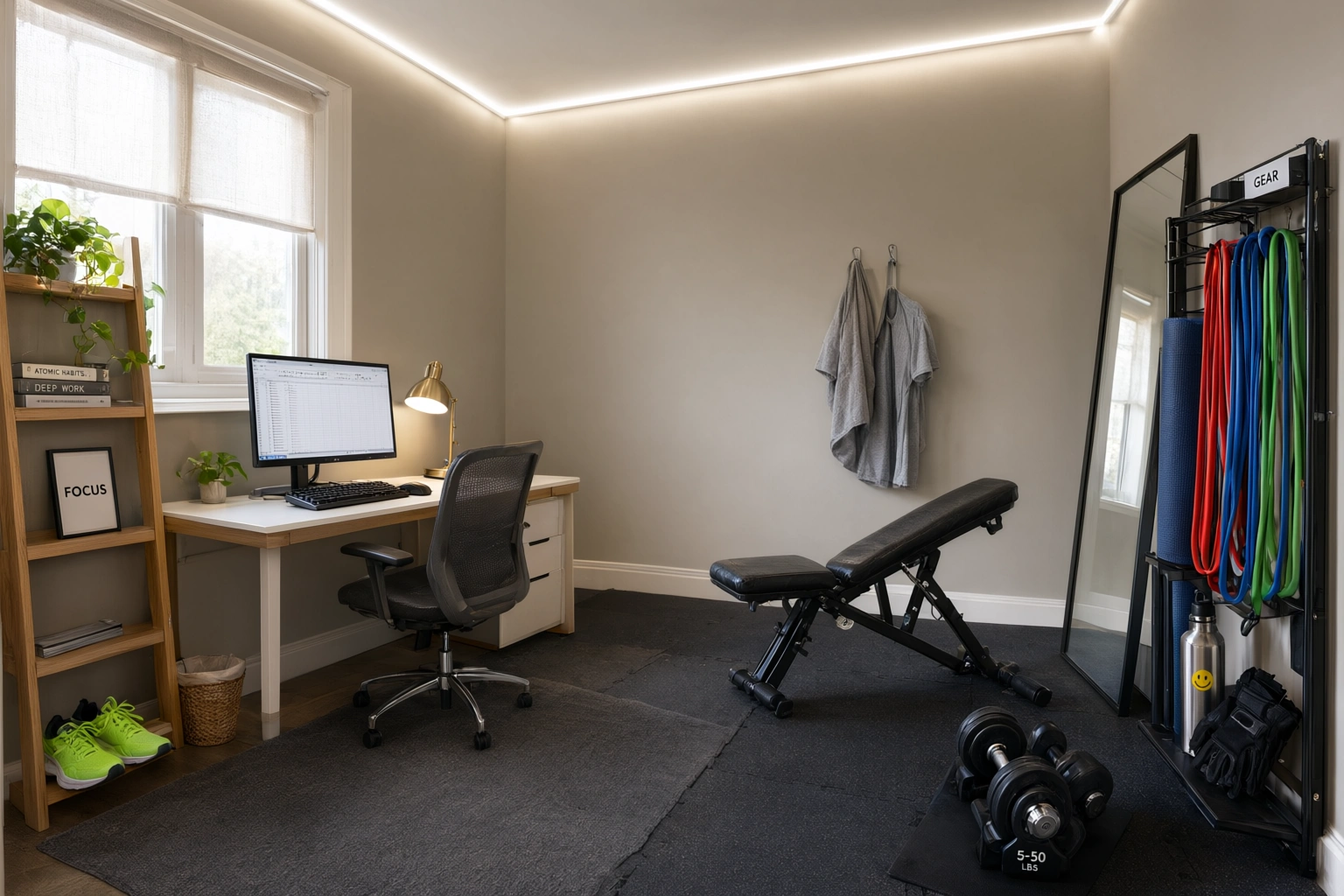
Renter-friendly office-to-gym setup
Best for: non-permanent changes
- removable flooring
- freestanding storage
- foldable bench
- compact weights
- bands and mat
- no wall-mounted systems unless allowed
This is usually the safest path if you need to restore the room later.
Larger room setup
Best for: more dedicated training
- rubber flooring
- rack or larger strength station
- bench
- dumbbells and plates
- mirror
- organized storage
- optional cardio machine
A larger room gives you more freedom, but the same rule applies: leave room to train, not just room to store equipment.
When to Consult a Professional
If you are considering wall-mounted storage, a heavy rack, mirror installation, or any setup that depends on structural support, it is wise to confirm the wall type and follow manufacturer guidance. If you are unsure about load limits, electrical changes, or whether a room can safely handle a heavier setup, a qualified contractor or installer can help you avoid expensive mistakes.
For general guidance on home exercise room planning, the National Strength and Conditioning Association and American Council on Exercise are useful references for training environment and equipment considerations. For broader home-improvement context, Energy Star can also be helpful when thinking about lighting and comfort in a small room.
A Practical Way to Get Started
If you want the simplest path, build the room in this order: floor protection, one versatile set of weights, one mat, storage, and then upgrades only after you know what you use consistently. That sequence keeps the room functional from day one and prevents a spare room from becoming an expensive storage problem.