
How to Create a Simple Home Gym

A simple home gym does not need to look like a commercial facility. For most beginners, the goal is much narrower: create a space that makes it easy to work out consistently with a small amount of equipment, a manageable budget, and minimal setup friction.
That usually means choosing one area, buying a few versatile basics, and making sure the setup is safe and convenient enough that you actually use it. If the room is awkward, the gear is bulky, or the floor gets damaged every time you train, the gym stops feeling practical.
Start With Your Goal and Available Space
Before buying anything, decide what the gym needs to support. A simple setup for strength training looks different from one built for cardio or general fitness.
A useful filter is to ask:
- Do I want to lift weights, do bodyweight workouts, or mix both?
- Do I need low-impact cardio, like walking or cycling?
- Will I use this space daily, or only a few times per week?
That answer shapes everything else. A beginner who wants full-body strength work may only need dumbbells, a bench, and a mat. Someone focused on general fitness might get more value from resistance bands, a jump rope, and floor space than from a large machine.
The other half of the decision is the space you already have. A spare room, garage, basement, or apartment corner can all work if the setup matches the area. The wrong approach is buying equipment first and trying to fit it in later.

Set a Realistic Starter Budget
A home gym budget should reflect your actual workout habits, not your idealized version of them. If you are just getting started, a basic setup can be built gradually instead of all at once.
Here is a practical way to think about it:
| Budget tier | Approximate budget range | What it usually supports | Typical first purchases | Space needs |
|---|---|---|---|---|
| Very small starter setup | About $50–$150 | General fitness, mobility, light strength work | Exercise mat, resistance bands, one pair of dumbbells or a light adjustable set | Small corner or open floor area |
| Mid-range starter setup | About $150–$500 | Strength training and broader exercise variety | Adjustable dumbbells or a few fixed pairs, bench, mat, bands | Spare room, garage section, or larger apartment area |
| Expanded simple setup | About $500–$1,500+ | Regular strength plus some cardio | Dumbbells, bench, pull-up bar, bike or jump rope, storage | Dedicated room, garage, or basement |
Those ranges are broad because equipment prices vary a lot by brand, weight range, and whether you buy new or used. Even so, they give beginners a much clearer planning target than a vague “small” or “moderate” budget.
A good rule for beginners is to buy the most useful items first and delay specialty equipment until the basics are being used regularly. That keeps the budget focused and reduces the chance of unnecessary purchases.
Choose the Best Location in Your Home
The best home gym location is the one that makes training easy to repeat. Convenience matters more than perfect conditions.
Spare room
A spare room is usually the simplest choice. It offers privacy, relatively easy storage, and a stable indoor environment. If the room has enough floor space, it can support strength work, stretching, and some cardio without much compromise.
Garage
A garage gives you flexibility and usually more room for equipment. It can work well for a more durable setup with rubber flooring, a rack, or storage shelves. The trade-off is temperature swings, dust, and sometimes less convenience in bad weather.
Apartment corner or living area
A corner in an apartment can still work if the equipment is compact and quiet. This setup usually favors foldable or portable items such as bands, a mat, and adjustable dumbbells. Noise, floor protection, and storage become more important here because the space may need to serve other purposes.
Basement
A basement can be a strong option if it stays dry and has enough ventilation. It often provides more room than an apartment, but you may need to think about moisture, lighting, and floor protection.
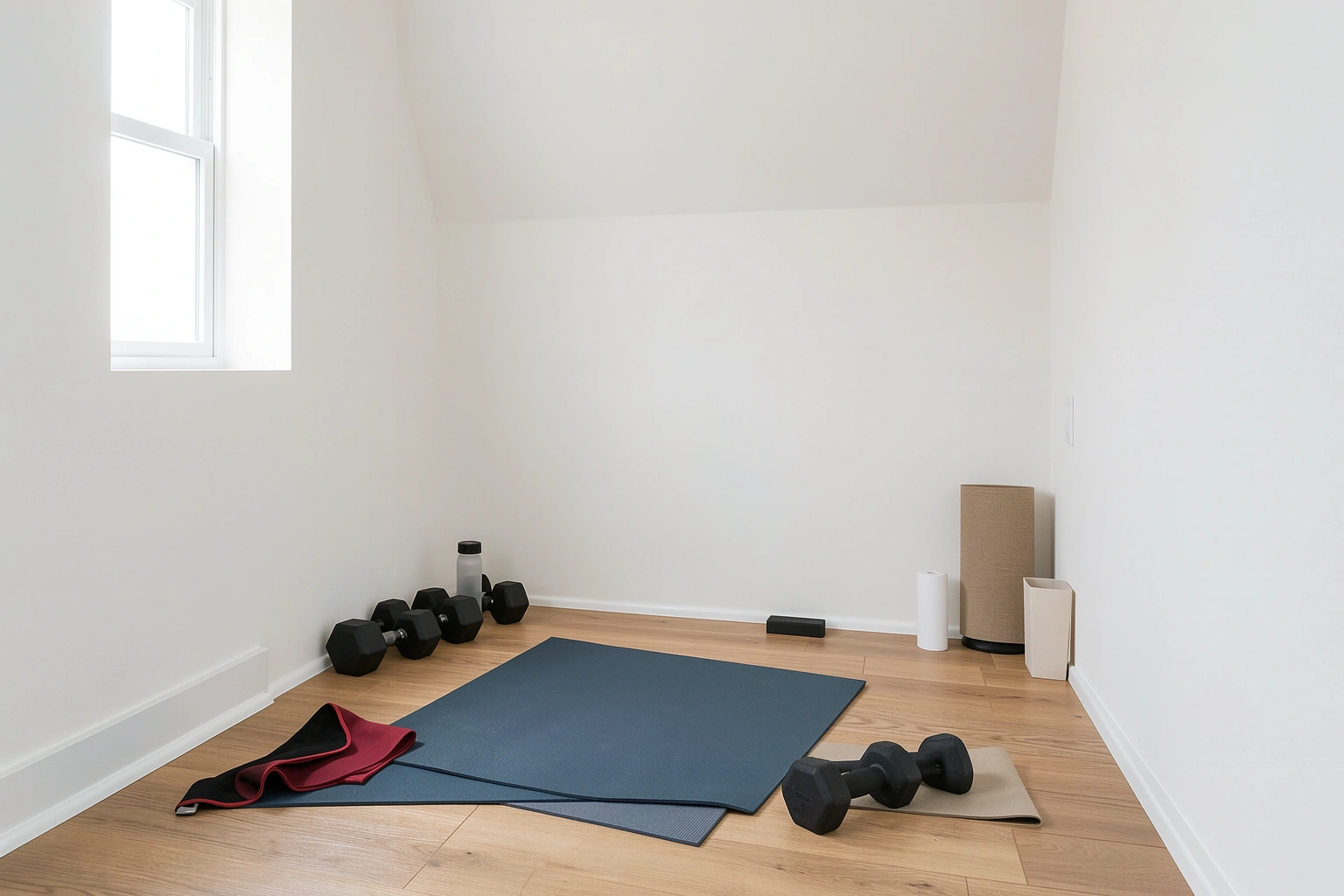
If you are deciding between these spaces, prioritize the one that is easiest to access and least disruptive to the rest of the household. A gym that is tucked away, noisy, or inconvenient tends to get used less.
For general home safety guidance, the Consumer Product Safety Commission is a useful place to check for equipment and household safety information, especially if you are working around heavy items, cords, or floor hazards.
Measure the Minimum Space You Actually Need
You do not need a huge room to make a basic gym work, but you do need enough room to move safely.
A simple way to plan it:
- Leave space for the exercise itself, not just the equipment footprint.
- Make sure you can get on and off a bench or mat without bumping walls.
- Check overhead clearance if you plan to press weights above your head or install a pull-up bar.
- Keep a clear path so you are not stepping around dumbbells, bands, or cords.
Here are practical space guidelines for common setups:
- Mat-only area: about 6 by 6 feet is a workable minimum for floor work, stretching, and bodyweight exercises. More room is better if you want to move side to side.
- Dumbbell area: about 6 by 8 feet usually gives enough space for a pair of dumbbells, a small storage rack, and room to lift safely.
- Dumbbell-plus-bench setup: about 8 by 10 feet is a comfortable target for bench work, rows, and movement around the bench.
- Cardio machine area: a treadmill often needs roughly 6 by 8 feet or more, while a stationary bike may fit in about 4 by 6 feet depending on the model. Always check the product dimensions before buying.
If you are using a bench, think about both the bench itself and the space around it. If you are using a cardio machine, remember that the machine is only part of the equation; you also need room to mount, dismount, and move around it safely.
When space is tight, it helps to choose equipment that can be stored vertically or folded away after use. That keeps the workout area functional without taking over the room.
Buy the Essential Starter Equipment First
A simple home gym works best when the first purchases cover the workouts you will actually do. The goal is not to own a lot of equipment. The goal is to make a usable setup as quickly as possible.
Core items for most beginners
- Exercise mat: Useful for floor work, stretching, mobility, and bodyweight exercises.
- Resistance bands: Compact, inexpensive, and effective for warm-ups, assistance work, and light strength training.
- Dumbbells: The most versatile strength tool for most beginners.
- Bench: Helpful for pressing, step-ups, supported rows, and seated exercises.
- Pull-up bar: Optional, but valuable if you want upper-body pulling work and have a safe place to install one.
A mat and resistance bands are often the easiest place to begin. If your budget allows for one strength item beyond that, dumbbells usually provide the best return because they support presses, rows, squats, lunges, and carries.
Buy in this order
For beginners, a simple purchase order keeps the setup from getting cluttered too early:
- Mat
- Resistance bands or a basic pair of dumbbells
- Adjustable dumbbells or heavier fixed dumbbells
- Bench
- Storage solution
- Cardio equipment, pull-up bar, or specialty items
That order works because it builds a usable foundation before adding larger or more specialized gear.
Must-have vs nice-to-have
Must-have items are the ones that help you train consistently right away. Nice-to-have items make the space more complete, but they are not necessary for a functional start.
Must-have for most simple setups:
– Mat
– One strength tool, such as dumbbells or bands
– Basic storage or a designated spot for equipment
Nice-to-have later:
– Bench
– Kettlebell
– Pull-up bar
– Cardio machine
– Mirror
– Extra accessories
If your space or budget is limited, the easiest mistake is buying accessories before covering the basics. A clean, usable setup beats a cluttered one every time.
Choose Equipment Based on Your Workout Style
The best starter equipment depends on what kind of workouts you want to do most often.
Strength-focused setup
If strength training is the priority, dumbbells are usually the first purchase to consider. They support a wide range of movements and are easy to scale as you get stronger. A bench adds even more exercise options, especially for pressing and supported rows.
A kettlebell can also be useful, but it is usually better as a later addition unless you already know you like kettlebell-style training.
Cardio-focused setup
If you want simple cardio at home, a jump rope, stationary bike, or treadmill are the main options.
A treadmill gives you walking and running variety, but it takes more space and usually costs more. A stationary bike is often more compact, quieter, and easier to fit into a shared home. For many beginners, the bike is the more practical choice if the main goal is steady cardio without much floor impact.
General fitness setup
If you want a little of everything, the most flexible setup usually includes:
– Dumbbells or adjustable dumbbells
– Resistance bands
– Mat
– Bench, if space allows
That combination supports strength, mobility, warm-ups, and short conditioning sessions without requiring a large footprint.
Compare Smart Equipment Trade-Offs
A simple home gym works best when each purchase earns its place. These are the biggest trade-offs beginners usually face.
Adjustable dumbbells vs fixed dumbbells
Adjustable dumbbells save space and can replace several pairs of fixed weights. They are useful when storage is limited or when you expect to increase resistance over time.
Fixed dumbbells are simpler to use and quicker to grab mid-workout. They can feel more durable in everyday use, but they take up more room and usually require more total pieces if you want a range of weights.
If you have limited space and want one main strength tool, adjustable dumbbells often make sense. If convenience matters more than storage, fixed dumbbells can be easier to live with.
Resistance bands vs free weights
Resistance bands are compact, portable, and useful for warm-ups, mobility, assistance exercises, and low-impact work. They are especially helpful in small spaces.
Free weights offer a more direct strength-training feel and are usually better for progressive overload in a broader range of movements.
Bands are excellent as a starter tool, but they do not replace dumbbells for everyone. A practical approach is to use bands as a supplement or as the first step before adding heavier resistance.
Treadmill vs stationary bike
A treadmill is better if you want walking or running indoors and do not mind the larger footprint. A stationary bike is often better for smaller homes, quieter workouts, and lower-impact cardio.
If your main goal is simply to move more consistently, the bike is often the easier choice to fit into a home environment.
Protect Floors and Set Up the Space Safely
Floor protection is not just about appearance. It helps reduce slipping, noise, and wear on the room.
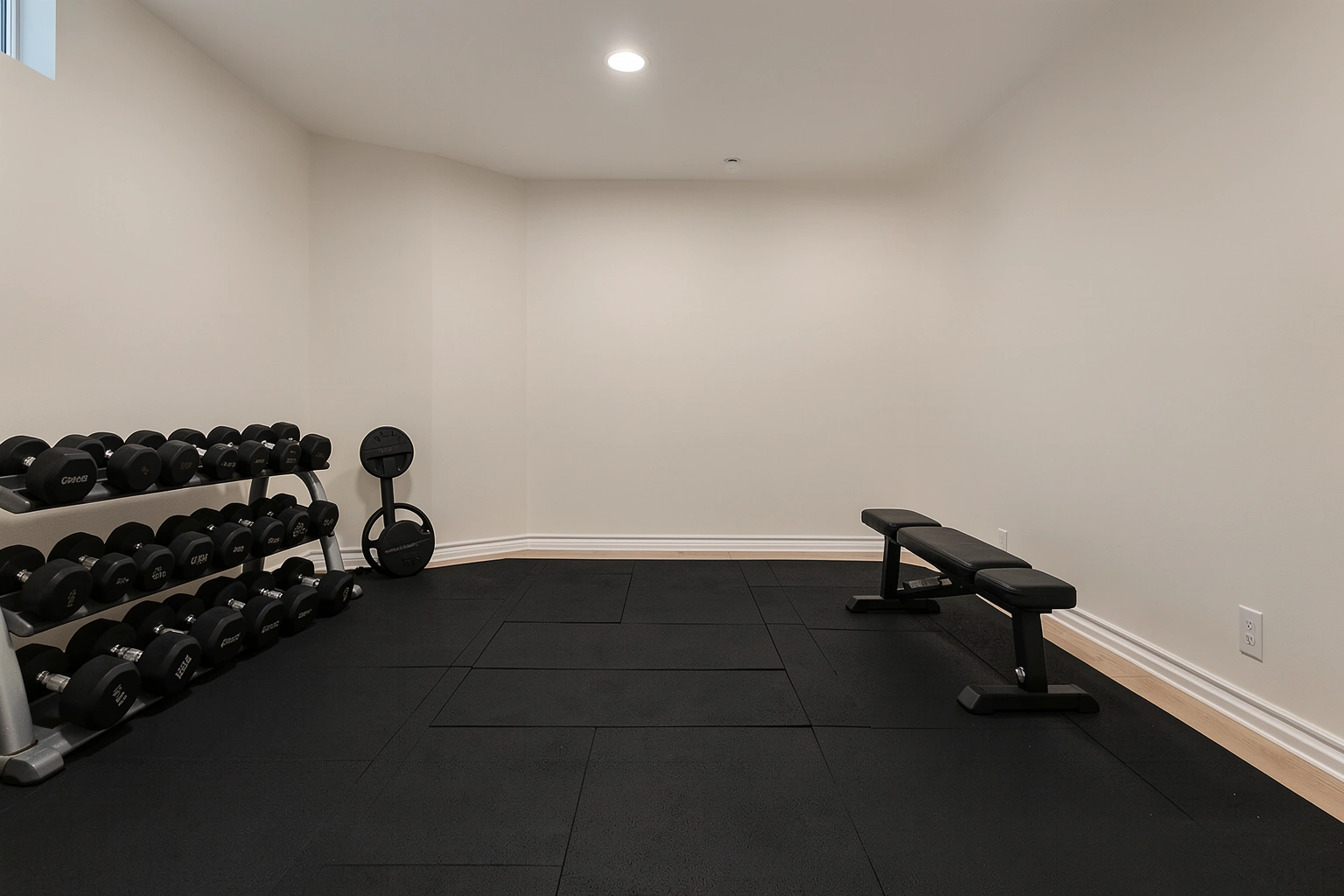
Rubber flooring or dense mats are commonly used under weights and cardio equipment because they can help protect the floor and create a more stable surface. For lighter setups, an exercise mat or interlocking floor tiles may be enough. If you are on an upper floor or in an apartment, floor protection becomes even more important because of vibration and noise.
Safety also comes down to placement:
– Keep weights away from doorways and walk paths.
– Leave enough room to lift without hitting walls or furniture.
– Check that the ceiling height works for overhead movements.
– Make sure machines sit level and stable.
– Follow the manufacturer’s instructions for assembly, weight limits, and anchoring.
For equipment with moving parts or load-bearing frames, the user manual matters. The American Council on Exercise also offers practical training guidance that can help beginners choose exercises and use equipment more safely.
If you are unsure whether a piece of equipment is appropriate for your space or body size, check the product specifications before buying. That is especially important for benches, racks, pull-up bars, and cardio machines.
Organize Storage So the Gym Stays Easy to Use
A home gym works better when it is easy to reset after each workout. If equipment is scattered around the room, the space becomes annoying to use and harder to keep safe.
Simple storage ideas include:
– A small rack or shelf for dumbbells
– A basket or wall hook for bands
– A corner stand for a mat
– A dedicated bin for accessories like handles, clips, or jump ropes
The best storage setup is the one that matches how often you train. If you use the equipment daily, keep it visible and easy to reach. If you use it less often, a closed shelf or cabinet may help the room stay tidy.
Avoid stacking equipment in unstable piles or leaning heavier items against walls. That creates clutter and can increase the chance of damage or tipping.
Simple Home Gym Setups by Budget Tier
Here are a few realistic starter approaches that keep the setup simple.
Small starter setup
Approximate budget: about $50–$150
This version works well for mobility, bodyweight training, and light strength work:
– Exercise mat
– Resistance bands
– One pair of dumbbells or a compact adjustable set
This is a good fit for an apartment corner, bedroom nook, or multi-use space. A setup like this usually works best in about 6 by 6 feet of open floor space.
Strength-first setup
Approximate budget: about $150–$500
This version is better if you want a more complete lifting routine:
– Adjustable dumbbells or a few fixed pairs
– Bench
– Mat
– Optional pull-up bar
This setup often fits best in a spare room, garage, or basement area with enough clearance around the bench. A room area of about 8 by 10 feet is a practical target for comfort and safe movement.
Cardio and general fitness setup
Approximate budget: about $500–$1,500+
This version is useful if your main goal is consistency and low-impact movement:
– Stationary bike or jump rope
– Mat
– Resistance bands
– Storage basket or shelf
If you choose a machine, this setup is usually easiest in a dedicated room, garage, or basement. A stationary bike can often fit in about 4 by 6 feet, while a treadmill usually needs closer to 6 by 8 feet or more.
Small-apartment example
If you live in a small apartment, a practical setup might include:
– 1 exercise mat
– 1 set of loop or tube resistance bands
– 1 pair of adjustable dumbbells
– 1 foldable storage bin or under-bed container
– 1 wall hook or slim corner stand for the mat
Store the dumbbells under a console table, bed, or in a closet corner. Keep bands in the storage bin so they do not tangle, and roll the mat vertically against a wall or tuck it beside a dresser. This kind of setup stays compact, quiet, and easy to clear away when the room needs to serve another purpose.
How to Expand Your Home Gym Over Time
The smartest way to grow a home gym is to add equipment only after you know what you actually use.
A practical order for expansion is:
1. Add the item that removes the biggest limitation in your routine.
2. Upgrade the piece you use most often.
3. Buy specialty gear only if it supports a workout you already do regularly.
For example, if you are using dumbbells constantly and outgrowing the weight range, that is a clear signal to upgrade. If you keep skipping cardio because your only option is a jump rope and you want something lower impact, a bike may be the next useful addition.
This approach prevents the common problem of buying a full setup too early and leaving half of it unused.
Beginner Workouts You Can Do With a Simple Setup
A basic home gym can support a lot more than many beginners expect.
With dumbbells, bands, and a mat, you can do:
– Squats
– Lunges
– Romanian deadlifts
– Floor presses
– Rows
– Shoulder presses
– Glute bridges
– Core work
– Mobility and stretching sessions
With a bench, you can add:
– Bench-supported presses
– Step-ups
– Incline or seated work
– More comfortable seated strength exercises
With a pull-up bar, you can add:
– Pull-ups or assisted pull-ups
– Hanging knee raises
– Grip and upper-back work
With cardio equipment, you can build:
– Low-impact steady-state sessions
– Warm-ups before strength work
– Short conditioning workouts on busy days
The point is not to recreate a commercial gym. The point is to build a setup that removes excuses and supports repeatable workouts.
When to Consult a Professional
If you have a recent injury, chronic pain, balance concerns, or a medical condition that affects exercise tolerance, it is wise to speak with a qualified healthcare professional before starting a new workout routine. The same applies if you are unsure whether a particular movement, machine, or setup is appropriate for your situation.
For the equipment side, consult the manufacturer’s instructions if you are installing a pull-up bar, rack, bench, or any machine that needs assembly, anchoring, or specific floor support.
Final Checklist Before You Buy
Before purchasing anything, make sure you can answer these questions clearly:
- What workouts will this space support?
- Where will the equipment live when not in use?
- Is the floor protected?
- Is there enough room to move safely?
- Which items will I use weekly, not just occasionally?
- Does this setup fit my budget without forcing unnecessary upgrades?
If the answer is yes to those questions, you are ready to build a simple home gym that is practical, safe, and easy to maintain.