
How to Create a Simple Home Gym

A simple home gym does not need to look like a commercial fitness center. For most beginners, the best setup is a small, versatile space built around a few items you will actually use: a floor mat, resistance bands, a pair of dumbbells or adjustable dumbbells, and maybe a bench later. That is enough to cover strength work, mobility, and basic conditioning without filling a room with equipment you may not need.
The goal is not to buy everything at once. The goal is to build a setup that fits your space, supports your routine, and stays easy to use. If the area feels crowded, noisy, or awkward to move in, you are less likely to train consistently. A simple layout with the right essentials usually works better than a larger setup with too many extras.
Choose the Right Space First
Before buying anything, decide where the workout area will live. That choice affects what equipment makes sense, how much noise you can make, and how much floor clearance you need.
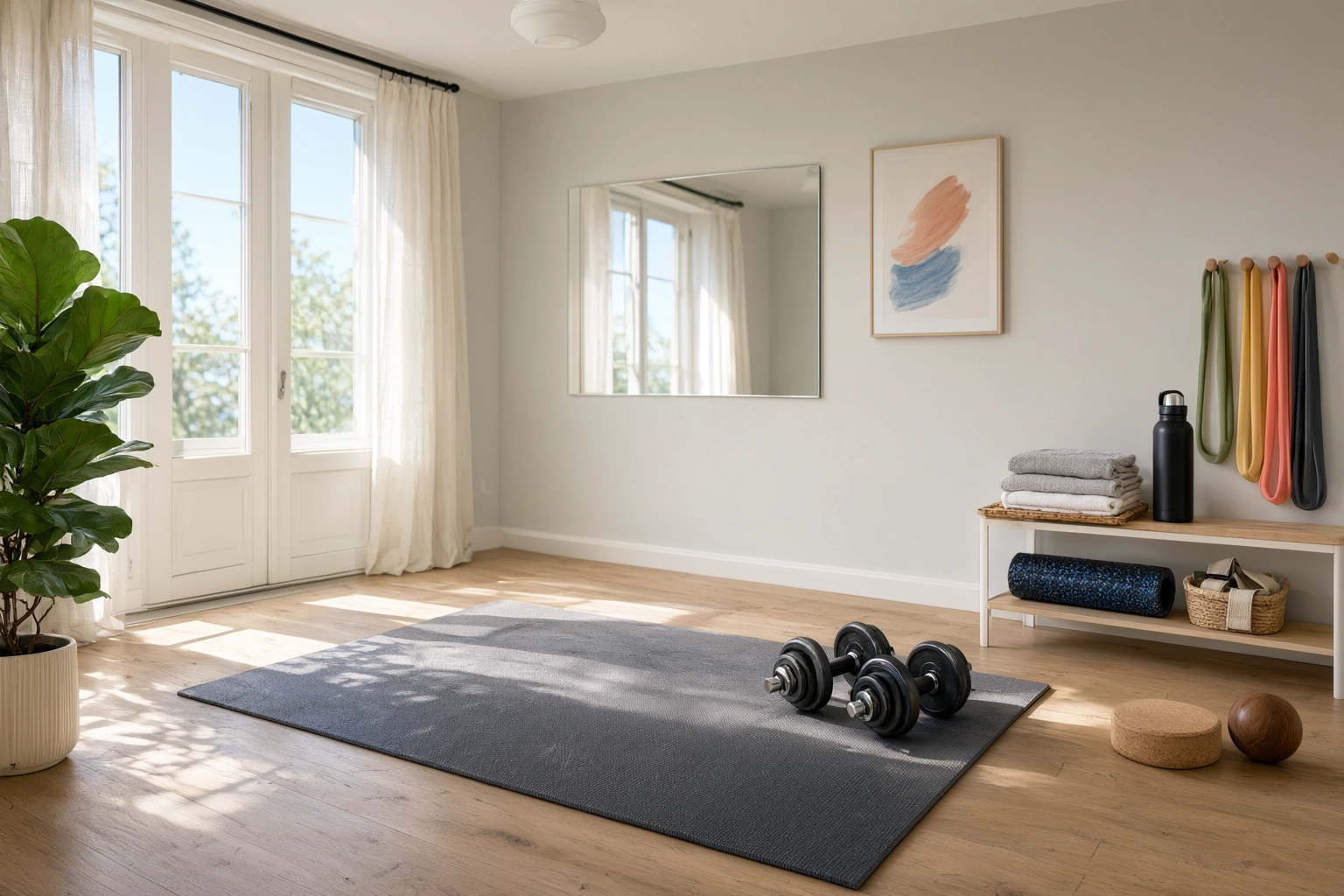
A corner of a bedroom, a spare room, a garage, or even part of a living room can work. The key is enough open floor for movement. You should be able to lie down fully on a mat, extend your arms, and step side to side without hitting furniture. If you plan to lift weights, leave extra room around the area so you are not constantly moving around obstacles.
A practical way to plan the layout is to measure the room and map it to scale before buying equipment. One useful approach is to draw or digitally map the room, then place your equipment and existing furniture into that layout so you can see how much space remains for movement and floor exercises. That keeps you from guessing and helps you avoid buying something too large for the area.
For a small apartment or spare room, a beginner should usually aim for at least about 30 to 40 square feet of clear workout space, which is roughly enough for a mat and a little room to move around it. More space is better, but that minimum can work for a simple setup.
For small apartments, portability matters. Equipment that can be stored away when not in use, such as resistance bands, yoga mats, and adjustable dumbbells, is often a better fit than bulky machines. If you live in a shared building, quieter options can also be more practical than gear that involves jumping or loud impact. A stationary bike or a rowing machine with magnetic resistance may be a better fit in some apartments, especially if noise is a concern.
[IMAGE_PLACEHOLDER_1]
If you want a visual planning step before you buy, create a simple inspiration board and compare it with your actual room measurements. That makes it easier to separate what looks nice from what will actually fit.
For more on space planning and small-room setup ideas, see this budget home gym planning guide and apartment-friendly equipment suggestions.
Set a Realistic Budget Before You Shop
Budget is the biggest filter for a beginner home gym. If you do not set a limit first, it is easy to drift toward buying a bench, rack, cardio machine, and accessories before you have covered the basics.
A simple way to think about budget is by tiers:
| Budget level | Approximate starter budget | What it can cover | Best for |
|---|---|---|---|
| Very low budget | About $25 to $75 | Mat, resistance bands, bodyweight exercises | Tiny spaces, first-time starters |
| Low budget | About $75 to $200 | Mat, bands, one pair of dumbbells or adjustable dumbbells | General fitness and basic strength |
| Moderate budget | About $200 to $500 | Dumbbells, bench, mat, bands, optional pull-up bar | A spare room or dedicated corner |
| Higher budget | $500+ | More storage, more weights, possibly cardio equipment | People who already train regularly |
The best starting budget is the one that matches your current habits. If you are still figuring out whether you will train three times a week, a minimal setup is often the smarter move. If you already know you prefer strength training, it may make more sense to spend more on weights and less on cardio gear.
Buying used equipment can stretch your budget further, especially for items like dumbbells, benches, and racks. That said, inspect used gear carefully for stability, damage, rust, or worn parts. For simple accessories like bands or mats, new gear may be the safer buy because wear is harder to judge.
Build Your Starter Equipment List in Priority Order
A beginner home gym works best when equipment is ranked by usefulness, not by how impressive it looks. If you only buy one or two items at first, choose pieces that support the widest range of exercises.
1. Exercise mat
A mat is the easiest first purchase. It gives you a defined workout area, protects your floor, and makes floor exercises more comfortable. It is especially useful if your plan includes stretching, core work, yoga, or bodyweight training.
2. Resistance bands
Bands are compact, inexpensive, and easy to store. They are useful for warm-ups, glute work, assisted pulls, and light resistance training. In a very small space, they can do more than most people expect because they take almost no room.
3. Dumbbells or adjustable dumbbells
If your goal includes strength training, dumbbells are usually the next step. Fixed dumbbells are simple and durable, but they take up more storage space if you need multiple weights. Adjustable dumbbells save space because one pair can replace several sets, which makes them especially appealing for apartments or small spare rooms.
4. Bench
A bench adds exercise variety. It helps with presses, step-ups, seated work, and supported movements. If your budget is tight, wait on the bench until you know you will use it regularly. A flat bench is enough for most beginners.
5. Pull-up bar or kettlebell
These are useful upgrades, but not required at the start. A pull-up bar is helpful if you want to train your upper body with bodyweight movements. A kettlebell can add variety for swings, goblet squats, and carries, but it overlaps somewhat with dumbbell training.
A beginner-friendly setup can also begin with bodyweight exercises alone. Push-ups, squats, lunges, planks, and glute bridges require almost no equipment and can still build a solid routine. If your budget is very limited, this is a legitimate place to start.
For a broader beginner equipment framework, Verve Fitness outlines a basic home gym list that includes flooring, a bench, a barbell setup, and accessories. That is more than many beginners need, but it shows how a home gym can expand once the basics are working.
Compare the Best Starter Equipment Choices
Some beginner decisions come down to trade-offs. The right answer is usually the one that fits your space, storage, and training style.
Adjustable dumbbells vs. fixed dumbbells
Adjustable dumbbells are usually better for small spaces because they replace multiple pairs of weights. The trade-off is that they can be more expensive upfront and may feel less convenient if you like changing weights quickly between sets.
Fixed dumbbells are simpler and often sturdier. They are a good fit if you already know your preferred weights and have enough storage. They are less flexible in a small apartment because several pairs can take up a lot of space.
Resistance bands vs. free weights
Resistance bands are lighter, cheaper, and easier to store. They work well for mobility, warm-ups, and lighter resistance. Free weights are better if you want more straightforward strength progression and a more familiar lifting feel.
Bands are excellent for minimal setups, but they do not replace heavy lifting as your strength improves. Free weights give you more room to progress, which makes them a better long-term foundation if strength is a main goal.
Bodyweight training vs. equipment-based training
Bodyweight training is the simplest entry point. It costs almost nothing and works in very small spaces. The downside is that progression can become limited unless you add harder variations or extra resistance.
Equipment-based training gives you more options for load and progression. It is usually the better path if you want to build strength steadily over time. A balanced approach often works best: use bodyweight exercises as the base and add a few tools to increase resistance when needed.
Match Your Setup to Your Main Fitness Goal
A simple home gym should reflect what you actually plan to do.
If your goal is strength
Prioritize dumbbells, adjustable dumbbells, a bench, and eventually a pull-up bar or more weight options. Strength-focused setups benefit from gear that allows steady progression. If you only buy one major item, dumbbells usually provide the best mix of versatility and space efficiency.
If your goal is cardio
You may not need much equipment at all. A mat, a jump rope if noise is not an issue, or a compact machine can be enough. In apartments, quieter equipment may be a better choice than high-impact options. Stationary bikes and rowing machines with magnetic resistance are often considered for apartment use because they can be quieter than some other cardio setups.
If your goal is general fitness
Choose a mixed setup: mat, bands, dumbbells, and maybe a bench later. This gives you enough variety for strength, mobility, and conditioning without committing to a large footprint. For most beginners, general fitness is the easiest place to start because it supports a wide range of workouts.
Make the Space Safe and Comfortable
Safety in a home gym is mostly about surfaces, spacing, and stability. You do not need a complicated setup, but you do need a stable one.
Rubber flooring or floor mats help protect the surface underneath and can reduce slipping. They also make the area feel more like a dedicated workout space. If you are training on hard floors, this matters even more for comfort and noise control.
Keep enough open space around your workout zone for getting on and off the floor, lifting, and moving between exercises. Crowding the area with too many items creates tripping hazards and makes workouts feel cluttered.
Make sure any bench, pull-up bar, or other mounted equipment is secure before use. If something wobbles, shifts, or feels unstable, stop and fix the issue before training.
For shared buildings or upstairs rooms, noise matters too. Dropped weights, bouncing accessories, and impact exercises can carry more than you expect. Softer flooring, controlled movements, and quieter equipment choices can make a big difference.
If you want a general reference point for exercise safety and home workout planning, the American Council on Exercise and Mayo Clinic both offer practical fitness guidance that can help you think through safe exercise habits.
Organize and Store Equipment Without Clutter
A home gym is easier to use when everything has a place. If equipment ends up scattered around the room, the space stops feeling inviting.
Use a bin, basket, or shelf for small items like bands, handles, straps, and jump ropes. Keep the mat rolled or folded in one consistent spot. If you have dumbbells, store them where they will not become a walking hazard.
In small rooms, vertical storage can help. Wall hooks, a narrow rack, or a shelf can keep the floor open. The main goal is not fancy organization; it is making sure you can put the room back into workout mode quickly.
If you share the space with other household activities, choose storage that makes cleanup easy. A setup that takes ten minutes to assemble often gets used less than one that takes one minute to clear.
[IMAGE_PLACEHOLDER_2]
Start Minimal and Upgrade Over Time
The cleanest path is usually the one that begins with a minimal setup and expands only after you know what you use.
A practical upgrade path might look like this:
- Begin with a mat and resistance bands.
- Add dumbbells or adjustable dumbbells once your routine feels consistent.
- Add a bench if you want more exercise variety.
- Add a pull-up bar, kettlebell, or cardio equipment only if your workouts call for them.
This approach keeps your budget under control and reduces the chance of buying gear that sits unused. It also helps you learn which exercises you enjoy before you commit to a larger setup.
A good rule is to let your workouts guide the next purchase. If you keep wishing you had more resistance, add weights. If you keep doing floor work and mobility sessions, a better mat or more storage may be a smarter upgrade than another machine.
Common Mistakes to Avoid
The easiest mistakes to make are also the most expensive.
One common problem is buying too much too soon. A home gym does not need to be complete on day one. If your space is small, too much equipment can make it harder to train, not easier.
Another mistake is choosing bulky machines before covering the basics. Machines can be useful, but they are rarely the best first purchase for a beginner with limited space or budget.
Skipping floor protection is another issue. Even a simple mat can improve comfort, reduce slipping, and protect the room underneath.
Finally, many beginners underestimate storage. If gear has no home, it ends up in the way. That makes the space feel messy and discourages regular use.
When to Consult a Professional
If you are unsure whether a wall-mounted bar, heavy rack, or other secured equipment can be installed safely in your space, consult a qualified installer or contractor. If you have pain, a recent injury, or a medical condition that affects exercise tolerance, ask a healthcare professional or licensed trainer for guidance before starting a new routine.
A Simple Home Gym Can Be Enough
A beginner home gym works best when it is practical, not impressive. If you choose the right space, buy only the essentials, and match the equipment to your goals, you can build a setup that supports consistent exercise without overspending. The best version is the one you can use regularly.
FAQs
How much space do I need for a simple home gym?
You only need enough room to lie down on a mat, move your arms freely, and step around safely. A corner or spare room can work if it is clear of furniture and clutter.
What should I buy first for a home gym?
For most beginners, a mat and resistance bands are the best first purchases. If strength training is your main goal, add dumbbells or adjustable dumbbells next.
Can I make a home gym in an apartment?
Yes. Compact, storable equipment is usually the best fit. Resistance bands, mats, and adjustable dumbbells are easier to manage in smaller spaces than bulky machines.
Is bodyweight training enough to start?
Yes. Bodyweight exercises can build a useful routine on their own, especially if your budget is tight. You can always add equipment later when you want more resistance or variety.
Should I buy new or used equipment?
Used equipment can be a smart budget option for dumbbells, benches, and some racks. For items that wear out or depend on elasticity, like bands, new gear is often the safer choice.
What can I skip at the beginning?
You can usually skip large cardio machines, multiple sets of dumbbells, and specialty accessories until you know you will use them. Focus on the items that support your most common workouts first.
How do I keep a small gym from feeling cluttered?
Give every item a storage spot and keep the floor as open as possible. In a small room, fewer pieces of equipment almost always work better than a crowded setup.

What is the best upgrade after the basics?
That depends on your routine, but a bench is often the most useful next step for strength training. If you prefer cardio or mobility work, storage or flooring may be the better upgrade.