
Home Gym Setup for Muscle Building: A Practical Guide for Small Spaces and Real Budgets

A home gym works for muscle gain when it supports three things: progressive overload, enough exercise variety to train the whole body, and a setup you can actually use consistently. That sounds simple, but it is where many home setups fail. People buy a machine they rarely use, fill a room with equipment that overlaps, or skip essentials like a bench and storage.
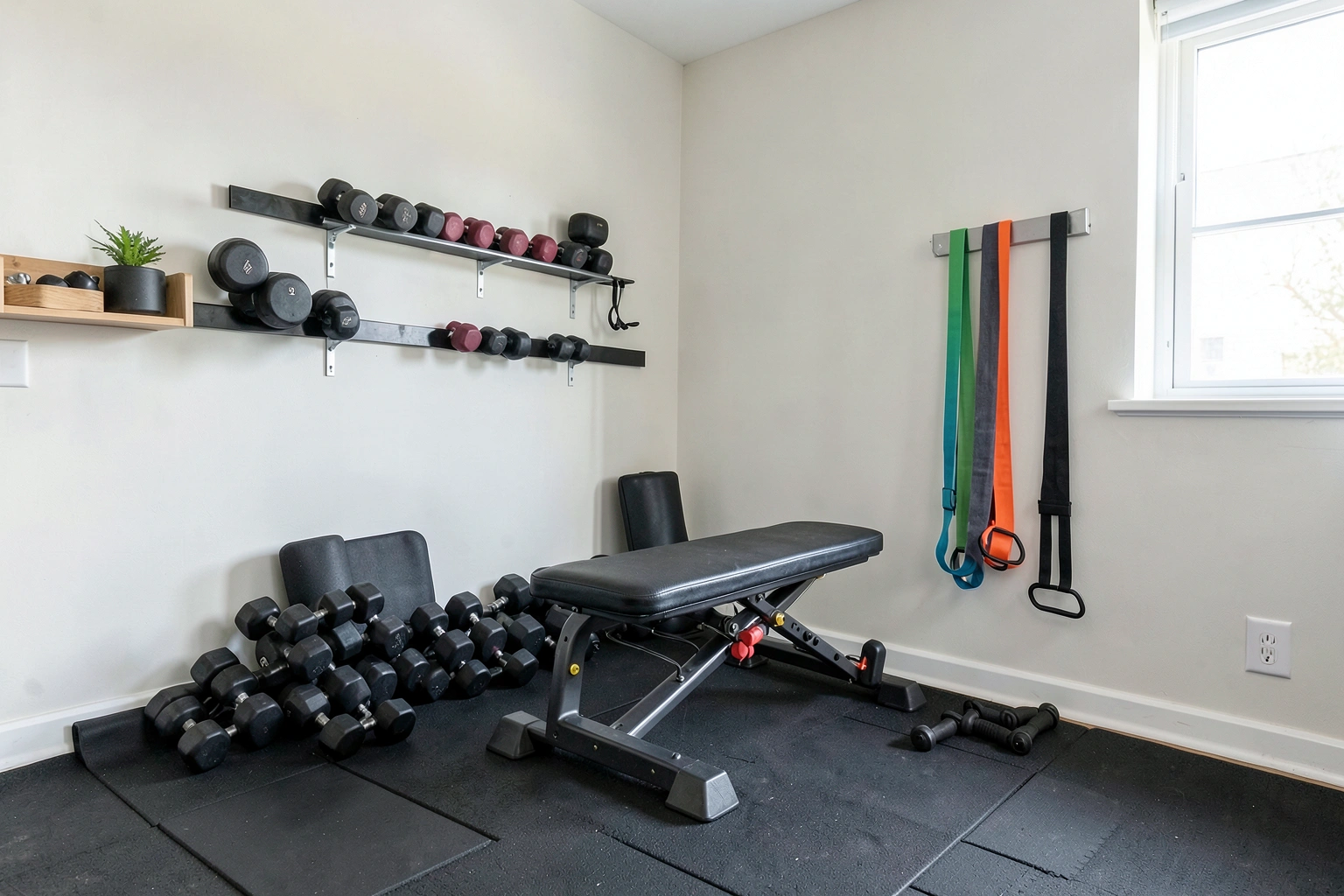
This guide focuses on building a home gym setup for muscle building that fits real-life constraints: apartments, garages, spare rooms, shared homes, and budgets that cannot absorb every piece of equipment at once. The goal is not to recreate a commercial gym. The goal is to build a compact, effective training space that lets you keep adding reps, load, or difficulty over time.
What a Muscle-Building Home Gym Needs to Do
For hypertrophy, your setup needs to cover the major movement patterns:
- Horizontal and vertical pushing
- Horizontal and vertical pulling
- Squatting
- Hip hinging
- Carrying
- Core training
That does not mean you need a separate machine for each pattern. It means your equipment should let you train those patterns hard enough, often enough, and safely enough to progress.
A simple home setup can build muscle if it supports:
– A stable pressing surface
– A way to pull with resistance
– Enough load for legs and hips
– A clear path to make exercises harder over time
A power rack, adjustable dumbbells, a barbell, or a cable station can all help with this. What matters most is whether the setup helps you train consistently and keep progressing.
For general hypertrophy principles, the American College of Sports Medicine and NHS guidance on strength exercise both support regular resistance training as part of a muscle-building routine. You do not need a commercial gym for that. You do need a plan.
How to Choose Your Setup Based on Space, Budget, and Training Style
Before buying equipment, match the setup to your room and training style.
If your space is very limited
Choose versatile equipment that folds, stacks, or stores easily. Adjustable dumbbells, a compact bench, resistance bands, and a pull-up bar cover a surprising amount of training.
This is the best fit for:
– Apartments
– Bedrooms or spare rooms
– Shared spaces where equipment must be put away
If you have a garage or dedicated room
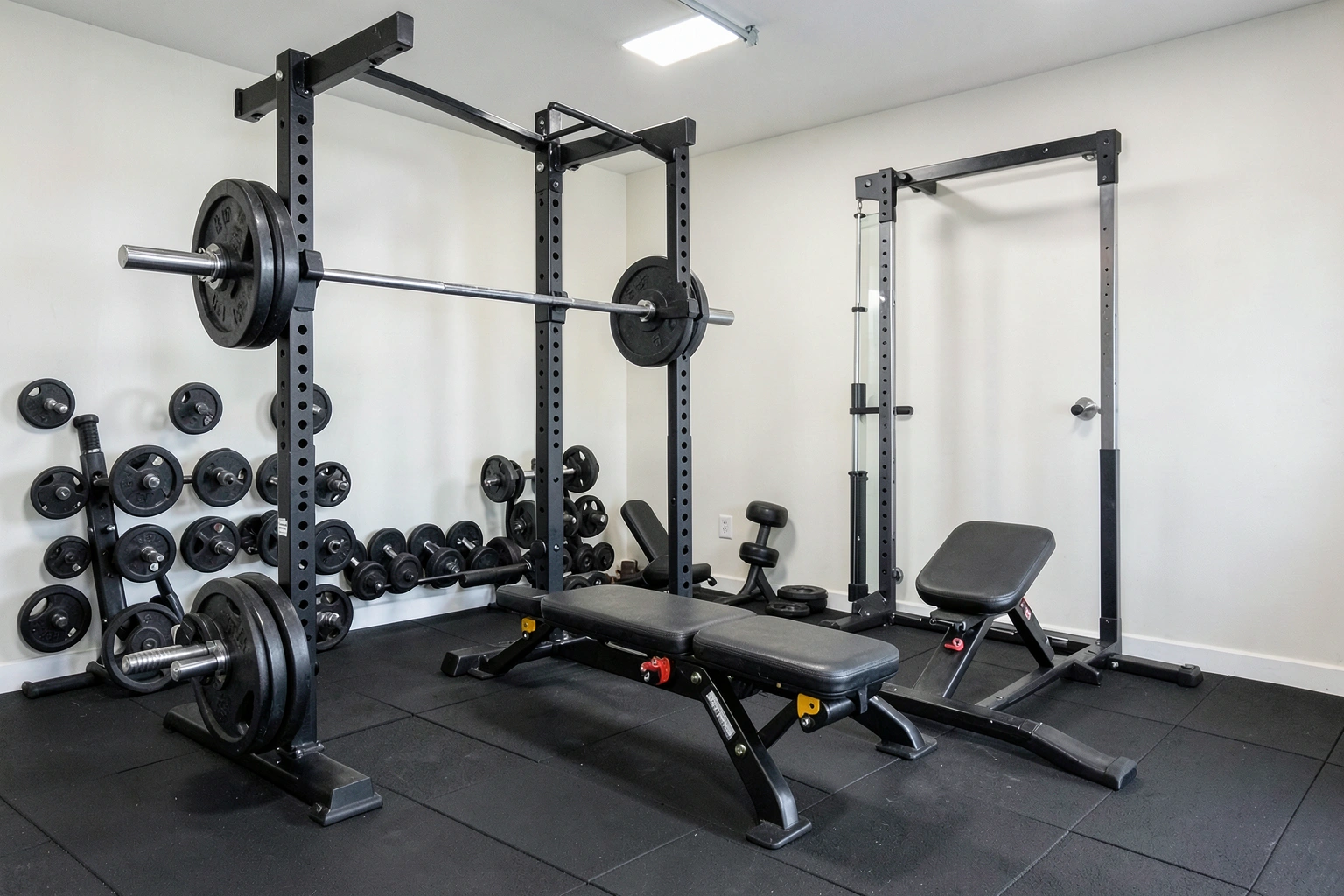
You can build around a rack, barbell, plates, and bench. That setup gives you the most room for progression and the broadest exercise selection.
This works well when:
– Noise is less of a concern
– You can leave equipment set up
– You want a long-term muscle-building base
If your budget is tight
Buy for coverage, not novelty. A few tools that do many jobs are better than one large machine that only handles a narrow slice of training.
A practical rule:
1. Buy the item that unlocks the most exercises
2. Add the item that improves progression
3. Only then add convenience pieces
If you prefer simple workouts
Dumbbells and a bench are often enough. If you like structured barbell training, a rack and barbell become more valuable. If you want machine-like stability and isolation, cables may eventually be worth it.
Hybrid vs machine-heavy setups
For most readers, a hybrid free-weight setup is the better first choice. Dumbbells, a bench, and later a rack or barbell usually cover more movement patterns per dollar than machine-heavy buying. Machines become more attractive when you already have the basics covered, want more isolation work, or are building a dedicated room with extra space.

Minimum Home Gym Setup for Muscle Gain
You can build muscle with a minimal setup if it still allows progressive overload and enough exercise variety.
The smallest practical setup
A strong minimum setup usually includes:
– Adjustable dumbbells or a pair of fixed dumbbells with enough load
– An adjustable bench
– Resistance bands
– A pull-up bar or a sturdy place to anchor pulling work
That combination can cover:
– Dumbbell bench press
– Overhead press
– Rows
– Goblet squats
– Split squats
– Romanian deadlifts
– Pull-ups or assisted pull-down variations with bands
– Core work such as planks, dead bugs, and loaded carries
What this setup does well
- Saves space
- Works in apartments or spare rooms
- Costs less than a full rack-based setup
- Supports full-body training
What it limits
- Heavy lower-body loading is harder
- Very strong lifters may outgrow the dumbbell load range
- Some exercises are less stable than barbell or machine versions
Best Value Equipment Priority Order
If you are building from zero, buy in this order.
1. Adjustable dumbbells or a useful dumbbell range
Best for:
– Pressing
– Rows
– Split squats
– Romanian deadlifts
– Lateral raises
– Curl and triceps work
This is the fastest way to cover the most movement patterns in a small space. Adjustable dumbbells usually make more sense than buying many fixed pairs unless you already know you need a large dumbbell collection.
New vs used: Adjustable dumbbells are often worth buying new if the mechanism is complex or if replacement parts matter. Fixed dumbbells are often a good used purchase if the condition is solid and the price is meaningfully lower.
2. Adjustable bench
Best for:
– Flat pressing
– Incline pressing
– Seated shoulder work
– Supported rows
– Chest-supported accessory work
A bench turns dumbbells into a much more complete muscle-building tool. If you are choosing between a bench and a rack on a very tight budget, the bench usually comes first unless your main goal is barbell squats and bench press from day one.
3. Pull-up bar or pull-up solution
Best for:
– Vertical pulling
– Lat and upper-back work
– Assisted bodyweight pulling
– Hanging core work
Vertical pulling is easy to neglect at home. A pull-up bar gives you a strong back and arm training option without taking much space.
4. Resistance bands
Best for:
– Warm-ups
– Assisted pull-ups
– Face pulls
– Triceps work
– Light accessory training
Bands are useful, but they should support training rather than replace loadable equipment.
5. Barbell, plates, and rack
Best for:
– Squats
– Bench press
– Overhead press
– Barbell rows
– Deadlift variations
This becomes the next major step if you have the space and want a more scalable long-term setup. If you plan to train barbell squats and bench press regularly, the rack should come before a cable machine and usually before most specialty accessories. In a barbell-focused setup, the rack is often more important than adding a second bench or extra gadgets.
6. Cable machine or functional trainer
Best for:
– Flyes
– Triceps pressdowns
– Lat pulldowns
– Face pulls
– Cable rows
– Constant-tension accessory work
This is a convenience and exercise-quality upgrade, not a first purchase. A cable machine is worth considering when you already have dumbbells or a barbell base and want more controlled isolation work. It is usually not the best first dollar spent in a small or starter gym.
7. Specialty accessories
Best for:
– Landmine work
– Dip variations
– Belt squat setups
– Other niche movement options
These can help later, but they are not the foundation.
What not to buy first
Delay these until the basics are covered:
– Large selectorized machines
– Specialty isolation machines
– Multiple benches
– Extra grips and handles that duplicate the same movement
– Decorative storage or novelty attachments
– Expensive cardio equipment if muscle gain is the main goal
Budget Tiers: What to Buy First and What It Costs
These are rough example bundles, not fixed prices.
Starter budget: about $200 to $500
Best for:
– Apartments
– First-time buyers
– Full-body dumbbell training
Example bundle:
– Adjustable dumbbells or a basic used dumbbell pair
– Adjustable bench
– Resistance bands
– Floor mats
Movement patterns covered:
– Push: dumbbell press, overhead press
– Pull: rows, band pull-aparts
– Squat: goblet squats, split squats
– Hinge: Romanian deadlifts
– Core: planks, dead bugs, carries
Approximate total cost:
– Lower end if buying used
– Higher end if buying new adjustable dumbbells
Mid-range budget: about $600 to $1,500
Best for:
– Spare rooms
– Small garages
– People who want a more complete long-term setup
Example bundle:
– Adjustable dumbbells or a wider dumbbell range
– Adjustable bench
– Pull-up bar
– Rack or half rack
– Barbell and plates
– Flooring mats
Movement patterns covered:
– Push: dumbbells, barbell bench, overhead press
– Pull: rows, pull-ups
– Squat: rack-supported squats, split squats
– Hinge: deadlifts, Romanian deadlifts
– Core: hanging work, carries, bracing drills
Approximate total cost:
– Usually higher if most items are bought new
– Often lower if rack, plates, or barbell are bought used
Premium budget: about $1,500 to $4,000+
Best for:
– Dedicated garages
– Serious long-term home gyms
– People who want both compound lifts and more isolation work
Example bundle:
– Power rack
– Barbell
– Full plate set
– Adjustable bench
– Adjustable dumbbells or fixed dumbbell range
– Cable machine or functional trainer
– Flooring/platform
– Storage
Movement patterns covered:
– Push: bench, incline work, cables, dumbbells
– Pull: pull-ups, rows, pulldowns, cable rows
– Squat: rack squats, split squats, goblet work
– Hinge: deadlifts, RDLs, hip thrusts
– Carry: dumbbell carries
– Core: cable anti-rotation, hanging work, loaded carries
Approximate total cost:
– Varies widely based on brand, new vs used, and how much cable equipment you add
Dumbbells vs Barbell vs Power Rack vs Machines
Each option has a role. The question is which one gives you the best return for your space and budget.
| Equipment | Strengths for muscle building | Trade-offs | Best use case |
|---|---|---|---|
| Adjustable dumbbells | Very versatile, compact, easy to store | Load ceiling can be limiting | Small spaces, apartments, all-purpose training |
| Barbell | Efficient for loading lower body and compound lifts | Needs plates, space, and usually a rack | Garage gyms, long-term strength and hypertrophy |
| Power rack | Improves safety and supports squats, presses, pull-ups | Takes space and costs more than dumbbells alone | Serious home gym base for free-weight training |
| Cable machine | Smooth resistance, great for isolation work | Larger footprint and higher cost | Hybrid setups, accessory-focused training |
| Fixed machines | Stable and easy to use | Less flexible, often expensive, space-heavy | Dedicated rooms, very specific training preferences |
Dumbbells vs barbell
Dumbbells are more flexible. A barbell is usually better for loading heavy compounds efficiently. If you only buy one, dumbbells usually win for a small space. If you want long-term progression and have room, a barbell setup becomes more compelling.
Power rack vs no rack
A rack adds safety, exercise options, and progression potential. Without one, you can still train well, but heavy barbell work becomes less convenient and sometimes less safe. A no-rack setup is fine if dumbbells are your main tool.
Cable machine vs free weights
Free weights are the best value for building a base. Cables shine when you want smoother resistance and easy isolation work. In a home gym, cables are usually a later upgrade, not the first purchase.
Resistance bands vs weights
Bands are useful, but they should support training rather than replace loadable equipment. They work well for warm-ups, assistance, and some accessory work. For primary muscle-building lifts, weights are usually more practical.
Adjustable dumbbells vs fixed dumbbells
Adjustable dumbbells are usually the better buy for small spaces because they save room and cover a wide load range. Fixed dumbbells make more sense when you have room, want faster workout transitions, or already know the loads you use most often. If you can only afford one set, adjustable usually wins. If you are building a larger home gym, a fixed-dumbbell rack can be a useful later addition.
How Much Space You Actually Need
Space matters more than people expect. A setup that looks good online can feel cramped in real life.
Apartment
A workable apartment setup often fits in roughly:
– About 6 x 8 ft for a very compact dumbbell-and-bench corner
– About 8 x 10 ft if you want a little more room to move around
Good apartment choices:
– Adjustable dumbbells
– Compact bench
– Bands
– Doorframe pull-up bar if allowed
– Mats or protective flooring
This is the best place for a quiet, compact setup that can be stored or tucked away.
Spare room
A spare room often works best at about:
– 8 x 10 ft for a minimal free-weight setup
– 10 x 12 ft or larger for a more comfortable dumbbell-plus-bench layout
You can usually fit:
– Adjustable dumbbells
– Adjustable bench
– Bands
– Wall-mounted storage
– Maybe a compact rack if ceiling height and floor space allow
Garage gym
A garage is the easiest place to build a serious home gym. A common practical footprint for a rack-based setup is roughly:
– 8 x 8 ft for the rack and lifting area
– 8 x 10 ft or more if you want plate storage, bench work, and room to move
You can usually fit:
– Rack
– Barbell
– Plates
– Bench
– Pull-up bar
– Storage
– Flooring or a lifting platform
Ceiling height and clearance
Overhead pressing and pull-ups need enough vertical room to avoid awkward movement. Rack height and bar path should be checked before purchase. Also leave enough clearance around the bench and rack to walk, rerack, and load plates safely.
Recommended Home Gym Setups by Budget and Room Type
Budget apartment setup
Best for:
– Limited space
– Quiet training
– Simple full-body routines
Approximate budget:
– About $200 to $500
Example shopping list:
– Adjustable dumbbells
– Compact bench
– Resistance bands
– Floor mats
– Pull-up option if your building allows it
Best exercises:
– Dumbbell press
– Rows
– Split squats
– Romanian deadlifts
– Lateral raises
– Band pull-aparts
– Core work
Buy first:
1. Adjustable dumbbells
2. Bench
3. Bands
4. Mats and storage
Delay:
– Rack
– Barbell
– Cable machine
– Large machines
Garage setup for full-body progression
Best for:
– Long-term muscle building
– Heavier loading
– More exercise variety
Approximate budget:
– About $600 to $1,500+ depending on what is bought new
Example shopping list:
– Power rack
– Barbell
– Weight plates
– Adjustable bench
– Pull-up bar
– Flooring mats or platform
– Basic plate storage
Best exercises:
– Squats
– Bench press
– Overhead press
– Barbell rows
– Deadlift variations
– Pull-ups
– Loaded carries
Buy first:
1. Rack
2. Barbell and plates
3. Bench
4. Flooring and storage
Delay:
– Cable machine
– Specialty attachments
– Extra machines
Hybrid setup for a spare room or home office corner
Best for:
– Moderate budget
– Moderate space
– A setup that can expand later
Approximate budget:
– About $400 to $1,200
Example shopping list:
– Adjustable dumbbells
– Bench
– Bands
– Pull-up solution if possible
– Storage rack or wall hooks
– Optional barbell later if space allows
Best exercises:
– Dumbbell pressing
– Rows
– Split squats
– Hinge variations
– Pull-up or band-assisted pulling
– Core work
This setup is a good bridge between minimal and full garage gym. It keeps training effective without taking over the room.
Exercises Your Home Gym Should Support
Use your equipment choices to cover the movement patterns that matter most.
Push
Examples:
– Push-ups
– Dumbbell bench press
– Barbell bench press
– Overhead press
– Incline pressing
Best equipment for this pattern:
– Dumbbells for flexibility and small spaces
– Bench for pressing angles
– Barbell and rack for heavier compound pressing
– Cables for flyes and triceps work
Pull
Examples:
– One-arm dumbbell rows
– Barbell rows
– Pull-ups
– Lat pulldown variations
– Band rows
– Face pulls
Best equipment for this pattern:
– Dumbbells for rows and small-space pulling
– Pull-up bar for vertical pulling
– Barbell for heavier rows
– Cable machine for pulldowns, rows, and face pulls
Squat
Examples:
– Goblet squats
– Split squats
– Front squats
– Back squats
– Step-ups
Best equipment for this pattern:
– Dumbbells for goblet squats and split squats
– Barbell and rack for heavier squat variations
– Bench or box for step-ups and split-squat setup
Hinge
Examples:
– Romanian deadlifts
– Barbell deadlifts
– Dumbbell deadlifts
– Hip thrusts
– Good mornings with appropriate experience
Best equipment for this pattern:
– Dumbbells for lighter hinges and single-leg work
– Barbell for heavier loading
– Bench for hip thrusts
– Rack if you want to set up barbell work more safely and consistently
Carry
Examples:
– Farmer carries with dumbbells
– Suitcase carries
– Rack carries if space allows
Best equipment for this pattern:
– Dumbbells are the main tool here
– Barbell can help with loaded carries in some setups, but dumbbells are usually simpler
Core
Examples:
– Planks
– Dead bugs
– Hanging knee raises
– Pallof presses
– Loaded carries
Best equipment for this pattern:
– Bodyweight for basic bracing work
– Pull-up bar for hanging core work
– Bands or cables for anti-rotation work
– Dumbbells for loaded carries
If your setup cannot support at least one good option from each category, it is probably incomplete for muscle building.
How to Progress Over Time Without a Commercial Gym
Progressive overload does not require fancy equipment. It requires a way to make training harder over time.
Simple ways to progress at home
- Add weight
- Add reps
- Add sets
- Slow the lowering phase
- Improve range of motion
- Move to a harder variation
Practical example
If you can dumbbell press for 8 reps with good form, work toward 10 or 12 before increasing load. If the dumbbells are already near your limit, add a set or switch to a more demanding variation such as incline pressing or slower eccentrics.
Safety, Flooring, Noise, and Storage Essentials
These details determine whether your home gym stays usable.
Flooring
Use mats or protective flooring under heavy equipment. This helps protect the subfloor, reduce vibration, and make the space feel more stable. In garages, flooring also makes the area more comfortable and easier to clean.
Noise control
If you live in an apartment or shared house:
– Avoid dropping weights unless your flooring is designed for it
– Use controlled lowering
– Choose rubberized surfaces or mats
– Keep heavier work for times when noise is less disruptive
Stability and load ratings
Check the manufacturer’s documentation for racks, benches, and pull-up bars. A stable setup matters more than a flashy one. If the equipment wobbles, flexes too much, or does not match your intended load, it is the wrong choice.
Storage
Store plates, dumbbells, and bands where they will not become trip hazards. Wall hooks, vertical racks, and simple shelving can make a small gym feel much larger.
Optional Accessories Worth Considering
Some accessories genuinely improve training quality.
Worth considering later
- Weight plates with small jump sizes for better progression
- Dip attachments if your rack supports them
- Landmine attachment for rows and pressing variations
- Adjustable cable handles if you add a cable station
- Foam rollers or mobility tools if they help your warm-up routine
Usually lower priority
- Specialty handles that duplicate existing exercises
- Large isolated-body-part machines before the basics are covered
- Decorative storage or novelty attachments that do not improve training
A useful test: if the accessory does not improve exercise coverage, progression, or convenience, it can probably wait.
Common Home Gym Buying Mistakes to Avoid
Buying in the wrong order
Many people buy a machine first and then realize they still need a bench, storage, or loadable weights. Build around the exercises, not the equipment catalog.
Ignoring room constraints
A rack that is too tall, a bench that blocks movement, or dumbbells that cannot be stored neatly will make the gym frustrating to use.
Overbuying specialty gear
A home gym does not need to mimic every machine in a commercial facility. That usually wastes money and floor space.
Forgetting progression
If your equipment only works for a few weeks of training, it is not a good muscle-building setup.
Skipping flooring and storage
These are not cosmetic details. They affect safety, noise, and whether the gym stays organized enough to use consistently.
When to Consult a Professional
If you are planning a rack installation, anchoring equipment to walls or floors, modifying electrical setup in a garage, or training around a space with structural concerns, consult the appropriate professional or follow the manufacturer’s installation guidance carefully. For apartment setups, check building rules before mounting pull-up bars or using equipment that may affect noise and vibration.
Final Thoughts
The best home gym setup for muscle building is the one that covers the major movement patterns, supports progressive overload, and fits the space you actually have. For many people, that means starting with adjustable dumbbells, a bench, and bands, then adding a rack, barbell, and plates when room and budget allow. The smartest setups are usually compact, practical, and built in the right order.
If you focus on exercise coverage, load progression, and usability, a home gym can support serious muscle gain without a commercial membership.