
Home Gym Setup for Couples: How to Build a Shared Space That Works for Two

A shared home gym should solve one problem well: give two people enough room, equipment, and flexibility to train without stepping on each other’s routine or wasting money on gear that only one person uses. That means planning around shared use, not just buying the same items you’d pick for a solo setup and hoping they fit.
The best home gym setup for couples usually starts with a small set of versatile pieces, then grows only where both partners will actually use the equipment. That approach keeps the space manageable, lowers clutter, and makes it easier to stay consistent.
What a Couple’s Home Gym Needs to Do
A couple’s gym has to handle different workout styles, different body sizes, and different schedules. One partner may want strength training three days a week while the other prefers cardio, mobility, or lighter dumbbell work. The setup should support both without requiring constant rearranging.
That usually means prioritizing:
– equipment that can be shared easily
– enough open floor space for one person to move while the other resets
– storage that keeps the room usable after each workout
– a layout that avoids bottlenecks around the main training area
A useful rule is to think in terms of “shared core” and “individual add-ons.” The shared core is what both people will touch regularly: bench, adjustable weights, resistance bands, flooring, and maybe a rack or cardio machine. Individual add-ons come later, if a specific training style proves worth the space.
[Image placeholder]
If you want a useful benchmark for planning, the American Council on Exercise and the National Strength and Conditioning Association both publish general training and facility guidance that can help you think through space, safety, and equipment selection. For room planning and home improvement constraints, the U.S. Consumer Product Safety Commission is also worth checking for safety guidance around installation and equipment use.
How Much Space You Actually Need
There is no universal minimum room size that works for every couple, because the right footprint depends on the equipment you choose. A room that feels comfortable for resistance bands and adjustable dumbbells may feel cramped once you add a rack, barbell, and cardio machine.
The real planning question is not just floor area, but clearance. Two people need room to:
– lift without striking walls, mirrors, or storage
– walk around loaded equipment safely
– switch stations without moving half the gym
– use the room at the same time when needed
As a rough planning guide:
– Very small shared room: about 80 to 100 square feet can work for a compact setup with adjustable dumbbells, a bench, bands, and floor work, but it will feel tight if both people train at once.
– Small-to-medium shared room: about 120 to 160 square feet is often more comfortable for a bench, dumbbells, storage, and one larger item such as a rack or cardio machine.
– Larger shared setup: about 180 square feet or more gives you more flexibility for a rack, a cardio machine, and a clearer two-person layout.
For a small shared setup, it helps to think in zones:
1. Primary strength zone: rack, bench, or dumbbell area
2. Open movement zone: stretching, floor work, warm-ups
3. Storage zone: plates, bands, mats, and accessories
4. Cardio zone: if you include a machine, keep it out of the main lifting path
A compact room can still work if one person lifts while the other uses floor space or cardio equipment. The mistake is trying to make every square foot do everything at once.
Practical clearance rule
Leave enough room for the movement pattern, not just the footprint of the equipment itself. A bench may fit on paper, but if you cannot walk around it, load it comfortably, and adjust it without bumping into something, the room will feel smaller than it is.
Ceiling height matters too
Ceiling height becomes more important if you plan to use:
– a pull-up bar
– overhead pressing
– a tall power rack
– a rowing machine with an upright handle path
If overhead work is part of your routine, measure the tallest movement you expect before buying a rack or fixed bar system.
Choose the Right Room: Spare Room, Garage, or Basement
The best room depends on how much noise you can tolerate, whether temperature control matters, and how much storage you need.
| Room type | Strengths | Trade-offs | Best for |
|---|---|---|---|
| Spare room | Easy access, cleaner environment, better climate control | Usually the smallest option; furniture may need to be removed | Compact setups, adjustable dumbbells, bench, bands, small cardio |
| Garage | More space, easier to store larger equipment, good for racks | Temperature swings, noise, floor protection needed | Power rack setups, barbell training, shared lifting stations |
| Basement | Often good for floor area and separation from living space | Moisture, ceiling height, and ventilation can be issues | Hybrid setups, cardio plus strength, organized shared gym zones |
A spare room works best when the couple wants a clean, compact setup and doesn’t need a full rack-based gym. A garage is usually the most flexible if you want heavier lifting and wall storage. A basement can be a good option if the ceiling height and humidity are manageable.
If you are choosing between a garage and a basement, ask which one will stay more comfortable year-round. A gym that feels too hot, damp, or noisy is harder to keep using.
Set a Budget and Prioritize Purchases
A shared gym budget should be built around what both people will use weekly. The easiest way to overspend is to buy specialty gear too early: a machine one partner likes, a niche attachment, or duplicate accessories before the core setup is finished.
A practical purchase order looks like this:
- Floor protection and storage basics
- A bench and adjustable weights
- Bands, mats, and small accessories
- Rack or cardio machine, depending on training style
- Specialty items only after consistent use
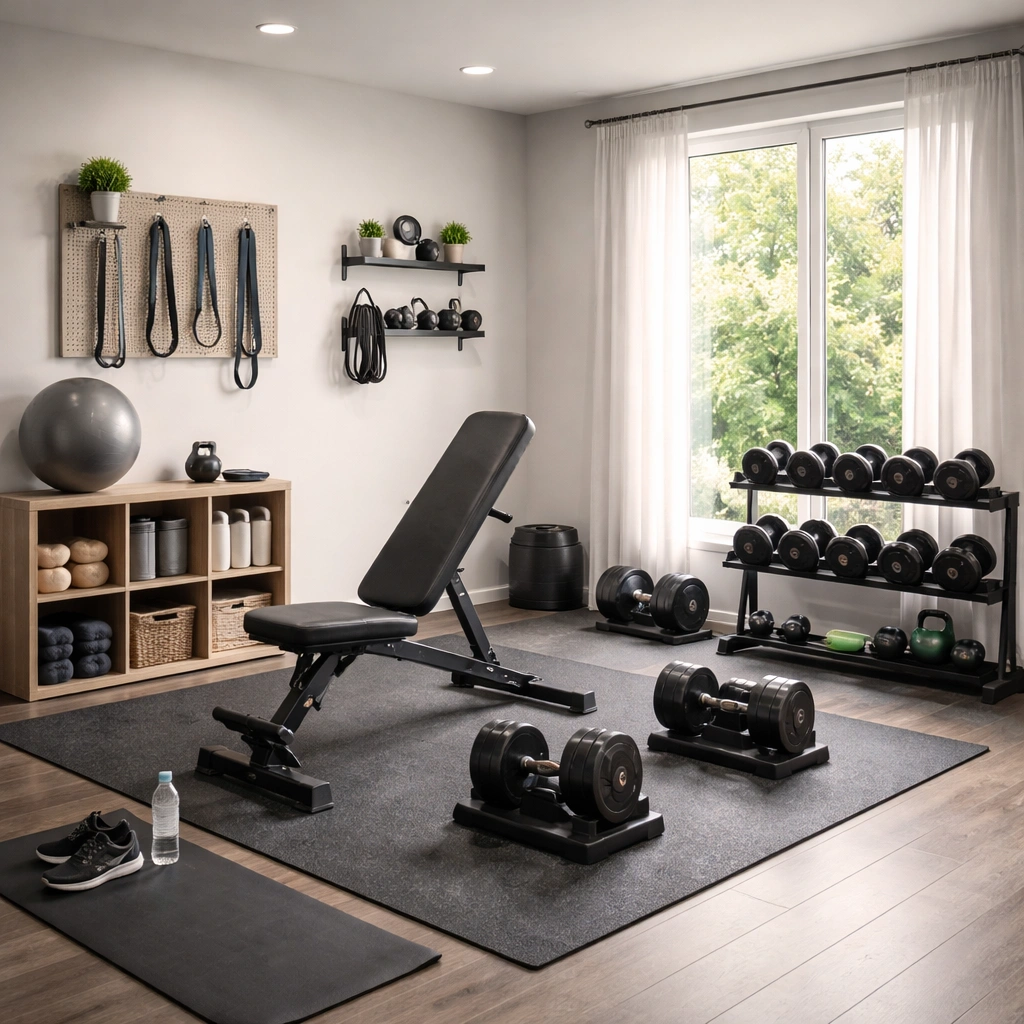
That order protects the room first, then builds the workout options.
Budget tiers with example shopping lists
- Budget setup: roughly $300 to $800
- adjustable dumbbells or a basic pair of dumbbells
- flat or basic adjustable bench
- resistance bands
- exercise mat or basic rubber flooring pieces
- simple storage rack or shelf
-
optional jump rope or compact cardio option
-
Mid-range setup: roughly $800 to $2,500
- better-quality adjustable dumbbells or a small dumbbell set
- sturdier adjustable bench
- power rack or squat stands
- barbell and starter plate set
- bands, mats, and basic accessories
- rubber flooring
- wall storage or plate storage
-
optional rowing machine or bike if cardio matters
-
Premium setup: roughly $2,500 and up
- heavier-duty rack and bench
- full barbell and plate setup
- larger dumbbell range or high-end adjustables
- dedicated cardio machine
- more durable flooring
- organized storage system
- specialty attachments or additional stations as space allows
These are planning ranges, not fixed price points, because equipment quality, brand, and shipping can change the total a lot.
How to split costs fairly
For most couples, the fairest approach is to split shared core items together and let each person pay for personal add-ons separately.
A simple method:
– Shared purchases: bench, flooring, rack, storage, shared cardio machine, barbell, plates
– Individual add-ons: extra resistance bands, specialty handles, personal lifting accessories, or a second set of items only one person uses
If one partner uses the gym more often or wants a more expensive upgrade, you can also split by category:
– one partner covers flooring and storage
– the other covers the bench and dumbbells
– shared items like the rack and cardio machine are split evenly
The key is to decide upfront which items are:
– shared
– personal
– optional later
That keeps the budget fair and avoids resentment over gear that benefits only one person.
Best Equipment for Two People to Share
The best shared equipment is versatile, easy to reset, and useful across different training levels.
Adjustable dumbbells
Adjustable dumbbells are often the first smart buy for couples because they replace multiple fixed pairs in a small footprint. They work well when one partner lifts lighter and the other wants more load progression. The trade-off is that they are slower to change than fixed dumbbells, so they are best when space matters more than rapid switching.
Adjustable bench
An adjustable bench supports pressing, rows, split squats, step-ups, and incline work. It is one of the most useful shared items because both partners can use it in very different ways. Look for a bench that feels stable for the larger user and easy to move for the smaller user.
Resistance bands
Bands take almost no space and are useful for warm-ups, mobility, assistance work, and accessory training. They are also one of the easiest items for two people to share because they can be used while someone else is on the bench or rack.
Power rack or squat stands
A rack becomes valuable when both partners want barbell work, especially if one person trains heavier or wants to squat and press safely at home. A power rack often provides more stable setup options and more exercise versatility than squat stands, but the exact difference depends on the specific rack or stand design, anchoring, and available safety attachments. Squat stands take less room and cost less. The trade-off is clear: more stability and versatility versus less footprint and lower cost.
Barbell and weight plates
A barbell setup is a strong long-term choice if both people want to progress in compound lifts. It is less compact than dumbbells, but it gives you the most room to grow in strength. If only one person plans to use a barbell regularly, it may be smarter to delay this purchase.
Kettlebells
Kettlebells are useful for swings, goblet squats, carries, and conditioning work. They are compact, but they can become redundant if you already own adjustable dumbbells and a bench. They make more sense when one partner prefers dynamic training or shorter conditioning sessions.
Cardio machine
If cardio matters to both people, choose one machine that is easy to share rather than buying two smaller pieces too soon. A treadmill, rowing machine, or exercise bike each solves a different problem:
– Treadmill: best for walking and running, but usually the largest footprint
– Rowing machine: efficient full-body conditioning and often easier to store in some designs
– Exercise bike: compact and simple, usually the least disruptive in a shared room
The best choice is the one both people will actually use consistently.
How to Balance Different Strength Levels and Fitness Goals
Couples often worry that one setup will favor the stronger partner or the person who lifts more often. That problem is usually solved by adjustability, not duplication.
If one person is newer to training, choose equipment that scales down easily:
– adjustable dumbbells instead of heavy fixed pairs
– bands for assisted movements
– a bench with multiple positions
– a rack with safety arms or spotter options
If one partner is much stronger, the question is whether the lighter user can still progress without being limited by the setup. Adjustable equipment helps here because it covers both ends of the range without taking up more floor space.
It also helps to think about body size and grip comfort:
– Bench height and pad width: a bench that feels stable for a larger lifter should still allow a shorter partner to plant their feet comfortably.
– Barbell load range: if one partner is newer or smaller, make sure the setup includes lighter loading options, not just heavy plates.
– Adjustable settings: choose racks, benches, and cardio equipment with simple adjustments so neither partner has to fight the setup every session.
– Safety arm reach and rack width: check that safety arms, J-cups, and bar path positions work for both users, especially if one has a shorter arm span or a different range of motion.
– Grip-friendly accessories: if one partner has smaller hands or lower grip strength, consider thinner handles, lifting straps, or dumbbells with a comfortable handle diameter.
A good test is this: can both people complete their main workout without changing the room into a different gym every time? If the answer is no, the setup probably needs fewer specialized items and more shared basics.
Strength, Cardio, or Hybrid? Build the Right Mix
A couple’s gym usually works best as either strength-focused or hybrid. Pure cardio setups are possible, but shared strength equipment tends to offer more training variety per square foot.
Strength-focused setup
Best when both partners want lifting, progressive overload, and long-term versatility. Usually built around a rack, bench, dumbbells, plates, and flooring.
Cardio-focused setup
Best when both people prefer conditioning, walking, cycling, or rowing. This works well in smaller rooms, but it can be limiting if one partner later wants more strength work.
Hybrid setup
Best for mixed goals. One partner can lift while the other uses cardio or floor work. This is often the most practical choice for couples because it covers more training styles without requiring a large amount of duplicate equipment.
Layout Ideas for Small Shared Spaces
Small spaces work best when the layout is simple and predictable. Avoid placing equipment in the center of the room unless it truly needs to stay there.
Example 1: Very small spare room, about 80 to 100 square feet
Place adjustable dumbbells, a bench, and bands along one wall. Keep the center open for floor work. Add a foldable cardio option only if both people will use it often.
Example 2: Small-to-medium room, about 120 to 160 square feet
Use one wall for a rack or squat stands, keep the bench nearby, and put dumbbells or storage on the opposite side. This size usually works better when one person lifts while the other stretches, uses bands, or does a short cardio session.
Example 3: Larger shared room, about 180 square feet or more
Split the room into two clear lanes: one for strength work and one for cardio or mobility. This is the easiest layout for couples who train at the same time and want fewer interruptions.
The most efficient shared rooms usually have one “anchor” piece and one open lane. Too many large items turn the room into a storage closet with workout gear in it.
Storage, Flooring, and Safety Essentials
These are not extras. They are what keep the gym usable.

Flooring
Rubber flooring helps protect the subfloor, can soften some impact depending on thickness and installation, and makes the room feel more finished. It also makes cleanup easier and can reduce noise compared with hard flooring alone, though the results depend on the material and how it is installed. In shared homes or apartments, that matters.
Storage
Use wall storage, a compact rack, or shelving for bands, collars, mats, and smaller items. If every accessory sits on the floor, the room becomes harder to use and less safe.
Safety spacing
Keep clear zones around:
– racks and benches
– cardio machines
– loaded plates and dumbbells
– mirrors or wall-mounted storage
If you plan to mount anything to a wall, check the manufacturer’s installation instructions carefully. For heavy or anchored equipment, follow the included hardware and anchoring guidance rather than improvising.
[Image placeholder]
What to Buy First vs Later
A phased plan keeps the budget under control and prevents regret purchases.
Buy first
- floor protection
- adjustable dumbbells or a basic weight set
- adjustable bench
- bands and mats
- storage for small items
Buy next
- rack or squat stands, if barbell training is a priority
- barbell and plates
- one cardio machine, if both people will use it
Buy later
- specialty attachments
- duplicate accessories
- niche machines
- extra items that support only one training style
This order works because it builds a usable room before adding complexity.
Common Mistakes Couples Make
The most common mistake is buying for the most enthusiastic partner instead of the most practical shared use. That often leads to equipment that one person loves and the other avoids.
Other mistakes include:
– choosing bulky machines before confirming floor space
– skipping storage and living with clutter
– buying fixed dumbbells too early when adjustables would work better
– ignoring noise and floor protection
– setting up the room for one training style only
– overloading a small space with too many “nice to have” items
A simple rule helps: if an item cannot serve both people or support a clear training need, delay it.
Sample Couple Home Gym Setups by Budget
Budget setup
Approximate total: $300 to $800
Example equipment list:
– adjustable dumbbells or a basic pair of dumbbells
– flat or basic adjustable bench
– resistance bands
– one or two exercise mats
– simple storage shelf or rack
– optional jump rope or compact cardio tool
Best for: a very small room, beginners, or couples who want a shared workout space without a large upfront cost.
Mid-range setup
Approximate total: $800 to $2,500
Example equipment list:
– sturdier adjustable dumbbells or a small dumbbell set
– adjustable bench
– power rack or squat stands
– barbell and starter plate set
– resistance bands
– rubber flooring
– wall storage or plate storage
– optional rowing machine or exercise bike
Best for: couples who both lift, want a more complete strength setup, and have a garage or basement with enough room.
Premium setup
Approximate total: $2,500 and up
Example equipment list:
– heavier-duty rack
– higher-quality bench
– full barbell and plate setup
– larger dumbbell range or premium adjustable dumbbells
– dedicated cardio machine
– upgraded flooring
– organized storage system
– specialty attachments or a second training station if space allows
Best for: couples who train often, want fewer compromises, and have enough space for a more permanent shared gym.
When to Consult a Professional
If you plan to anchor a rack, mount storage to walls, add a heavy cardio machine, or set up equipment in a basement or garage with moisture, electrical, or structural concerns, check the manufacturer instructions and consider a qualified installer or contractor. That is especially important when the setup involves drilling, load-bearing surfaces, or electrical outlets near powered equipment.
FAQs
What equipment do we need for a home gym for two people?
For most couples, the core list is adjustable dumbbells, an adjustable bench, resistance bands, flooring, and storage. Add a rack, barbell, or cardio machine only if both people will use them regularly.
How much space do we need for a shared home gym?
The answer depends on the equipment, but the room should allow safe movement around the main training area. A compact setup can work in a spare room, while a rack-based gym usually needs more open floor space and better clearance.
Adjustable dumbbells or fixed dumbbells for couples?
Adjustable dumbbells usually make more sense in a shared gym because they save space and cover a wider load range. Fixed dumbbells are faster to grab, but they take much more room and are harder to justify in a small setup.
Is a power rack better than squat stands?
A power rack usually gives more stability and more training options, which is helpful for couples sharing one space. Squat stands take up less room and cost less, but they are a narrower solution.
What cardio machine is best for a couple?
The best choice is the one both people will use. A treadmill suits walking and running, a rowing machine offers full-body conditioning in a compact format, and an exercise bike is usually the simplest and least intrusive option.
How do we avoid buying equipment one person will never use?
Build the gym around shared essentials first and delay specialty items until both partners have used the room consistently. If an item only supports one person’s routine, it should usually come later.
A shared home gym does not need to be large to work well. It needs to be planned around real use, not wishful buying. When the room is organized, the equipment is versatile, and the layout respects both people’s workouts, the space becomes easier to use consistently.
Quick decision checklist
- Measure the room and confirm your usable square footage.
- Decide whether the setup is budget, mid-range, or premium.
- Choose the shared core items first.
- Split costs: shared items together, personal add-ons separately.
- Check ceiling height, clearance, and installation needs.
- Buy flooring and storage before specialty gear.
- Add only the equipment both partners will use regularly.