
Home Gym Equipment Buying Mistakes

A home gym can save time and make training easier to keep up with, but it can also become an expensive storage problem if the first purchases are made without a plan.
The most common regrets are predictable: buying for the person you hope to become instead of the routine you actually have, underestimating how much room and support equipment are required, and choosing gear that looks impressive but does not match your goals. That is why the smartest home gym purchases usually come from a simple process: define the training goal, measure the space, set the full budget, and then choose the most versatile equipment first.
Why Home Gym Buyers Regret Their First Purchases
The first mistake is buying around an aspiration. A shopper who wants to “get serious” may jump straight to a treadmill, a large cable machine, or a full rack setup without knowing whether they will use it often enough to justify the footprint. A few months later, the machine becomes a clothes rack or a storage shelf.
A few concrete examples show how this happens. Someone who only lifts may buy a treadmill because it seems like a “complete” home gym, then never use it. A beginner in a tiny apartment may buy a power rack before checking whether there is enough room to load plates, move the bench, and still walk around it comfortably. Another common regret is buying a machine before a consistent routine exists, which often leads to an expensive piece of equipment that outgrows the user’s actual habits.
Another common regret is assuming the sticker price is the total cost. Flooring, delivery, assembly, storage, and missing accessories can change the budget quickly. Even a simple setup can cost more than expected once you add a bench, collars, flooring, and a place to store plates or dumbbells.
The third regret is buying equipment that does not fit the room. A rack that technically fits on paper can still feel cramped if there is not enough space to load plates, move around the bench, or perform an overhead press safely.
A practical way to avoid these problems is to treat every purchase as part of a system, not a single item. A home gym should support the workouts you will repeat, not just the equipment you think looks best in a listing.
Start With Your Training Goal, Not the Equipment List
The easiest way to overspend is to build a shopping list before you know what kind of training the gym needs to support.
Strength-focused setup
If your main goal is strength training, the core of the gym is usually a barbell-based setup. That often means a barbell, weight plates, a bench, and either a power rack or squat stand. This setup supports a wide range of movements and can grow with you over time.
A common mistake here is buying a machine first because it looks “complete.” Many machines are useful, but they often take up more space and do less than a basic barbell setup for the same room.
General fitness setup
For general fitness, versatility matters more than specialization. Adjustable dumbbells, resistance bands, a bench, and maybe a compact cardio machine can cover a lot of ground without taking over the room.
This is where buyers often overspend on a large machine they think they should own, rather than on a few pieces they will actually use. If your workouts are short, varied, and not highly specialized, a compact setup usually makes more sense than a full machine lineup.
Cardio-focused setup
If cardio is the priority, the mistake is assuming any cardio machine is automatically a good buy. Treadmills, rowers, bikes, and ellipticals all have different footprints, noise levels, and storage needs.
For many home gyms, a compact bike or rower is worth considering first because it is easier to place, easier to live with, and less likely to dominate the room. A treadmill can make sense if walking or running is already a consistent habit and you have the space, but it is often overkill for beginners or for multi-use rooms. Ellipticals and large commercial-style cardio units are usually harder to justify unless cardio is the clear priority and the room is built around that purchase.
A useful rule: buy for the workouts you are already doing, not the workouts you imagine doing “once the gym is ready.”
Measure the Space Before You Buy Anything
A product can fit in a room and still be a bad fit for the room.
Look at footprint, not just dimensions
Many listings show the equipment’s overall size, but that is only part of the picture. You also need usable space around it. A bench needs room to walk around it. A rack needs room to load plates and step back safely. A cardio machine needs space for mounting, dismounting, and regular use.
In small spaces, the difference between “fits” and “works well” is huge. A full-size machine might technically fit against a wall but still make the room feel unusable. Also check door swing, hallway clearance, and whether the equipment blocks a closet, storage bin, or main walking path.
Check ceiling height early
This matters most for racks, pull-up bars, and overhead pressing. If the ceiling is too low, you may not be able to use a power rack comfortably or safely. Garage doors, beams, and ductwork can also create surprise clearance problems.
Before buying, measure the tallest point in the room and compare it with the equipment height plus the movement you need above it. That is especially important if you plan to do pull-ups, overhead presses, or use a rack with attachments.
Plan storage at the same time
A home gym is not just where equipment is used; it is where it lives. Weight plates need a place to go. Dumbbells need storage. Resistance bands, collars, and accessories need somewhere to stay organized.
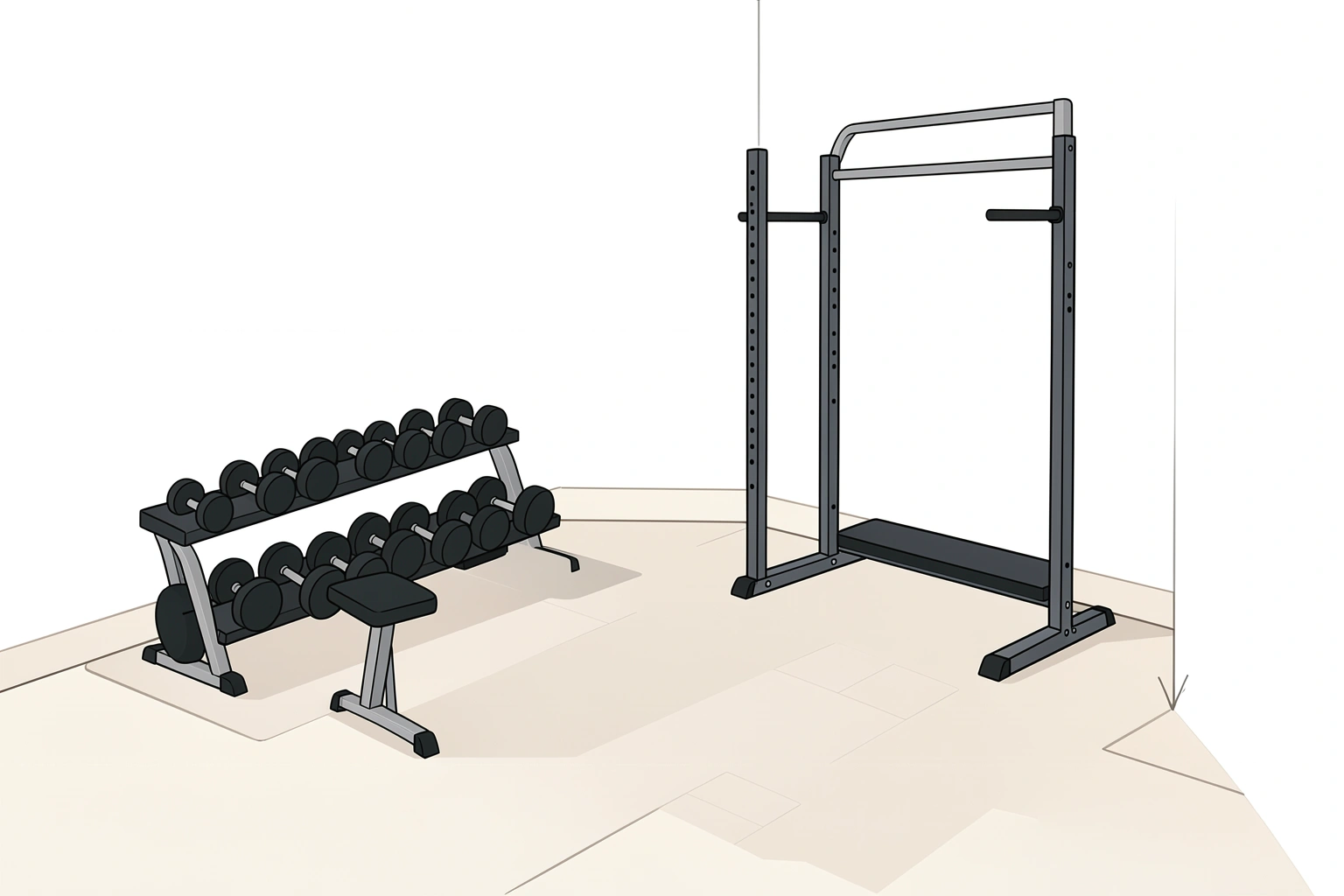
If storage is ignored, the room becomes cluttered fast. The result is often a gym that looks full but functions poorly.

Think in zones
A simple way to plan the room is to divide it into zones:
- lifting area
- cardio area
- storage area
- walking path
If one item blocks another zone, the layout is probably too tight. In a garage, for example, a rack near the center may work better than one pushed into a corner if you need room to load plates and move a bench.
Small rooms, garages, and basements each have extra pitfalls. In a small room, the biggest mistake is choosing equipment that leaves no room to open the door fully or move around the bench. In a garage, floor slope, vehicle clearance, and seasonal temperature swings can matter as much as footprint. In a basement, low beams, moisture, and uneven concrete can affect both safety and durability. If you are planning on rubber flooring or mats, check whether they will create a tripping edge at thresholds or make doors harder to open.
Set a Realistic Budget and Include Hidden Costs
The equipment price is only part of the total.
Common hidden costs
Depending on the setup, you may also need:
- rubber flooring or mats
- delivery or freight charges
- assembly help
- storage solutions
- specialty attachments
- collars, pins, or adapters
- maintenance items such as replacement parts
These costs matter because they can turn a “budget” purchase into a much larger project. A buyer who only budgets for the main machine often ends up cutting corners on the parts that make the gym usable.
A simple example: if you plan to spend a set amount on a barbell setup, the real total may rise once you add flooring, a bench, and storage for plates. That is why it helps to budget in layers: main equipment first, then the items required to use it safely, then the accessories that make it convenient.
Decide where quality matters most
Not every item needs to be premium. In many home gyms, the bench, rack, and barbell matter more than decorative extras or specialized accessories. If you have to choose, prioritize stability and durability over features that look impressive in photos.
For a barbell-based setup, quality issues in the rack, bench, or bar can affect safety and long-term use. For a dumbbell-based setup, the handles, locking mechanism, and storage matter more than flashy finishes.
Buy in stages when the budget is tight
A staged approach usually works better than trying to finish the whole gym at once. That might mean buying a bench and adjustable dumbbells first, then adding a rack later if strength training becomes more important.
This approach reduces regret because each purchase is based on actual use, not guesswork.
Buy the Most Versatile Equipment First
The best first purchases usually do more than one job.
Adjustable dumbbells
Adjustable dumbbells are one of the most practical space-saving purchases for beginners and intermediate users. They replace a full run of fixed dumbbells and take up far less room. They also reduce the upfront cost of building a complete weight range.
The trade-off is convenience. Fixed dumbbells are faster to grab and swap, while adjustable dumbbells save space and money. If your room is small or your budget is limited, adjustables are often the better first buy.
Resistance bands
Bands are inexpensive relative to their usefulness. They can support warm-ups, accessory work, mobility, and some strength movements. They also store easily, which makes them a smart add-on when space is limited.
They are not a replacement for everything, though. They are best treated as a versatile supplement rather than the core of a serious strength setup.
Bench
A bench becomes more valuable than many buyers expect. It supports presses, rows, step-ups, and seated work. If you plan to use dumbbells or a barbell, a stable bench is often a better early purchase than a specialized machine.
The key is stability. A bench that wobbles or has a low weight capacity is not a bargain.
Barbell-based starter setup
If your main goal is strength, a barbell, plates, and a bench can be a more complete foundation than a single large machine. It offers progression, flexibility, and room to grow.
The downside is that it usually requires more planning. You need more room, better flooring, and careful attention to compatibility between the bar, plates, rack, and bench.
Common Comparison Decisions That Affect Value
Some buying choices have a bigger impact than the brand name on the box.
| Decision | Better for space | Better for budget | Better for versatility | Better for durability |
|---|---|---|---|---|
| Adjustable dumbbells vs fixed dumbbells | Adjustable | Adjustable | Adjustable | Fixed, if well made |
| Power rack vs squat stand | Squat stand in very tight spaces; rack in dedicated rooms | Squat stand | Power rack | Power rack |
| Barbell-based vs machine-based setup | Barbell-based in most compact home gyms | Barbell-based if you want broad training value | Barbell-based | Often barbell-based, though quality varies |
| New vs used equipment | New, if you want less inspection work | Used, if condition is good and the item is simple | Depends on the item | New, or used only after careful inspection |
| Compact vs full-size equipment | Compact | Compact | Depends on the exercise | Full-size, if built well |
Adjustable vs fixed dumbbells
Fixed dumbbells are simple and fast. Adjustable dumbbells are better when space and budget are limited. The trade-off is speed versus efficiency. If you train in short sessions and want less clutter, adjustable dumbbells usually win.
Power rack vs squat stand
A power rack generally offers more stability and more training options, especially if you want to add safeties or attachments. A squat stand takes up less room and may cost less, but it gives up some support and versatility.
For a garage or dedicated room, a rack is often the better long-term choice. For a tight space, a stand may be the more realistic option.
Barbell-based vs machine-based setup
Barbell-based setups are usually more flexible and easier to expand. Machine-based setups can be more guided and may suit users who prefer fixed movement paths, but they often cost more, take up more room, and are less adaptable.
If your goal is broad strength development without filling the room with large equipment, barbells and free weights usually offer better value. That said, machines can still make sense for users who specifically want guided movement, limited exercise selection, or easier access for certain needs.
New vs used equipment
New equipment gives you a warranty, clearer condition, and less uncertainty. Used equipment can be a smart deal if you know what to inspect and the seller is trustworthy.
Used gear is not automatically the better bargain. A worn barbell, a rusted rack, or a bench with a damaged frame can cost more to replace than you saved.
A simple decision framework helps:
- Buy new when the item is safety-critical, hard to inspect, expensive to ship, or likely to have hidden wear, such as a rack, bench, or machine with moving parts.
- Buy used when the item is simple, durable, easy to inspect, and cheap enough that a replacement would not erase the savings, such as some plates, basic benches, or straightforward accessories.
- Buy refurbished when you want a middle ground and the seller clearly explains what was repaired, tested, or replaced, especially if there is some warranty or return protection.
If the item has complex electronics, missing parts, or compatibility uncertainty, used is often not worth the risk.
How to Judge Quality, Durability, and Safety
A cheap item is only cheap if it lasts and works safely.
Check the weight capacity carefully
Weight capacity matters for racks, benches, stands, and some cardio machines. Do not rely on the product title or a marketing summary alone. Read the actual specifications and, when possible, the manual or product page from the manufacturer.
If the listed capacity is vague or hard to verify, that is a warning sign.
Look for stability, not just appearance
A sturdy-looking frame is not always a stable one. Pay attention to the base, the connection points, and whether the product is designed to remain steady under load. This is especially important for benches, squat stands, and folding racks.
Confirm compatibility before you buy
Compatibility problems are a common source of regret. Check whether rack attachments fit the exact rack model, whether plate standards match your barbell sleeves, and whether dumbbell systems use the same adjustment method or storage format you expect. A small mismatch can make an accessory useless.
Read the warranty and return policy
A warranty does not guarantee perfect quality, but it does tell you something about the seller’s confidence and the support you can expect. Return policy matters just as much, especially for large items that are expensive to ship back.
Watch for misleading specs
Marketing language can hide important details. “Commercial-grade” does not automatically mean appropriate for home use. “Heavy-duty” is not a substitute for a real load rating. If the listing does not clearly explain materials, compatibility, and capacity, treat it cautiously.
Mistakes to Avoid When Buying Used, Refurbished, or Budget Gear
Used and budget equipment can work well, but only if you inspect it with a critical eye.
Used equipment risks
Check for rust, bent parts, missing hardware, worn knurling on barbells, damaged upholstery, and unstable welds or joints. If the item includes attachments or accessories, confirm that all locking pieces are present.
A used barbell and plate set can be a good buy, but only if the parts are complete and compatible. Missing collars, mismatched plates, or damaged sleeves can erase the savings quickly.
Refurbished equipment
Refurbished gear can be a middle ground between new and used. It may offer better condition than a random secondhand listing, but the details matter. Ask what was replaced, what was tested, and what warranty remains.
Budget equipment
Budget equipment is not automatically low quality, but it often cuts corners in the frame, padding, hardware, or finish. That is acceptable for some accessories, but not for items where stability matters.
A low-cost bench that wobbles under load is not a deal. It is a replacement purchase waiting to happen.
Plan for Storage, Assembly, and Long-Term Use
The best equipment is the gear you can live with.
Assembly effort matters
Some items are simple to assemble. Others require more time, tools, or help. Large machines and racks may involve multiple boxes, heavy parts, or awkward alignment steps. If you live alone or have limited tools, that should affect the purchase decision.
Storage shapes daily use
If plates, dumbbells, and bands have no permanent place, the gym becomes cluttered and less inviting. Storage solutions are not optional extras; they are part of the system.
A compact rack with plate storage may be more useful than a slightly cheaper version without it, especially in a small garage or basement.
Think about progression
A good purchase should still make sense six months from now. If you expect to get stronger, buy equipment that can support that progression. If you expect your routine to stay simple, do not overbuy for a version of training you may never adopt.

A Simple Home Gym Buying Checklist
Before you check out, ask these questions:
- Does this equipment match my current training goal?
- Will it fit the room, including movement space and ceiling height?
- Do I know the full cost, including flooring, delivery, and accessories?
- Is the weight capacity and stability appropriate for how I will use it?
- Will I still use it after the first few months?
- Does it store easily when not in use?
- Is the return policy and warranty acceptable?
- If buying used, have I checked condition, compatibility, and missing parts?
If any answer is unclear, pause the purchase. The cost of a wrong buy is usually higher than the cost of waiting a few days to verify the details.
What to Buy First by Situation
Small-space beginner
Start with adjustable dumbbells and a bench if you want the broadest training options in the smallest footprint. Add resistance bands next if you want low-cost variety. Skip larger machines until you know the room can support them without blocking traffic flow.
Strength-focused shopper
A strength-focused buyer should usually prioritize a barbell, plates, a bench, and a power rack or squat stand. If room and budget are tight, start with the barbell, plates, and bench, then add the rack when the layout is ready.
Budget-conscious user
A budget-conscious shopper should focus on the most flexible items first. Adjustable dumbbells, bands, and a stable bench often provide more value than a single specialized machine. If buying used, inspect condition carefully and avoid pieces with missing parts or obvious structural wear.
Buyer upgrading from a basic setup
If you already own a few basics, buy the next item that removes the biggest limitation. That might be a rack for safer barbell work, a better bench for stability, or storage to clean up the room and make the setup easier to use.
When to Consult a Professional
If you are unsure whether a rack, machine, or heavy installation is appropriate for your floor, ceiling, or electrical setup, consult a qualified professional before buying. That is especially relevant for basements, garages with uneven surfaces, and any equipment that requires special installation or anchoring.
A quick check can prevent an expensive mistake and help you choose equipment that is both practical and safe for your space.
Final Takeaway
Most home gym buying mistakes come from skipping the planning stage. Choose the goal first, measure the room carefully, account for the full cost, and buy versatile equipment before specialized pieces. That approach keeps the gym useful, affordable, and easier to expand later.