
Home Gym Design Mistakes: What to Avoid Before You Buy Anything

A home gym can be one of the most useful rooms in a house, garage, or apartment. It can also become an expensive storage area filled with equipment that does not fit, gets in the way, or is unpleasant to use.
Most home gym design mistakes come from the same pattern: people buy equipment before they plan the space. That leads to cramped layouts, poor flooring, awkward traffic flow, unsafe clearances, and a room that looks finished but works badly in practice. The good news is that these problems are usually preventable with a few careful decisions made early.
This guide focuses on the mistakes that cost the most in money, usability, and safety, and how to avoid them whether you are building a gym in a spare room, garage, basement, or shared space.
Why Home Gym Design Mistakes Are So Costly
A poorly planned gym is not just inconvenient. It can change how often you use the room and how safely you move in it.
If a bench has to be dragged out every time you train, the setup becomes annoying enough that you may skip sessions. If a treadmill is placed where it blocks a door or narrows a walkway, the room becomes harder to use for everything else. If flooring is too thin or too soft, weights can damage the subfloor or feel unstable underfoot. If storage is an afterthought, dumbbells, collars, bands, and mats end up on the floor where they create trip hazards.
The mistake is often assuming the room will “feel right” once the equipment arrives. In reality, a home gym works best when the room layout is decided first and the equipment follows.
For basic room planning and safety concepts, it helps to look at manufacturer guidance and building-related standards rather than guessing. For example, the American Council on Exercise offers general fitness guidance, and equipment manuals from manufacturers usually specify clearance, assembly, and anchoring requirements that matter more than broad advice.
Start With the Space: Measure the Room, Ceiling, and Clearances
Before shopping, measure the room in three ways: floor dimensions, ceiling height, and usable clearances around doors, windows, vents, and fixed obstacles.
A common mistake is measuring only the open floor area and forgetting the real working space around equipment. A rack, bench, or cardio machine may technically “fit” in a room but still be difficult to use if there is no room to load plates, walk behind it, or move safely around it.
Measure more than the walls
Write down:
- Room length and width
- Ceiling height
- Door swing direction
- Window placement
- Baseboards, posts, low beams, and sloped ceilings
- Outlet locations
- Heating and cooling vents
Then sketch the room at a simple scale. Even a rough drawing helps reveal problems before you buy.
Leave space for movement, not just equipment
A useful way to think about planning is to separate the room into a lifting zone, a movement zone, and a storage zone.
If those zones overlap too much, the room will feel crowded even if the equipment technically fits.
Practical clearance planning for common equipment
Exact spacing depends on the manufacturer, but these minimum planning ranges are useful when you are sizing a room:
- Power rack or squat rack: plan for roughly 3 feet or more on the front and working sides when possible, with extra room if you will bench inside the rack, load plates from the sides, or use a barbell with a long sleeve. If the rack has rear storage horns or a pull-up bar, check overhead and rear clearance too.
- Bench: leave enough room to walk around the bench and set up safely. A 24 to 36 inch buffer on the sides and ends is a practical starting point in small rooms.
- Treadmill: allow the machine footprint plus at least 2 feet on each side and 6 feet or more behind the belt if the manufacturer recommends a rear safety zone. Also check ceiling height, since running often needs more headroom than walking.
- Rower, bike, or elliptical: these often need less side clearance than a treadmill, but the moving parts and user position still need open space. Plan for the full stride or handle path, not just the base footprint.
- Dumbbell and kettlebell storage: keep them close to the training area, but avoid placing storage where it narrows the walking path. A 2 to 3 foot circulation path is a good planning target in compact rooms.
- Barbell storage and plate storage: allow enough room to remove and return plates without turning sideways or bumping into another machine.
If you are unsure, use the manufacturer’s installation and clearance guidance as the final word. The room should be planned around the equipment, not the other way around.
Example of a bad fit
A power rack placed close to a wall may seem fine until you try to bench, load plates, or step back for a squat. The issue is not just the rack footprint. It is the clearance needed around it for movement and safety.
Example of a better fit
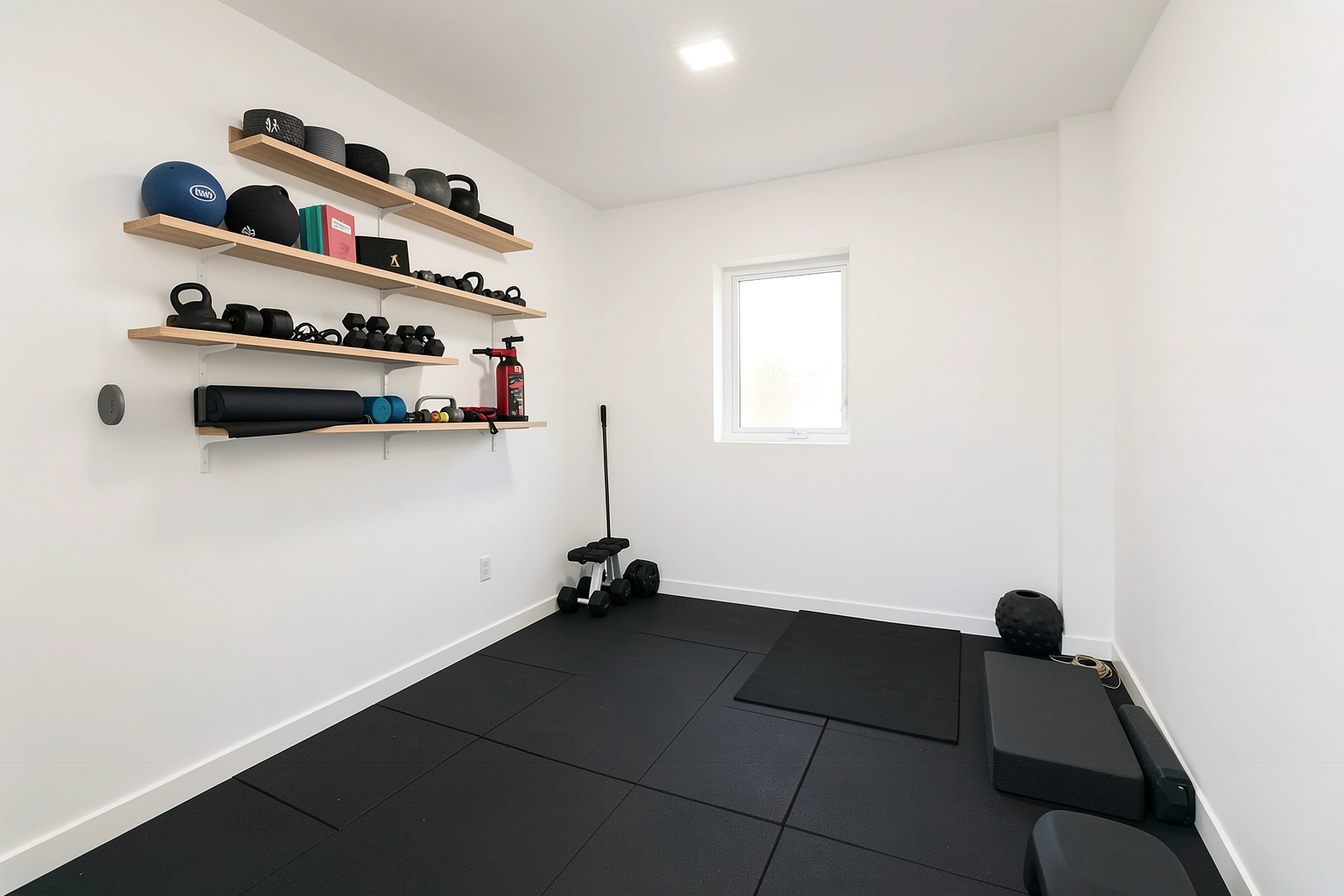
A compact setup with adjustable dumbbells, a folding bench, and wall storage can leave the center of the room open. That gives you usable floor space for lifting, mobility work, or cardio without constantly moving equipment.
Choose the Right Room or Area for Your Training Style
The best room depends on how you train and how much flexibility you need.
Spare room
A spare room works well for compact strength training, mobility work, and lighter cardio. It is usually easier to control for temperature and noise than a garage. The trade-off is limited space and the need to preserve the room’s original purpose.
This option is best when you want a clean, quiet setup with minimal equipment.
Garage gym
A garage often offers the most space, but it also brings temperature swings, dust, and noise concerns. It is usually better for larger equipment, racks, and plate storage than a spare bedroom.
A garage gym can handle a heavier setup, but it usually needs more attention to flooring, ventilation, and organization. If the garage door stays open during workouts, airflow improves; if not, heat and humidity can become a problem.
Basement gym
Basements can work well for lifting and cardio, but moisture, low ceilings, and limited natural light are common issues. If the room feels damp or has a musty smell, address that before adding equipment.
Multi-use room
A multi-use room is the most demanding design challenge. It needs to function as a gym without losing its other purpose. That usually means choosing foldable or movable equipment and keeping the center open.
The room choice should support the training style you will actually use consistently.


The Biggest Layout Mistakes to Avoid
Layout mistakes are often more damaging than equipment mistakes because they affect every workout.
Blocking doors, windows, and access points
Do not place a rack, bench, or storage unit where it interferes with a door swing or blocks access to a window, vent, or electrical panel. A room should still be easy to enter, exit, and ventilate.
Cramping all equipment into one wall
Packing everything against one side of the room can seem tidy, but it often creates a narrow central strip that is hard to use. A better approach is to dedicate one wall to storage or fixed equipment and preserve a clear training area elsewhere.
Putting the rack too close to walls
This is one of the most common and frustrating mistakes. You need room to load plates, adjust pins, move a bench, and step in and out of lifts comfortably. The exact clearance depends on the rack and training style, so check the manufacturer’s guidance rather than guessing.
Ignoring the path between equipment
A dumbbell area next to a bench is efficient only if you can move between them without stepping around a stool, cable, or mat. The room should support a natural flow: enter, train, store, exit.
Bad layout vs better layout
Bad layout: treadmill in front of the door, dumbbells on the floor beside the rack, bench stored behind the rack, and no clear walking path.
Better layout: rack on one wall, dumbbells on a rack nearby, bench stored vertically or folded away, and the center of the room left open for movement.
Bad garage layout: a rack parked where the car door opens, bumper plates stacked in the walkway, and a cardio machine pushed so far back that it is hard to use in winter.
Better garage layout: rack on the back wall, plates on a vertical tree or compact plate rack, cardio equipment along one side, and a clear lane for the car or for moving through the space.
Bad multi-use room layout: a sofa, toy bins, and a treadmill all sharing the same center space, so every workout starts with moving furniture.
Better multi-use room layout: foldable bench, adjustable dumbbells, freestanding storage, and equipment parked along the perimeter so the room can switch back to its other use quickly.
How to Prioritize Equipment Without Overcrowding the Room
The easiest way to overcrowd a home gym is to buy too much too soon.
A better sequence is to build from essentials outward:
- Flooring and protection
- Primary training equipment
- Storage
- Comfort upgrades
- Specialized extras
That order helps you avoid buying items that do not match the room once the basics are in place.
Buy in the right order for your training style
Your first purchases should match the style of training you will do most often.
- If you mainly lift and have a small room: start with flooring, adjustable dumbbells, a folding or compact bench, and basic storage. Add a rack only if the room can support the clearance it needs.
- If you mainly lift and have a medium room: start with flooring, a rack, a bench, and barbell or dumbbell storage. Add cardio equipment later if there is still open floor space.
- If you mainly do cardio: start with the machine you will use most, plus flooring and ventilation. Then add only a small amount of storage for accessories.
- If you want mixed training: buy the most versatile items first, such as adjustable dumbbells, a bench, bands, and a rack only if the room can truly fit it.
Use budget and room size to decide what comes first
If the budget is tight, buy the items that unlock the most workouts per square foot. That usually means flooring, adjustable weights, and a bench before specialty machines.
If the room is small, prioritize compact equipment that can serve multiple exercises. If the room is medium-sized, you can usually justify one larger anchor piece, such as a rack or cardio machine, but not both at once unless the layout still leaves open training space.
Example: small room purchase order
For a spare room with limited space, a smart order might be:
- Rubber flooring or removable mats
- Adjustable dumbbells
- Folding bench
- Wall or freestanding storage
- Bands, mat, and small accessories
- Rack only if the room still has safe clearance
Example: medium room purchase order
For a garage or basement with more room, a smart order might be:
- Flooring
- Power rack or squat rack
- Bench
- Barbell and plates, or adjustable dumbbells
- Storage for plates and accessories
- One cardio machine if there is still open space
Avoid “nice to have” purchases early
Items like specialty machines, large mirrors, or extra cardio equipment can wait until you know the room works. Many home gyms become cluttered because the owner adds equipment before confirming that the core setup is comfortable.
A simple decision rule
If an item is large, single-purpose, or hard to move, it should earn its place by solving a clear training need. If it does not, it will probably become a space problem.
Free Weights vs Machines: What Fits Best in a Home Gym
This choice affects both space and flexibility.
Free weights
Free weights, especially adjustable dumbbells, a barbell, and a bench, are usually more compact and versatile than large machines. They support a wide range of exercises without taking over the room.
The downside is that they require more attention to flooring, clearance, and safe movement. You also need enough open space to lift and set down weights properly.
Machines
Machines can be easier to use and may feel more stable, but they usually take up more space and are less flexible. A single machine often serves one movement pattern, which can be a poor trade-off in a small room.
Practical comparison
If you have a small spare room, free weights usually make more sense than a large machine. If you have a dedicated garage or basement with plenty of room, a machine may be worth adding later if it solves a specific training need.
Best fit by space
- Small room: adjustable dumbbells, bench, bands, and compact storage
- Medium room: rack, bench, dumbbells, and one cardio machine
- Large garage or basement: more room for machines, plate storage, and dedicated zones
Flooring Mistakes That Damage Comfort, Safety, and Subfloors
Flooring is one of the most overlooked parts of home gym design. It affects noise, grip, stability, and how much impact reaches the floor below.
Foam flooring vs rubber flooring
Foam flooring is softer and often used for light workouts, stretching, or bodyweight exercise. It is not usually the best choice under heavy weights or equipment that needs a stable base.
Rubber gym flooring is generally better for lifting areas because it is denser, more durable, and more resistant to impact. It also tends to provide better protection for subfloors and better stability under equipment.
Thickness matters too
Thin flooring may be fine for light movement, but it often does not do enough for heavier lifting or dropped dumbbells. Thicker rubber flooring usually offers better protection and noise control, while very soft surfaces can make stable lifting harder.
A practical approach is to match thickness to use:
- Light movement and stretching: thinner mats or foam may be enough
- General home gym use: medium-thickness rubber flooring is often a better all-around choice
- Heavy lifting or garage floors: thicker rubber or layered protection is usually more appropriate
Budget-friendly flooring fixes
If you are trying to save money, you do not always need to cover the entire room with premium flooring at once.
- Use removable flooring tiles or mats in the main training zone first
- Add rubber stall mats in the heaviest-use area of a garage gym
- Use a platform or layered protection only under the rack or deadlift zone if the rest of the room does not need full coverage
- In rentals, choose portable mats that can be removed without permanent changes
Common flooring mistakes
- Using thin foam under weights
- Skipping flooring entirely on concrete or finished floors
- Choosing a surface that is too slippery
- Covering only part of the workout area and creating uneven transitions
What to prioritize
Match the flooring to the heaviest use in the room. If the space is mainly for lifting, choose a more durable surface. If the room is for light movement or stretching, softer flooring may be enough.
For installation details and subfloor considerations, manufacturer instructions matter. Check the product guidance before committing so you know how the flooring is meant to be used on your specific surface.
Storage and Organization Errors That Create Clutter and Hazards
A gym becomes unsafe faster when accessories migrate to the floor.
Keep frequently used items visible and reachable
Dumbbells, bands, collars, mats, and straps should have a home close to where you use them. If storage is too far away, people stop putting things back.
The best storage is easy to access without blocking the workout zone. Items you use every session should be within arm’s reach or just a step away from the main training area.
Wall-mounted vs freestanding storage
Wall-mounted storage saves floor space and works well when you want a cleaner layout. It can be ideal for plates, bands, and smaller accessories, but it may require secure installation and careful placement.
Freestanding storage is often better for renters or anyone who wants flexibility. It can move with you and avoids permanent wall changes, though it usually takes up more floor space.
If you do use wall-mounted storage, make sure it is installed only where the wall structure can safely support it. In rentals or shared spaces, freestanding racks are usually the safer budget-friendly choice.
Use storage to protect the walking path
Storage should reduce clutter, not create another obstacle. A rack placed in a corner is useful only if it does not block the route between the door and the training area.
Simple organization rule
Store heavy, bulky, or rarely used items lower down. Keep the most frequently used items at waist height or within easy reach. That makes the room easier to use and reduces unnecessary bending or lifting.
Budget-friendly storage fixes
- Use a freestanding dumbbell rack instead of built-ins
- Choose a foldable bench that can be stored upright or under a wall shelf
- Add vertical plate storage instead of wide shelving when floor space is tight
- Use open bins or stackable containers for bands, straps, and smaller accessories
- In rentals, use portable storage racks rather than permanent wall systems
Lighting, Ventilation, and Noise: Comfort Issues That Affect Safety
A gym can have the right equipment and still feel unpleasant if the environment is wrong.
Lighting
Poor lighting creates shadows around steps, benches, and plates. That makes the room feel smaller and can make it harder to see equipment edges clearly. Bright, even lighting is more useful than decorative lighting.
Mirrors can help with form checks, but they should not create glare from windows or overhead fixtures. Use mirrors only where they are safely mounted and where reflected light will not become distracting or hazardous.
Ventilation and temperature
A gym needs airflow, especially if it is in a garage, basement, or enclosed room. Heat and humidity make workouts less comfortable and can affect equipment over time. If the room gets stuffy, add ventilation, a fan, or climate control as needed.
Noise and vibration
Noise matters more in apartments, shared homes, and upper floors. Dropping weights, moving a treadmill, or using a rower can transmit vibration through the floor. Rubber flooring helps, but placement and equipment choice matter too.
If you live in a shared space, consider quieter equipment and avoid putting high-impact gear directly over sensitive areas.
For ventilation and indoor air quality basics, the U.S. Environmental Protection Agency is a useful source for general guidance on indoor environments. For electrical safety around powered equipment, UL Solutions is a better reference point than general internet advice.

Small-Space, Garage, and Multi-Use Room Design Mistakes
These spaces can work well, but they require more discipline.
Small rooms
The biggest mistake in a small room is buying full-size equipment before confirming the layout. Compact equipment usually performs better than oversized gear here because it leaves room to move.
A folding bench, adjustable dumbbells, and wall storage often provide more value than a room filled with separate pieces.
Bad small-room layout: a full rack, a fixed bench, and a large cardio machine all competing for the same floor space.
Better small-room layout: adjustable dumbbells, a folding bench, and one clear training lane with storage pushed to the perimeter.
Garage gyms
Garage gyms often fail when owners ignore temperature, dust, and floor transitions. Concrete alone is rarely enough for lifting comfort or noise control. The room also needs a plan for storing equipment when cars, tools, or seasonal items share the space.
Bad garage layout: plates on the floor near the car path, a treadmill in front of the garage door, and no flooring where the rack sits.
Better garage layout: rubber gym flooring in the lifting zone, a rack on the back wall, and storage along one side so the center stays open.
Multi-use rooms
A multi-use room should remain visually and physically flexible. That means avoiding permanent clutter, using movable storage, and preserving an open center area.
Bad multi-use layout: decorative furniture, toy storage, and workout gear all mixed together so nothing can be used without moving something first.
Better multi-use layout: a foldable bench, freestanding storage, and equipment that can be tucked away quickly when the room needs to serve another purpose.
Renter-friendly approach
If you rent, prioritize removable flooring, freestanding storage, and equipment that can move with you. Permanent wall mounting may not be worth the limitation unless you have explicit permission.
A useful trade-off
Compact equipment usually gives up some features to save space. That is often a good trade in a small room, where usability matters more than having every possible machine.
A Practical Home Gym Planning Checklist
Before you buy anything, confirm these basics:
- Measured room dimensions and ceiling height
- Door swing, window, vent, and outlet locations
- Clearance around the main equipment
- Training style and equipment priority
- Flooring type matched to the heaviest use
- Storage plan for accessories and smaller items
- Lighting that avoids shadows and glare
- Ventilation or airflow plan
- Noise and vibration considerations
- A layout that leaves a clear walking path
- A decision on whether the room must stay multi-purpose
- A purchase order that starts with essentials, not extras
If a piece of equipment does not fit the room on paper, do not assume it will work in practice.
When to Consult a Professional
Some home gym decisions are simple. Others deserve outside help.
Consult a professional if you are:
- Mounting heavy equipment to walls or ceilings
- Installing a rack, pull-up bar, or storage system with load-bearing concerns
- Dealing with moisture, structural issues, or uneven floors
- Planning electrical changes for multiple powered machines
- Creating a gym in a shared building where noise or vibration may affect neighbors
For anchored or load-bearing equipment, follow the manufacturer’s installation instructions exactly and do not improvise. If the setup depends on structural support, a qualified contractor or installer is the safer choice.
Common Questions About Avoiding Home Gym Design Mistakes
How much space do I need for a home gym?
It depends on the equipment and how you train. A compact gym can work in a small room if you choose versatile equipment and leave enough clearance to move safely. The key is not just floor area, but usable area around each piece.
What is the best layout for a home gym?
The best layout is the one that preserves a clear training zone, keeps storage out of the walking path, and places fixed equipment where it will not block doors or vents. In practice, that usually means one wall for storage or a rack and an open center area.
Should I buy cardio or strength equipment first?
Buy the equipment you will use most often and that fits the room best. For many small home gyms, that means starting with flooring, an adjustable bench, and adjustable dumbbells before adding larger items.
What flooring is best for a home gym?
Rubber flooring is usually the more practical choice for lifting areas because it is durable and better suited to impact and equipment stability. Foam flooring can work for lighter exercise or stretching, but it is not the best base for heavy weights.
How do I keep a small gym from feeling cluttered?
Limit the number of large pieces, use vertical storage, and keep accessories off the floor. Compact equipment and a clear layout matter more than filling every corner.
Is a garage gym better than a spare-room gym?
A garage usually offers more room and more flexibility for larger equipment, while a spare room is easier to control for comfort and noise. The better choice depends on whether you value space or convenience more.
Final Takeaway
Most home gym design mistakes are not dramatic. They are small planning errors that compound: a rack placed too close to a wall, a floor that is too soft, storage that never got planned, or equipment bought before the room was measured.
If you get the space, layout, flooring, and storage right first, the rest of the gym becomes easier to build and easier to use. That is what turns a room full of equipment into a home gym that actually supports your routine.