
Common Home Gym Safety Mistakes

A home gym can be practical, affordable, and convenient. It can also be risky if the space is treated like a storage room with equipment in it rather than a workout area designed for movement, load, and impact.
Small setup errors can stack up: a barbell with no safeties, a treadmill placed too close to a wall, loose plates on the floor, or a rack sitting on thin foam that shifts under load. Those mistakes are easy to overlook until someone trips, strains a back, or gets pinned under a bar.
If you train in a garage, basement, spare room, or apartment corner, the goal is not perfection. The goal is to remove the hazards that make ordinary workouts unsafe.
Why Home Gym Safety Matters
A home gym has fewer built-in protections than a commercial facility. There may be no staff to notice a loose bolt, no dedicated flooring under heavy equipment, and no one nearby if a lift goes wrong. That makes the setup itself part of the safety system.
The biggest risks are usually predictable:
- A lifted weight has nowhere safe to go if you fail a rep.
- A rack or bench shifts because the floor is uneven or too soft.
- A dumbbell rolls into a walkway.
- A treadmill cord or outlet placement creates a trip or snag hazard.
- Moisture, rust, or wear weakens equipment over time.
Even a simple mistake can create a serious problem. A beginner benching alone without safeties may lower the bar too far and get trapped. A lifter rushing deadlifts with no warm-up may round the back and strain something. A cluttered room can turn a normal set into a fall hazard between exercises.
Real-world near-misses often come from exactly those kinds of setup mistakes: someone misses a bench press rep and has to dump the bar awkwardly because there are no safeties; someone steps off a treadmill and catches a foot on a cord or water bottle; someone places a rack on unstable flooring and feels it shift during a squat. None of those situations need to be dramatic to become dangerous.
For general exercise safety guidance, the CDC physical activity basics are a useful reminder that activity should be adapted to the person and the setting. Home gym safety is largely about making the setting support the activity instead of working against it.
The Most Common Home Gym Safety Mistakes
The mistakes below show up in real home gyms again and again. Some are obvious once pointed out. Others are easy to miss because the room still “looks” functional.
| Hazard | What it can cause | Safer fix |
|---|---|---|
| Equipment too close to walls or shelves | Limited movement, awkward bar path, harder emergency exit | Leave clearance for the full range of motion and a safe step-back or dismount |
| Thin mats under heavy equipment | Wobble, slipping, floor damage, poor shock absorption | Use flooring that matches the load, such as rubber flooring under racks and weights |
| Dumbbells, plates, bands, and cords on the floor | Trips, ankle injuries, dropped equipment | Store items off walkways and keep the training lane clear |
| Skipping warm-ups | Poor movement quality, strains, rushed load jumps | Use a brief warm-up before lifting or cardio |
| Adding weight too quickly | Form breakdown, joint stress, back strain | Increase load gradually and only after the current weight is controlled |
| Using damaged or unstable equipment | Collapse, pinching, sudden failure | Stop using equipment with wobble, cracks, fraying, or loose parts |
| No safeties for barbell work | Getting trapped under a failed rep | Use safety bars, spotter arms, or a spotter when failure is possible |
| Poor treadmill placement | Difficulty stepping off, cord hazards, collisions with walls | Keep the area open on all usable sides and route cords safely |
| Weak band anchors | Band snapback, door damage, loss of balance | Use a secure anchor rated for the intended use |
| Moisture and poor ventilation | Rust, slippery floors, mold, electrical issues | Control dampness and keep the space dry and ventilated |
Poor spacing is more than inconvenience
A common mistake is placing a bench or rack where the room “just fits.” That can work on paper and fail in practice. A lifter needs space to unrack, re-rack, step out, and recover from a missed rep. If a wall, shelf, or treadmill is too close, the workout becomes awkward before it becomes dangerous.
As a rough guide, a power rack usually needs enough room for the rack itself plus clear space in front and behind so you can load plates, walk the bar out, and bail without hitting nearby furniture. A bench area should leave room to lie down, set your feet, and move the bar through a full path without brushing a wall. For a treadmill, leave open space around the machine and make sure you can step on and off without clipping furniture, a wall, or a cord. For dumbbells, keep a clear lifting lane and a separate storage zone so you are not stepping around loose weights between sets.
This matters even more in small rooms because people tend to compensate by twisting, shortening range of motion, or rushing sets. Those adjustments increase the chance of losing balance or using poor form.
Clutter becomes a hazard fast
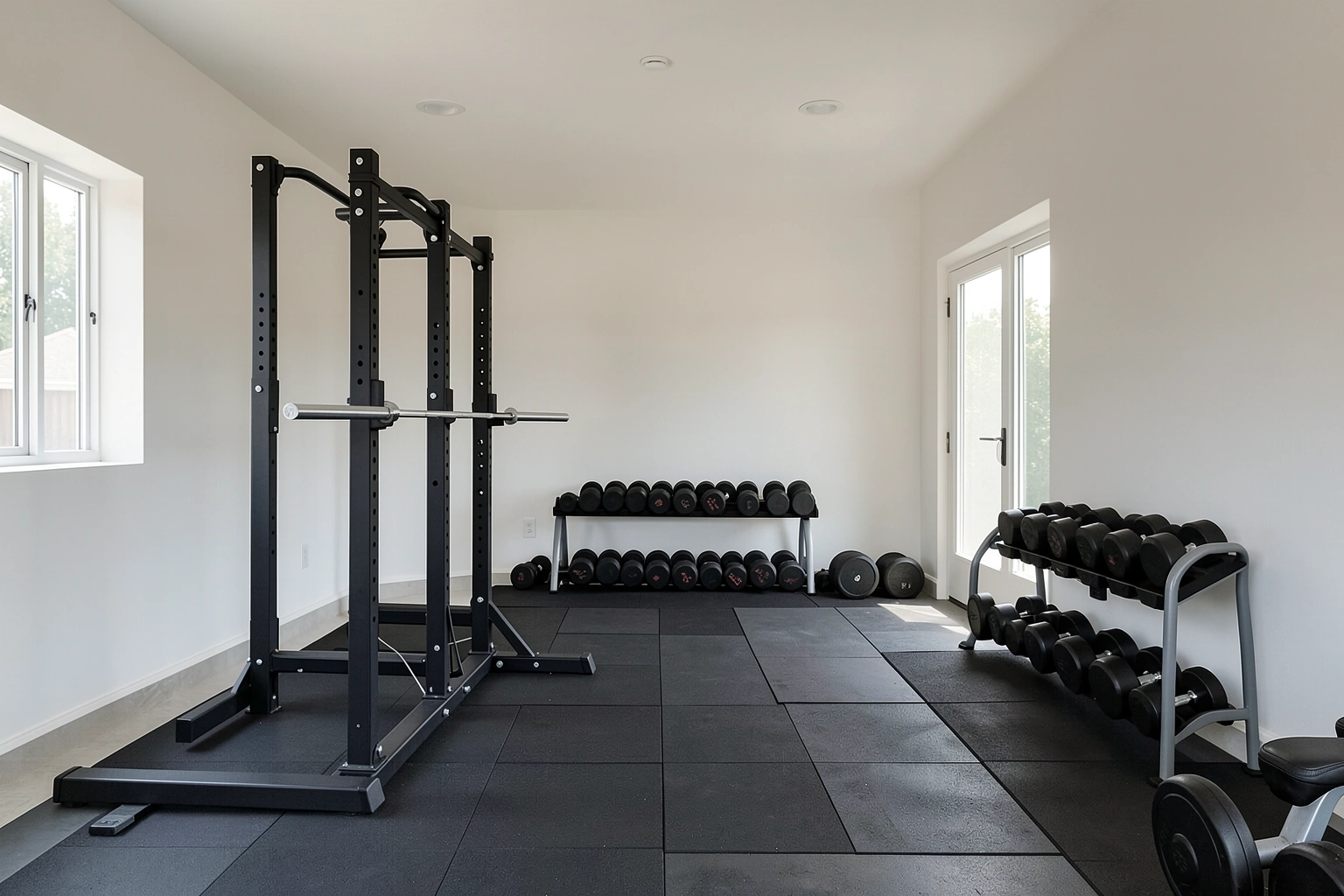
A pair of dumbbells left in a walkway is enough to trip someone carrying a barbell plate. Bands, jump ropes, collars, and charging cords are easy to forget until they are underfoot. In a home gym, clutter is not just untidy; it is part of the injury risk.
How to Check Whether Your Space Is Safe
Think of the room in four parts: floor, ceiling, airflow, and movement paths.
Check the floor first
The floor should be level, stable, and appropriate for the load. This is especially important for racks, benches, and any lifting platform. Thin foam puzzle mats may feel comfortable but can compress unevenly under weight, which is a problem if a rack or bench shifts while you are under load.
Rubber flooring is usually the safer option for heavier training because it is more stable and better at handling impact than thin mats. It is also more useful for dropped dumbbells or plates. Thin mats are fine for light work, stretching, or bodyweight exercise, but they are not a substitute for a stable surface under heavy lifting.
If you are unsure whether the floor can support the equipment and the load, check the room structure and the equipment manual. For mounted or heavy setups, manufacturer guidance matters more than guesswork.
Check ceiling height and overhead clearance
Low ceilings are a common basement problem. Overhead presses, pull-ups, and some cable exercises can become unsafe if the bar or user is too close to the ceiling, light fixtures, or exposed pipes. If you have to duck, bend, or shorten the movement unnaturally, the setup is too tight.
Check ventilation, moisture, and temperature
Garage gyms often have more room than spare rooms, but they also face temperature swings, dampness, and dust. Basements may have moisture and limited airflow. Spare rooms can have better climate control but less space and more furniture nearby.
Moisture is not just uncomfortable. It can rust plates, weaken cable systems over time, and make floors slick. Ventilation matters too, especially if the room gets hot during cardio or heavy lifting.
Check outlets, cords, and access
Powered equipment needs careful placement. A treadmill or rower should not block an outlet, press cords against a wall, or create a step-off hazard. Keep cords out of walking paths and make sure you can reach the power switch quickly if needed.
Approximate clearance and spacing guidance
These are not exact rules, but they are useful starting points for safe home gym setup:
- Power rack: leave enough room to stand, load plates, and walk the bar out without turning sideways. If you train inside the rack, make sure you can step back from the bar and still clear the wall or nearby storage.
- Bench press area: leave space at both ends of the bench so your head and feet are not boxed in. You should be able to unrack, press, and re-rack without your elbows, plates, or spotter arms hitting anything.
- Treadmill: keep the machine away from walls, shelves, and low-hanging items. You need open space for mounting, dismounting, and emergency stepping off, plus a clear path behind and to the sides.
- Dumbbell zone: create a clear lifting area where you can curl, press, or hinge without stepping over weights. Store dumbbells outside the movement lane so the floor stays clear between sets.
If the room only works when you are standing perfectly still, it is too tight for training.
Room-by-room safety concerns
- Garage gym: Watch for moisture, dust, temperature swings, and uneven concrete. Good for space, but not always ideal for delicate equipment.
- Basement gym: Watch for low ceilings, dampness, and limited exits. Flood risk and ventilation are worth considering.
- Spare-room gym: Watch for furniture, fragile walls, outlets, and tighter clearances.
- Apartment gym corner: Watch for noise, vibration, floor load, and shared-wall impact.
For apartment and small-space setups, noise and vibration matter as much as floor space. Dropping weights, jumping, or using a treadmill on a thin floor can transmit vibration through shared walls and ceilings. That can bother neighbors and may also make the equipment feel less stable. In small rooms, choose controlled movements, use flooring that helps dampen impact, and avoid placing heavy equipment directly against shared walls when possible.
For fire safety and clear exit pathways, the NFPA home fire safety guidance is a helpful reminder to keep exits accessible and pathways clear.
Free Weights vs. Machines: Which Is Safer at Home?
Neither option is automatically safe. Each has different risks.
Free weights
Free weights such as dumbbells and barbells are versatile and space-efficient, but they demand more control. They also create more consequence if form breaks down or a lift is failed without protection.
For beginners training alone, dumbbells and simpler free-weight movements are often safer than a barbell bench or squat without safeties because they are easier to bail from. A beginner doing dumbbell presses on the floor can usually escape safely. A beginner benching a barbell alone without safeties has much less margin for error.
Machines
Machines can feel safer because the movement path is guided. That can be helpful for beginners, especially on exercises where balance is not the main goal. In small-space setups, machines may also reduce clutter because the movement stays in one place and the load is easier to control. But machines still cause injuries if they are poorly adjusted, unstable, or damaged. A cable machine with frayed cables or a loose seat is not safer just because it has a fixed path.
Practical decision rule
If you train alone, have limited space, or are still learning basic movement patterns, machines can reduce some risk on certain exercises. If you want versatility and are willing to build a safer setup with racks, safeties, and flooring, free weights can still be used safely at home.
A simple rule of thumb: solo lifters should be more cautious with barbell bench press, heavy back squats, and maximal overhead pressing than with dumbbell work, machine work, or floor-based variations. Beginners usually do better starting with movements that are easier to control and easier to abandon if something feels off.
Safety Setup for Racks, Barbells, and Heavy Lifts
A power rack is one of the most useful safety purchases for a home gym, but only if it is used correctly.
Use safeties for lifts that can fail
For squats, bench press, and other barbell lifts where failure could trap you, use safety bars or spotter arms when training alone. Do not assume you will “just be careful.” Fatigue, distraction, and underestimating a load are common reasons failed reps become accidents.
Safety bars and spotter arms are not the same thing, and the best choice depends on the rack and the exercise. Safety bars generally provide a catch point inside the rack. Spotter arms extend outward and can be useful in some setups, especially when the rack is open or space is limited. In either case, the attachment must be installed correctly and rated for the load.
Collars matter too
Barbell collars keep plates from sliding. They do not make a failed lift safe, but they do reduce the chance of uneven loading or plates shifting unexpectedly during a set.
Do not improvise with unstable supports
Using benches, boxes, or furniture as substitutes for safeties is a bad trade. They can move, tip, or fail under impact. If the rack does not have the right protection, reduce the load or choose a different exercise.
When a spotter is still useful
A spotter is valuable for heavy benching, maximal attempts, or any lift where a miss would be hard to escape safely. Even then, the spotter should understand the lift and the handoff. A person standing nearby is not automatically a spotter.
For general strength-training safety principles, the American Council on Exercise has useful guidance on exercise technique and safe progression.
Flooring, Mats, and Shock Absorption
Flooring is one of the most overlooked safety decisions in a home gym.
Thin mats vs. rubber flooring
Thin mats are fine for stretching, yoga, light dumbbell work, or protecting a floor from sweat. They are not ideal under a rack, a heavy bench, or an area where weights may be dropped.
Rubber flooring is more stable, better at reducing impact, and less likely to shift under load. It also helps protect the floor below from dents, vibration, and repeated impact. The trade-off is cost and installation effort, but the stability is worth it for most serious lifting setups.
Match the flooring to the activity
- Bodyweight and mobility work: simple mat may be enough
- Light dumbbells and accessories: mat or basic flooring protection may work
- Barbell lifting, rack work, or dropped weights: rubber flooring is the safer choice
- Treadmills and other powered machines: stable, level flooring matters as much as cushioning
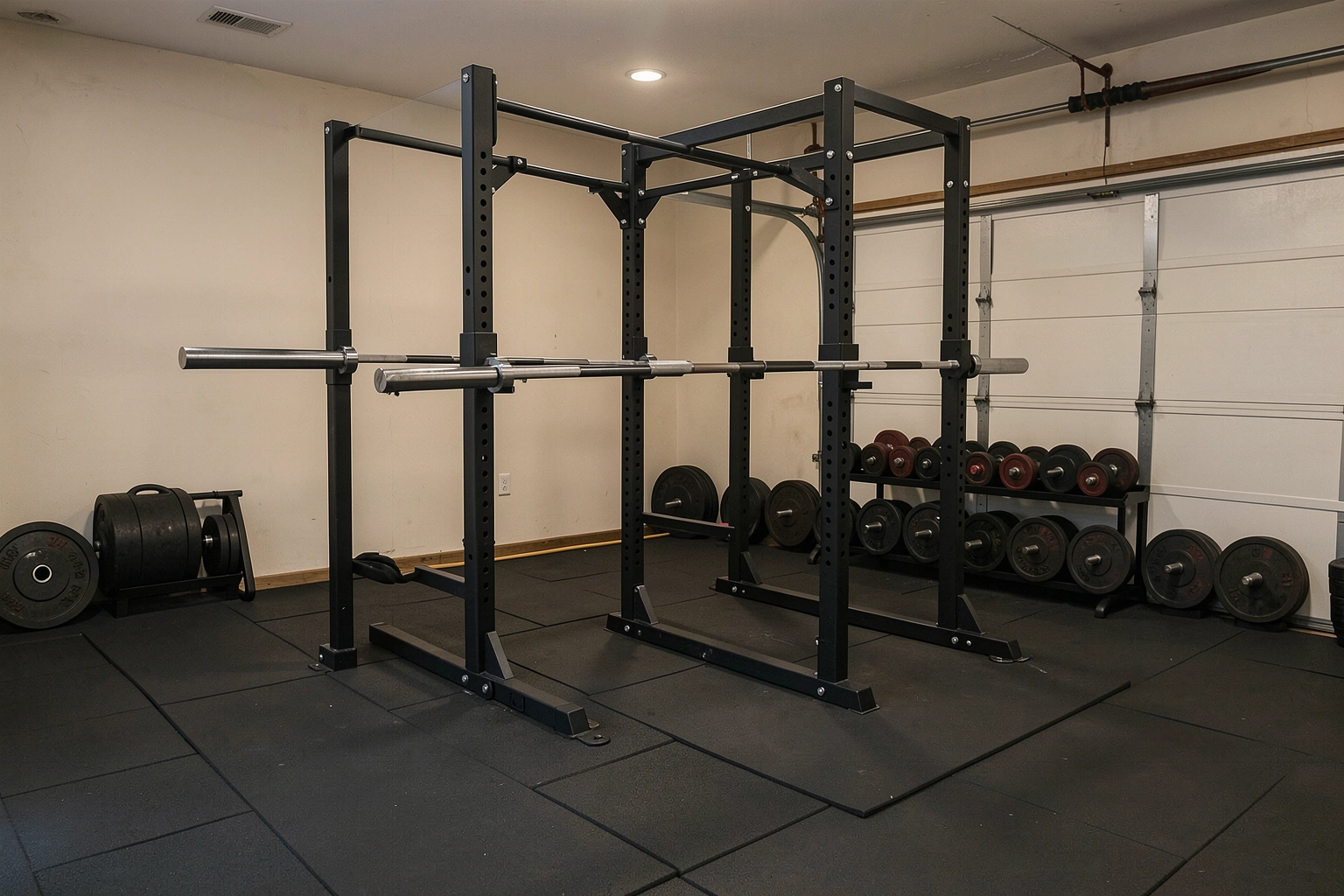
If the rack or bench rocks even slightly, the floor setup needs attention before the workout does.
Safe Storage and Clutter Control
Storage is a safety issue, not just an organization issue.
Keep the floor clear
The safest training lane is the one with no loose equipment in it. That means plates stored on a rack or plate tree, dumbbells on a rack, bands hung or boxed, and cords routed away from movement paths.
Avoid unstable stacks
A shelf full of dumbbells can tip if the weight is removed unevenly or the shelf is not designed for the load. Plates should not be leaned in unstable stacks where they can roll. Resistance bands should not be shoved into a drawer where they can tangle, fray, or get caught underfoot.
Use a home gym “drop zone”
A simple habit helps: create one place for all accessories after each workout. Collars, clips, straps, bands, and jump ropes should go back there every time. This keeps the floor predictable and reduces the chance of stepping on small objects.
Pre-Workout and Weekly Safety Checks
A quick inspection catches more problems than people expect.
Before each workout
Check the following before lifting:
- Confirm the floor is clear, level, and dry.
- Make sure the rack, bench, or machine is stable and in the right position.
- Check bolts, pins, adjustment knobs, collars, and safeties.
- Inspect cables, bands, and moving parts for visible damage.
- Load plates evenly and keep dumbbells, cords, and accessories off the floor.
- Set up a safe warm-up area and then begin training.
Once a week
Do a slower inspection:
- Look for loose bolts or wobbly joints
- Check for frayed cables, cracked handles, or stretched bands
- Inspect barbell knurling, sleeves, and collars
- Look for rust, moisture, or corrosion
- Listen for unusual noises from moving parts
- Check treadmill belt alignment and general machine stability
If equipment starts making new noises, shifting under load, or feeling different from usual, treat that as a warning rather than a quirk.
Common Beginner Lifting Mistakes That Increase Injury Risk
Many home gym injuries come from habits, not equipment.
Skipping the warm-up
Jumping straight into working sets makes poor movement more likely. A short warm-up helps you notice stiffness, adjust technique, and prepare the joints and muscles you are about to load.
Increasing weight too fast
Progressive overload is useful, but the word “progressive” matters. If the load jumps faster than your form can handle, the risk rises quickly. A set should look controlled before the next increase is added.
Chasing depth or load at the expense of position
This shows up often in squats and deadlifts. If the back rounds, knees cave, or the bar path drifts because the load is too heavy, the exercise is no longer serving you well. Reduce the weight and rebuild the movement.
Lifting to failure without a safe setup
Training hard is not the same as training recklessly. Some lifts are reasonable to push close to failure when safety equipment is in place. Others are not worth that risk, especially when training alone.
Cardio Equipment Safety: Treadmills and Other Machines
Cardio equipment has moving parts, electrical components, and step-off risks that make placement important.
Treadmills need open space
A treadmill should not be squeezed between furniture, walls, and cords. You need enough room to mount, dismount, and recover if you lose balance. If the step-off area is cramped, the machine is too tightly placed.
There are also common near-misses here: a runner trips on a loose cord or shoe lace near the treadmill base, catches the front edge of the belt while stepping off, or bumps a wall because the machine was placed too close to a corner. Those are the kinds of mistakes that turn a routine session into a fall.
Keep cords and outlets out of the path
Do not run a power cord where a foot can catch it. Avoid placing a treadmill so close to a wall that the cord bends sharply or the user has to step over anything to get on or off.
Watch for moving-part hazards
Belts, rollers, pedals, and flywheels can pinch fingers or catch clothing if you adjust them while the machine is running. Turn the machine off before cleaning, moving, or inspecting it.
Other cardio machines
Bikes, rowers, and ellipticals are generally simpler than treadmills, but they still need stable placement and regular inspection. Loose pedals, unstable bases, or worn resistance parts can create sudden movement or noise that signals a problem.
When to Repair, Replace, or Stop Using Equipment
Some issues are minor. Others mean the equipment should come out of service.
Stop using equipment until it is repaired or replaced if you notice:
- Wobbling that was not there before
- Loose bolts that keep coming back
- Frayed cables or stretched bands
- Cracks in frames, welds, or plastic parts
- Rust that affects moving parts or structural areas
- Unusual noises under normal use
- Slipping, binding, or uneven movement
- A bench, rack, or machine that no longer sits level
- Electrical problems such as sparking, a burning smell, tripped breakers, intermittent power, or damaged cords
The difference between cosmetic wear and a real safety problem is whether the issue affects structure, movement, or power. Scuffed paint, minor surface scratches, and normal finish wear are usually cosmetic. Cracks, wobble, frayed cables, bent parts, or electrical faults are not cosmetic and should be treated as immediate reasons to stop using the equipment.
If there is any doubt about a load-bearing part, electrical component, or moving cable system, remove the equipment from service until it is checked.
Safer Habits for Solo Lifters and Small-Space Setups
If you train alone, your setup needs to be more forgiving. If the room is small, your exercise choices matter even more.
Favor exercises that are easier to bail from
Dumbbell movements, machine work, goblet squats, and floor presses are often easier to manage alone than heavy barbell lifts without safeties. That does not make them “better,” only safer in a solo setting.
Some exercises are usually poor choices alone unless you have proper safeties or a spotter: heavy bench press, heavy back squat outside a rack, and max-effort barbell attempts that you cannot safely dump or rerack. By contrast, dumbbell benching on the floor, goblet squats, split squats, and many machine exercises are generally easier to manage in a small space.
Use the rack properly
If you own a power rack, learn how to set safety bars or spotter arms for the lifts you do most. That single habit can turn a risky solo squat or bench session into a manageable one.
Keep the load honest
Small spaces can encourage bad form because there is no room to move freely. If you are brushing walls, hitting shelves, or shortening your range of motion to fit the room, the workout is too constrained.
Choose safer alternatives when needed
If a lift feels unsafe without a spotter or proper safeties, swap it for a variation that does not depend on a rescue. That is not a downgrade. It is a smart adjustment to the environment.
When to Consult a Professional
Some situations are worth outside help:
- You are unsure whether the floor can support a heavy rack or machine
- You need to anchor wall-mounted or ceiling-mounted equipment
- The room has moisture, structural concerns, or electrical issues
- A machine is damaged in a way that may affect load-bearing parts
- You are unsure whether a setup meets the equipment manufacturer’s instructions
For equipment installation, the manufacturer’s manual should come first. For structural or electrical concerns, a qualified professional is the safer route.
Home Gym Safety Checklist
Use this quick checklist before training:
- Floor is level, stable, and appropriate for the load
- Clearance is enough for the full movement and a safe exit
- Rack, bench, and machine bolts are tight
- Safety bars, spotter arms, or a spotter are in place when needed
- Plates, dumbbells, and cords are off the floor
- Bands, cables, and moving parts look intact
- No unusual wobble, noise, rust, or looseness
- Treadmill or cardio machine area is open and clear
- Room is dry, ventilated, and free of obvious hazards
A safe home gym is usually not the most expensive one. It is the one where the equipment fits the room, the floor supports the load, and the user has built habits that reduce preventable mistakes.