
Best Treadmills for Heavy People: 300 to 400 lb Capacity Explained

The best treadmills for heavy people: what max user weight really means, motor, belt, frame and cushioning for 300 to 400 lb users, plus walking and running picks.
This article may contain affiliate links. If you buy through them, we may earn a small commission at no extra cost to you. Learn more.
As an Amazon Associate, we earn from qualifying purchases. If you buy through a link on this page we may earn a small commission at no extra cost to you. We do our best to keep that from influencing what we recommend.
If you are a bigger person shopping for a treadmill, the “max user weight” number on the listing matters more than any screen or program. A treadmill pushed close to its limit every day will wobble, run hot and wear out fast. One with plenty of margin will feel solid and last for years.
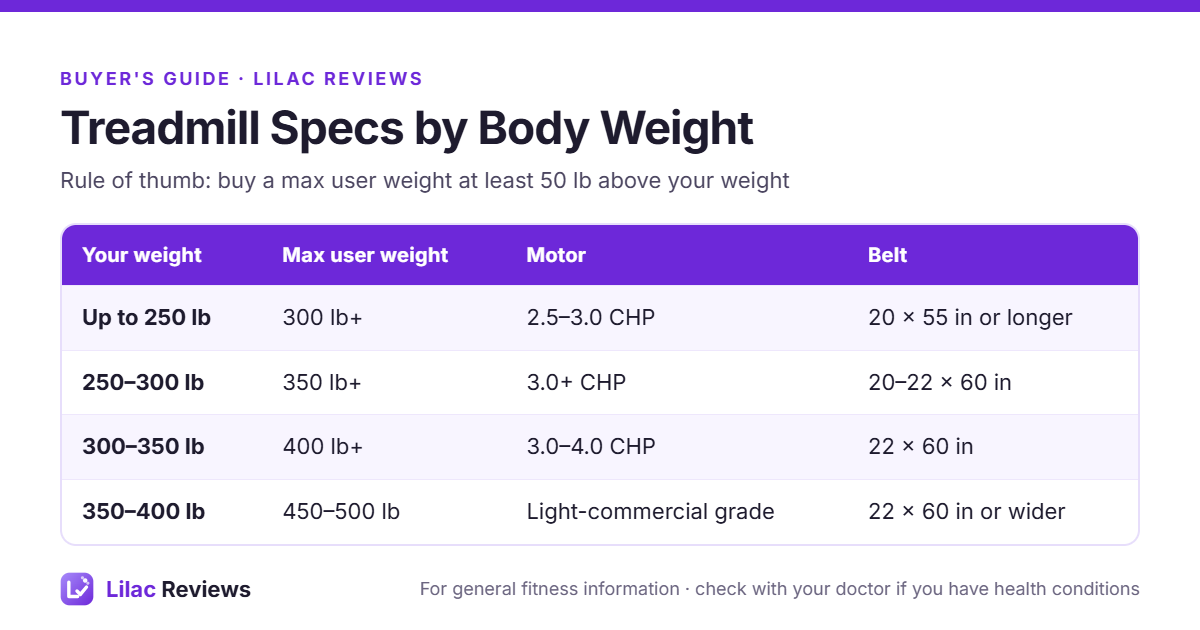
This guide explains what to look for at 250, 300, 350 and 400 lb, and suggests treadmills that are built for it. No judgment here: walking on a solid treadmill is one of the best things you can do for your health, and you deserve equipment that is up to the job.
Specs by body weight
What “max user weight” really means
The max user weight is the heaviest person the manufacturer says can safely use the treadmill. It is not a target. Each step, especially when jogging, puts more force on the deck than your standing weight. A good rule of thumb is to choose a treadmill rated at least 50 lb above your current weight. More margin is better if you plan to jog.
What else to look for
Motor (continuous horsepower)
Heavier users make the motor work harder, especially at low walking speeds and on inclines. Look for 3.0 CHP or more. Ignore “peak HP” figures.
Wider, longer belt
A 22-inch wide belt gives you more room side to side, which feels safer and more natural. A 60-inch length is ideal if you plan to jog.
Frame and deck
A heavier steel frame, larger rollers and a thicker deck reduce flex and bounce. Heavier treadmills (machine weight) are usually sturdier.
Cushioning
Good deck cushioning softens each step for knees and hips without feeling spongy.
Handrails and step-up
Long, sturdy side rails make getting on and off easier. A lower step-up height helps too.
The best treadmills for heavy people
We have not lab-tested these ourselves. Picks are based on published specifications and consistent feedback from independent reviewers and owners. Weight ratings can change between model years, so confirm the current listing.
Best for walking up to 400 lb: Exerpeutic TF1000 Walk to Fitness
This walking treadmill is built for capacity, with a listed 400 lb user limit and extra-long handrails. It is designed for walking speeds only, which keeps forces on the frame lower. It is a sensible, budget-friendly choice for heavier walkers who want stability above all.
Best heavy-duty folding treadmill: Sole F80
The F80 is Sole’s bigger folding treadmill, with a stronger motor, a 22 x 60 inch belt and a higher weight rating than the F63. Reviewers describe it as very stable for a folding model. It suits heavier users who want to walk, incline walk and jog.

Best for users up to about 275 lb: Sole F63
With a 325 lb user limit, a 3.0 HP motor and a 20 x 60 inch belt, the F63 is a solid option if you are under roughly 275 lb and want margin. It costs less than the F80.

Light-commercial options for 400 lb and up
If you weigh over about 350 lb and want to jog, look at light-commercial treadmills rated for 400 to 500 lb. They are heavier and more expensive, but they are built for the load. Check the warranty, delivery and whether the motor runs on a standard household outlet.
What to avoid
- Walking pads rated around 220 to 265 lb if you are near or above that. They have no rails and smaller motors.
- Treadmills rated exactly at your weight; leave margin.
- Very cheap folding models with 16-inch belts and no CHP rating listed.
Low-impact alternatives
If your knees or hips hurt when walking, a recumbent bike or elliptical with a high weight rating can be more comfortable. The Sole E35 is rated for 350 lb, and our recumbent bike guide covers step-through bikes with 300 lb-plus limits. For the bigger picture, see our guide to home gym space and flooring, as heavy treadmills benefit from a firm mat.
Getting started
Start with 10 minutes of comfortable walking, three to five days a week, and add a few minutes each week. Use the handrails for balance while you get used to the belt, then try to walk with a natural arm swing. Every bit counts toward the CDC’s 150 minutes a week.
FAQ
What treadmill can hold 400 lb?
Some walking treadmills like the Exerpeutic TF1000 and many light-commercial treadmills list 400 lb or more. Always check the current spec on the listing.
Is it safe to use a treadmill near its weight limit?
It is within spec, but you will get a steadier ride and longer life with at least 50 lb of margin.
Treadmill or elliptical for heavier people?
Both can work. Ellipticals are gentler on joints; treadmills are more natural for walking. Compare them in elliptical vs treadmill.
Bottom line
Buy for margin: at least 50 lb above your weight, 3.0 CHP or more, and a wide belt. For walking up to 400 lb, the Exerpeutic TF1000 is the budget pick. For walking and jogging with more stability, look at the Sole F80. And if your joints need a break, a high-capacity elliptical or recumbent bike is a great alternative.
Check with your doctor before starting a new exercise routine, especially if you have heart, joint or blood pressure conditions.
This guide is for general information only and is not medical advice. Talk to a qualified professional before starting a new exercise program, especially if you have an injury or health condition.