
Home Gym Planning Mistakes: How to Avoid Costly Setup Errors

A home gym can be one of the most useful upgrades to a home, apartment, or garage. It can also become one of the easiest places to waste money.
The biggest problem is usually not the equipment itself. It is the planning. People buy gear before measuring the space, choose machines that do not fit their training style, or forget that flooring, storage, noise, ventilation, and power all affect how well the gym actually works. The result is a room that looks finished on paper but feels cramped, noisy, or inconvenient in daily use.
If you are planning your first setup, the goal is not to build the biggest gym possible. The goal is to build one you will use consistently without regret. That means matching the room to your workouts, the equipment to your budget, and the layout to the realities of your home.
Why Home Gym Planning Mistakes Are So Costly
Planning mistakes tend to compound. A wrong-sized treadmill, for example, is not just a bad purchase. It can block walking paths, create noise issues, and force you to rearrange the rest of the room. A thin floor covering is not just uncomfortable; it can transmit vibration, damage flooring, and make lifting feel unstable.
These mistakes are costly in three ways:
- Money: equipment, flooring, delivery, assembly, and repairs can add up quickly
- Space: a bad layout can make a room feel smaller than it is
- Consistency: if the setup is awkward, noisy, or uncomfortable, you stop using it
A home gym should make workouts easier to start and easier to repeat. If the setup creates friction every time you train, the equipment may look useful but still go unused.
A few common mistakes show how quickly that friction builds. Buying a bulky machine for a compact room can leave no clear path to the door, which makes the space feel cramped and discourages quick workouts. Choosing a treadmill or weight setup without thinking about noise can also create tension with neighbors or family members, especially in apartments and shared homes. Even a “good” purchase can become a problem if it forces daily rearranging just to use the room.
Start With Your Training Goals, Not the Equipment List
The most common mistake is building a shopping list before defining the actual use case. A home gym for strength training looks different from one built for walking, mobility, or general fitness. A setup for three short workouts a week also does not need the same equipment as a room intended for heavy lifting and conditioning.
Ask a few concrete questions before buying anything:
- What workouts will I actually do in a normal week?
- Which exercises matter most?
- How much time will each session usually take?
- Do I want a flexible space or a dedicated training room?
For example, if your real routine is dumbbell work, push-ups, and occasional cardio, a bench, adjustable dumbbells, floor space, and storage may be enough. If you buy a power rack, barbell, multiple plates, and a large machine first, you may end up with a setup that takes over the room without improving your routine.
A useful rule: if an item does not support the training you are already doing, treat it as optional until the core setup is complete.
Match equipment to actual habits
A home gym works best when it reflects what you already do, not what you imagine doing someday. Aspirational purchases are one of the fastest ways to waste budget. A rower, cable machine, or specialty bench may be excellent for the right person, but not if they replace the basics you use every week.
For a beginner, the most practical first purchases are often the ones that support multiple movement patterns: adjustable dumbbells, a bench, a mat or flooring, and a storage solution. Those items stay useful even as training changes.
Measure the Real Space You Can Use
Room size on paper is not the same as usable training space. A room may have enough square footage for a gym and still be awkward because of low ceilings, door swings, sloped ceilings, baseboard heaters, built-ins, or furniture that cannot be moved.
Measure these things before you buy:
- usable floor area, not just total room dimensions
- ceiling height, especially for overhead pressing or pull-up work
- clearance around equipment
- door swing and traffic flow
- space needed to store equipment when not in use
Clearance matters more than many people expect. A bench may fit in the room but still leave too little space to load plates, adjust dumbbells, or walk safely around it. Cardio equipment can create a similar problem if it sits too close to walls or blocks access to other parts of the home.
If you are planning a rack, bench, or larger machine, check the manufacturer’s installation guidance and spacing recommendations rather than guessing. That is especially important for wall-mounted or anchored equipment.
Think in movement paths, not just furniture placement
A good layout leaves room for the body to move, not just the equipment to sit still. You need space to step back from a bench, load weights, open a door, or move between exercises without turning the workout into a game of obstacle avoidance.
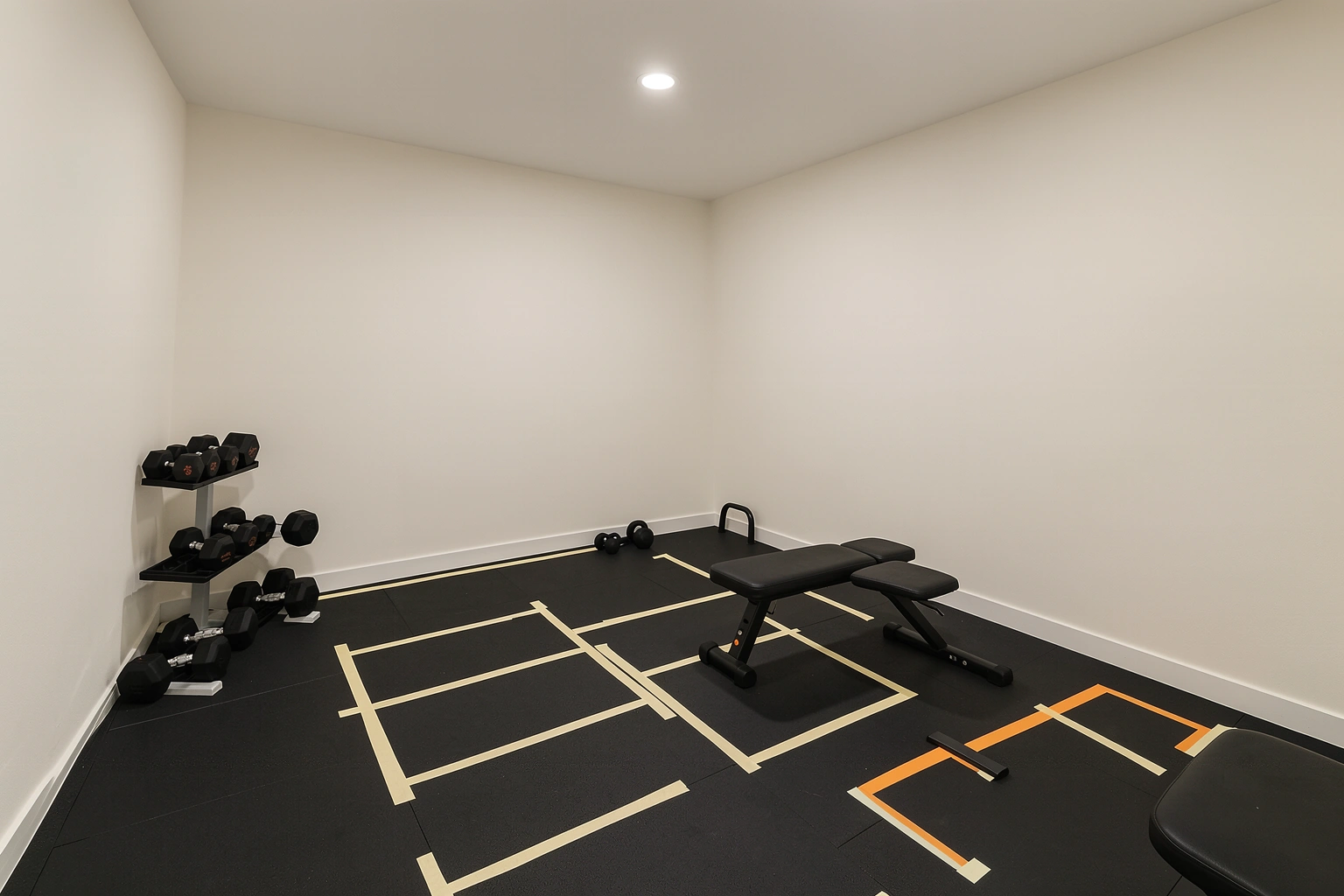
One practical method is to tape the footprint of major items on the floor before buying them. Use painter’s tape to mark the dimensions of a rack, bench, or cardio machine, then walk through the space as if you were training. If the room feels tight with tape, it will feel worse with metal and rubber in place.
Match the Setup to the Room Type
The same gym plan does not work equally well in every room. A garage, spare room, basement, and apartment each come with different constraints.
| Room type | Strengths | Common constraints | Best planning approach |
|---|---|---|---|
| Garage | More open space, easier for larger equipment | Temperature swings, dust, moisture, noise | Prioritize flooring, storage, and climate comfort |
| Spare room | More controlled environment, quieter use | Limited space, furniture conflicts, ceiling height | Use compact, multi-use equipment |
| Basement | Good for dedicated setups, often private | Moisture, low ceilings, lighting, access | Check humidity, lighting, and airflow first |
| Apartment | Convenient and space-efficient | Noise, vibration, shared walls and floors | Keep equipment compact and low-impact |
A garage gym often looks simple at first, but flooring, insulation, and storage can become major parts of the project. A spare room usually needs a tighter equipment strategy because every square foot matters. Basements can work well if moisture and ventilation are managed. Apartments are the most sensitive to noise and vibration, which makes dropped weights and heavy cardio machines poor fits unless the building and flooring can handle them.
If you are unsure which room is best, choose the one that lets you train most often with the fewest compromises. Convenience matters more than theoretical capacity.
Renter and apartment planning checklist
If you are renting or setting up in an apartment, check the rules before you buy:
- Get landlord approval for flooring, wall mounting, and any anchors or fasteners
- Review lease terms for noise, equipment limits, and restrictions on modifications
- Check building rules for shared walls, hallways, elevators, and delivery windows
- Confirm whether rubber flooring, mats, or underlayment are allowed on the subfloor
- Ask about wall-mounted storage, mirrors, and rack installation if you plan to use them
- Plan for noise and vibration control before choosing cardio or heavy lifting gear
- Protect floors with the right material if the lease or building requires it
In compact rentals, a setup that seems fine to you can still create problems below or next door. A little planning up front is usually easier than dealing with complaints, damage charges, or having to remove equipment later.
The Most Common Home Gym Planning Mistakes
This is where most first-time setups go wrong.
Buying equipment before defining the layout
People often buy a rack, treadmill, or machine because it seems like the “main” gym item, then discover there is no sensible place to put it. Layout should come first because the room determines what is realistic.
A better sequence is: measure the room, define the training goal, choose the equipment mix, then buy.
Overbuying single-purpose machines
A small space usually benefits more from versatile gear than from multiple machines that each do one job. A cable machine, leg extension machine, and separate cardio machine may make sense in a large dedicated room, but in a tight space they can crowd out the basics.
Multi-use equipment is often the smarter choice when space or budget is limited. Adjustable dumbbells, an adjustable bench, and a compact storage system can support a wide range of training without dominating the room.
Ignoring flooring and floor protection
Flooring affects comfort, noise, and safety. It also protects the subfloor beneath the gym. Thin foam mats may work for light stretching, but they are usually not enough for weights or heavier equipment. Rubber flooring is commonly used because it is more durable and helps reduce impact and vibration, though the right thickness and installation method depend on the room and equipment.
If the floor is unstable, slippery, or too soft, the gym will feel less secure. That matters whether you are lifting, stepping on and off a bench, or moving cardio equipment.
For installation and product-specific load guidance, check the flooring manufacturer’s instructions rather than assuming one material fits every room.
Forgetting storage until the room is already full
Storage is not a finishing touch. It is part of the layout. Without a place for dumbbells, bands, mats, collars, or jump ropes, equipment ends up on the floor. That creates clutter, makes cleaning harder, and increases trip hazards.
Wall storage, shelves, bins, and compact racks can keep the space usable. In a small room, storage often matters as much as the workout equipment itself.
Underestimating noise and vibration
This mistake is especially common in apartments and shared homes. A treadmill on a bare floor, a dropped dumbbell, or a rack used for heavy lifting can create noise that travels farther than expected. Even if the sound seems manageable in the room, it may be a problem below or next door.
If you live in a shared building, prioritize quieter training options and floor protection. That may mean choosing adjustable dumbbells over heavier free-weight drops, or a bike over a treadmill if impact noise is a concern.
Ignoring ventilation, lighting, and temperature
A gym that is too hot, stuffy, dim, or humid is harder to use consistently. In garages and basements, this can become the difference between a space you enjoy and a space you avoid.
Good lighting helps with safe setup and movement. Ventilation and temperature control help the room feel comfortable enough for regular use. In damp spaces, humidity control may also matter for both comfort and equipment longevity. For broader safety and ventilation guidance, the U.S. Consumer Product Safety Commission and OSHA are useful starting points for general home and work-area safety principles.
How to Choose the Right Equipment Mix
The best equipment mix is the one that supports your actual training without crowding the room.
A simple first setup often works best:
– adjustable dumbbells
– a bench
– a mat or proper flooring
– a storage solution
– one cardio item if you will truly use it
If strength training is the priority, a power rack can be a strong anchor for the room, but only if the ceiling height, footprint, and clearance all work. If space is tight, a rack may be a better long-term investment than multiple isolated machines because it supports more exercises in a single footprint.
If your main goal is general fitness or low-impact conditioning, you may be better off with a compact bike, rowing machine, or just floor-based training tools. If a machine will take up most of the room and only serve one narrow purpose, it deserves extra scrutiny.
Budget setup vs full home gym
A budget setup should focus on the smallest set of items that makes regular training possible. That usually means flooring or floor protection, a few versatile tools, and storage that keeps the room usable.
A fuller home gym can add machines, specialty attachments, mirrors, and comfort upgrades once the core setup is already working. The key is to avoid buying “nice-to-have” items before the basics are in place.
Buy-first / buy-later priorities by training style
- General fitness or beginner strength: buy flooring, adjustable dumbbells, a bench, and storage first; add cardio or specialty gear later
- Barbell strength training: buy flooring, a rack if the room supports it, a barbell, plates, and storage before accessories
- Low-impact cardio and mobility: buy flooring or a mat, a compact cardio option, and open floor space before larger machines
- Mixed training in a small room: buy the most versatile pieces first and delay single-purpose machines until the layout proves they will fit
Free weights vs machines in limited space
Free weights are usually more space-efficient because one set of dumbbells or a barbell setup can cover many exercises. Machines can be easier to use and sometimes more comfortable, but they often require more room and less flexibility.
For a first home gym, free weights plus a bench often provide a better balance of cost, versatility, and footprint. Machines make more sense once the core setup is already working and the room can support them.
Don’t Forget the Hidden Costs
Many people budget only for the equipment and are surprised by the rest of the project.
Common hidden costs include:
– flooring or floor protection
– mirrors
– storage
– delivery and assembly
– wall mounting or anchoring hardware
– electrical work or outlet access
– climate or ventilation improvements
– cleaning supplies and maintenance items
A garage gym owner, for example, may focus on racks and weights, then discover that flooring, storage, and comfort upgrades are needed before the space is actually usable. The same is true in apartments, where noise control and floor protection can be just as important as the equipment itself.
If you are working within a limited budget, keep the room usable before chasing completeness. A small, well-planned setup is more valuable than a half-finished large one.
Plan for Safety, Comfort, and Consistency
A home gym should be easy to enter, safe to use, and comfortable enough to repeat week after week.
Safety basics that affect daily use
- Keep heavy equipment stable and level.
- Follow manufacturer instructions for anchoring, assembly, and load limits.
- Leave enough clearance to lift, step, and re-rack weights safely.
- Avoid placing equipment in front of exits or in a way that blocks movement.
For racks, wall mounts, mirrors, and storage, check the product’s installation guidance and weight ratings. If something needs to be anchored or mounted, treat that as a requirement, not a suggestion.
Comfort details that improve consistency
Lighting should make the room feel bright enough to move confidently. Ventilation should keep the air from feeling stale. Temperature should be manageable enough that you do not dread entering the space. These are not luxury features; they affect whether the gym becomes part of your routine.
If the room feels unpleasant, the equipment will not save it.
Habit and long-term use
A good setup also has to match your real schedule and motivation level. If you only have 20 to 30 minutes on most days, a complicated system with multiple setup steps can become a barrier. If you are still building the habit, it may be better to buy equipment that is easy to access and quick to use than to invest in a room that only works for idealized future workouts.
The best plan is one you can repeat on a busy week, not just when motivation is high.
A Step-by-Step Home Gym Planning Checklist
Use this checklist before you buy anything:
- Write down your main training goal.
- List the exercises you actually do now.
- Measure usable floor space and ceiling height.
- Mark door swings, outlets, vents, and fixed obstacles.
- Decide whether noise or vibration will be a problem.
- Choose the minimum equipment needed for your routine.
- Plan flooring and floor protection.
- Add storage to the layout before buying gear.
- Check installation guidance for racks, mounts, and machines.
- Budget for delivery, assembly, and room upgrades.
- Test the layout with tape or cardboard cutouts.
- Leave space for future progression, not just current needs.
This process takes longer than impulse buying, but it prevents the most expensive mistakes.
Budget Priorities for a Better First Setup
If money is tight, spend in this order:
- Safety and floor protection
- Core equipment you will use weekly
- Storage
- Comfort upgrades like lighting or ventilation
- Optional specialty equipment
That order works because the room must function before it can feel complete. A cheap but cluttered gym is less useful than a modest setup that is safe, organized, and easy to use.

A practical budget example can help. On a tight budget, you might put most of the money into floor protection and one or two versatile pieces, then delay everything else. On a larger budget, you can cover flooring, storage, core equipment, and one or two comfort upgrades without sacrificing usability. The exact amounts will vary, but the principle stays the same: protect the floor, cover the basics, then add convenience.
For many first-time buyers, the smartest path is a minimalist gym built around versatile essentials rather than a crowded room filled with overlapping gear. You can always add equipment later once you know what your routine actually demands.
When to Consult a Professional
Some home gym projects are straightforward. Others benefit from professional input.
Consider getting help if you are:
– mounting heavy equipment to walls or ceilings
– adding electrical work for powered machines
– converting a garage or basement with moisture, insulation, or ventilation concerns
– unsure whether the floor can handle the intended load
– dealing with shared walls, floors, or building rules that affect noise or installation
If local building codes, permits, or fire safety requirements may apply, confirm them with your municipality or building manager before making structural changes. In apartment settings, landlord approval may also matter for flooring, wall mounting, and electrical changes.
Common Questions About Home Gym Planning
How much space do I need for a home gym?
There is no universal minimum that fits every setup. A small gym can work in a spare corner if you only need floor work and adjustable dumbbells. A rack, bench, and barbell setup needs much more room, especially once you account for clearance and safe movement.
What should I buy first?
Buy the items that support your actual weekly workouts. For many people, that means flooring, adjustable dumbbells, a bench, and storage before specialty machines. If strength training is the priority and the room can handle it, a rack may come earlier.
Is a garage gym better than a spare room gym?
Not automatically. A garage offers more openness and often more equipment flexibility, but it usually needs more attention to temperature, dust, and moisture. A spare room is more comfortable but can be too small for bulky equipment.
What flooring is best for a home gym?
The best flooring depends on the room and equipment. For many setups, rubber flooring or rubber floor protection is a practical choice because it is more durable and helps with impact and noise. Always check product guidance and match the flooring to the load and use case.
How do I keep a home gym quiet enough for neighbors?
Choose low-impact equipment, use proper floor protection, avoid dropping weights, and place heavy items on stable surfaces. In apartments, it is usually safer to plan around vibration control from the beginning than to try to fix it later.
Should I buy more equipment now or build slowly?
Build slowly unless you already know the room can support a larger setup. A smaller, well-used gym is usually a better investment than a crowded one full of underused gear.
Final Takeaway
The best home gyms are not the ones with the most equipment. They are the ones that fit the room, support real training habits, and stay comfortable enough to use regularly.
A simple decision rule helps: if you are choosing between a bigger purchase and a more usable setup, prioritize the option that improves consistency first. Measure the room, confirm the rules, cover flooring and storage, and buy equipment in the order your actual training demands it. That approach is usually the safest way to avoid regret, especially in apartments and other compact spaces.