
Home Gym Setup Mistakes Beginners Make

A home gym can save time and make training more consistent. It can also become an expensive storage room full of gear you do not use.
That is usually where beginners go wrong. They buy equipment before defining their training goals, underestimate the space they actually have, and spend money on items that look useful but do not support their real routine. The result is a setup that feels crowded, awkward, and more expensive than it should be.
This guide focuses on the most common home gym setup mistakes beginners make and how to avoid them before you buy anything. The goal is not to build the perfect gym on day one. The goal is to build a setup that fits your space, your budget, and the workouts you will actually do.
Why Beginners Regret Their First Home Gym Setup
Most first-time buyers regret one of three things:
- They bought the wrong equipment for their training style.
- They filled the room too quickly and lost usable space.
- They spent the budget in the wrong order.
A common example is the beginner who buys a treadmill first because it seems like a safe all-purpose choice, then later realizes they wanted strength training more than cardio. Another is the renter who fills a spare room with large machines, only to discover there is no safe clearance to use them properly.
The bigger issue is that home gym purchases are hard to undo. At home, every item has to earn its place in the room, the budget, and your routine. That is why a bad first purchase can create problems in two places at once: it can crowd the room and push out the equipment you actually need.
Start With Your Training Goals Before Buying Anything
Before you compare racks, dumbbells, or cardio machines, decide what your home gym should support.
Ask yourself a simple question: What workouts will I do most weeks?
If your routine will center on strength training, your priorities are different from someone who wants low-impact cardio, mobility work, or general fitness. If you want strength work, you may eventually want a bench, dumbbells, and barbell equipment, but you do not need to buy all of that at once. If you want cardio, you may need more open floor space and one machine you will actually use. If you want general fitness, a flexible mix of dumbbells, bands, and a small amount of open space may be enough.
This step matters because many beginner mistakes come from buying gear that is technically useful but not useful for your plan. A rowing machine can be excellent, but not if your real goal is full-body strength work. A rack can be a smart long-term purchase, but not if you only have room for bodyweight training and adjustable dumbbells.
A useful rule: buy for the workouts you will do in the next six to twelve months, not the version of yourself you imagine three years from now. That keeps the setup realistic and prevents overbuilding.
A simple decision framework for first purchases
If you are not sure where to start, choose based on your main goal:
- Strength-focused beginner: start with the most versatile strength tools you can fit, such as adjustable dumbbells, a bench, and floor protection. Add barbell equipment later only if you know you will use it and have the room for it.
- Cardio-focused beginner: start with the cardio option you are most likely to use consistently, then leave enough open floor space around it. If the machine will crowd the room, it may be the wrong first buy.
- General-fitness beginner: start with a flexible base such as dumbbells, bands, a bench, and mats. That gives you strength, mobility, and conditioning options without locking you into one training style too early.
Measure Your Space and Plan the Layout First
A home gym should be measured like a room you intend to use, not a room you hope will somehow fit everything.
Before you buy, measure:
- Floor dimensions
- Ceiling height
- Doorway width
- Clearance around the area
- Storage space for plates, bands, and accessories
This is especially important for racks, benches, and any equipment that moves through an arc or requires loading space. A rack that looks compact online may feel oversized in a small room once you account for barbell clearance, walking space, and access to nearby walls or doors.
For very small rooms and apartments, it helps to think in practical room sizes:
- About 5′ x 6′ to 6′ x 8′: usually better for floor work, bands, adjustable dumbbells, and a folding or compact bench if you can keep the area clear.
- About 8′ x 10′: often enough for a more complete beginner setup with dumbbells, a bench, storage, and some open movement space.
- A spare bedroom or garage corner with more depth: may allow a small rack or larger cardio machine, but only if you still have room to move safely around it.
If you are in an apartment or a tight spare room, the question is not just whether the equipment fits. It is whether you can still walk around it, use it safely, and store it without blocking doors or furniture.
[IMAGE PLACEHOLDER 1]
The layout should also respect traffic flow. If you have to move a bench every time you want to reach a dumbbell, the room is working against you. If a door opens into your lifting area, that matters. If you need space for a pull-up bar, overhead clearance matters too.
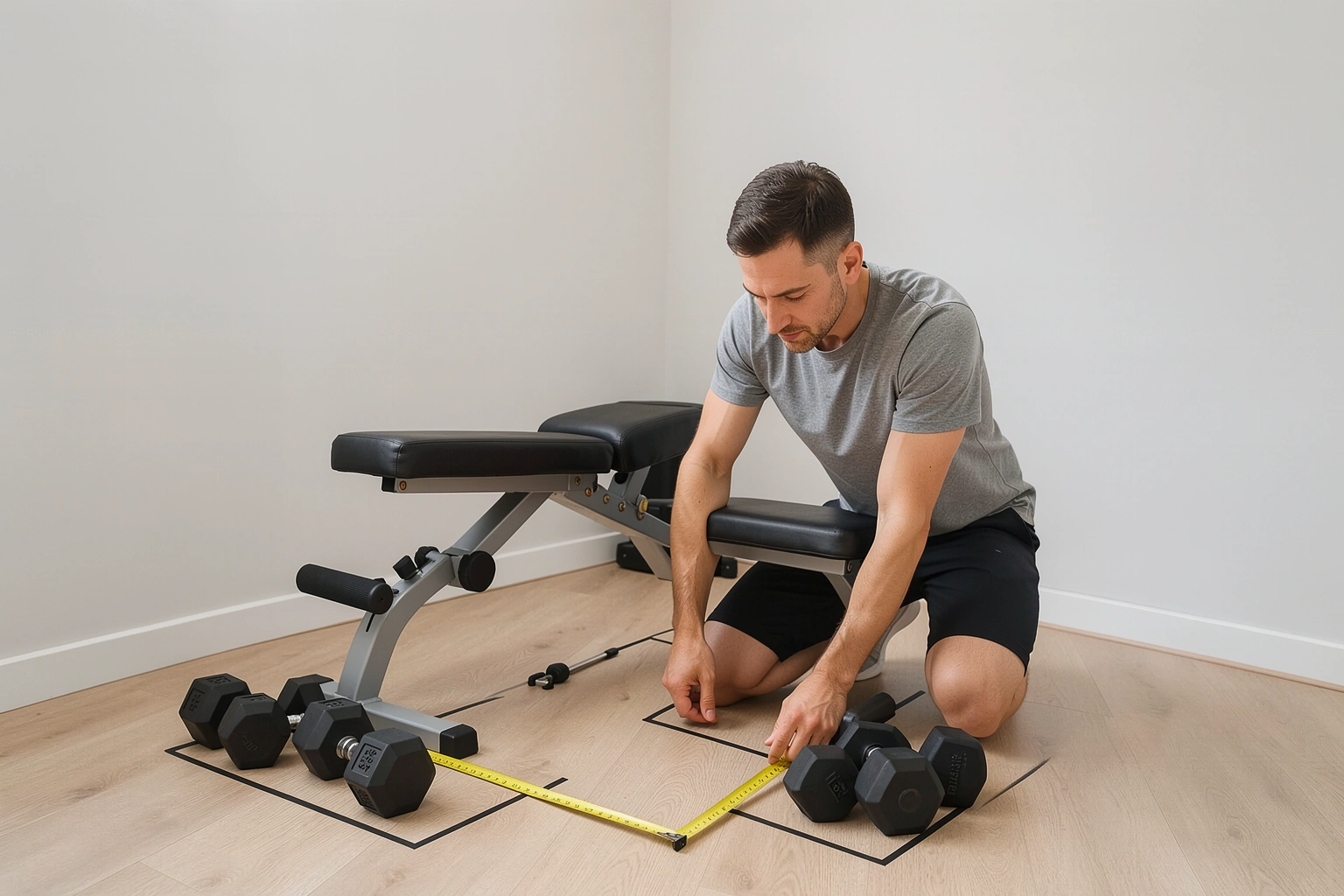
For mounted or heavy equipment, use manufacturer instructions for installation and anchoring. When a product depends on studs, concrete, or a specific wall type, the safest answer is always the product documentation, not guesswork. For general home safety and room planning, Consumer Reports and OSHA both publish practical safety guidance that can help you think through hazards, storage, and setup.
Mistake #1: Buying Equipment Before Defining a Budget
A budget is not just a spending limit. It is a decision tool.
Without one, beginners often do the opposite of what they intended: they buy one expensive item, then realize they have no money left for the essentials that make the gym usable. That can leave you with a rack and no barbell, or a treadmill and no space for strength training accessories.
A practical approach is to divide your budget into tiers:
- Essentials: the minimum needed to train the way you want
- Support items: flooring, storage, and safety-related pieces
- Extras: specialty accessories, cardio add-ons, and convenience items
If a purchase does not support your main training plan, it should wait until the essentials are covered.
This is also where impulse buys cause trouble. A catalog or product page can make every attachment look useful, but accessories are easy to overbuy. A beginner who adds dip bars, curl attachments, landmine tools, and specialty handles before buying the basics may end up with a cluttered room and a thin workout foundation.
A simple decision rule helps: if the item does not improve your main workouts this month, it is probably not the next purchase.
Mistake #2: Choosing Bulky or Single-Use Equipment Too Early
Large single-purpose machines can be appealing because they look complete. In practice, they often consume more floor space than beginners expect and limit how flexible the room can be.
This is where multi-use equipment usually wins. An adjustable bench can support presses, rows, step-ups, and seated work. Adjustable dumbbells can replace several pairs of fixed dumbbells in a small room. Resistance bands take almost no space and can supplement warm-ups, assistance work, and mobility.
The trade-off is straightforward:
- Single-use equipment may feel more specialized and comfortable for one exercise
- Multi-use equipment usually offers better value per square foot and per dollar
That does not mean every machine is a mistake. It means the timing matters. A beginner with one room and a modest budget usually benefits more from versatile gear than from a large machine that only serves one function.
A good example is the difference between a treadmill and a compact cardio option. If you know you will walk or run often and you have the space, a treadmill can make sense. If you are unsure, a bulky machine is a risky first buy because it can dominate the room before you know whether you will use it consistently.
What to Buy First in a Beginner Home Gym
A smart starter setup usually follows a simple sequence:
- Floor protection
- One primary training tool
- A bench or support surface, if your workouts need one
- Storage
- Optional cardio or accessories
For many beginners, that means starting with:
- Adjustable dumbbells or a small set of fixed dumbbells
- An adjustable bench if you plan to press, row, or do seated work
- Resistance bands
- Rubber flooring or mats
- Basic storage for plates or small items
If your goal is barbell training and you have the room for it, a barbell, weight plates, and a stable rack or squat solution may come before extra accessories. If your goal is mostly cardio, the first purchase may be the machine you will realistically use, plus enough open space around it to move comfortably. If your goal is general fitness, a compact setup built around dumbbells, bands, and mats is often the easiest place to start.
The main idea is to build a usable base first. A home gym is not more effective because it has more items. It is more effective when the items you own support actual training without crowding the room.
Adjustable Dumbbells vs Fixed Dumbbells, and Other Key Trade-Offs
Some beginner decisions are less about right or wrong and more about trade-offs.
| Choice | Best for | Main advantage | Main drawback |
|---|---|---|---|
| Adjustable dumbbells | Small spaces, beginners, limited budgets | Replaces multiple pairs in one footprint | Can be slower to change and may have limits on weight range |
| Fixed dumbbells | Frequent use, shared spaces, fast transitions | Quick to grab and use | Takes much more storage space |
| Power rack | Barbell training, heavier lifting, long-term use | More stable and versatile for serious strength work | Larger footprint and higher upfront commitment |
| Squat stands | Smaller rooms, lighter setups | Smaller and more flexible | Less stable and less protective than a full rack |
| Budget gear | First setup, limited budget | Lower initial cost | May wear faster or feel less stable |
| Premium gear | Long-term use, heavy training, frequent sessions | Better durability and finish | Can absorb too much of the budget too early |
A beginner in a small apartment often gets more value from adjustable dumbbells and a bench than from a full rack. A beginner with a garage or dedicated room may be able to build toward a larger barbell setup sooner. The right choice depends on both training style and room size.
For example, adjustable dumbbells often make more sense than a full spread of fixed dumbbells in a spare room. But if multiple people will train there daily, fixed dumbbells may be easier to share and faster to use.
Mistake #3: Ignoring Safety, Flooring, and Clearance Space
Safety problems in a home gym are often simple and preventable.
The most common issues are:
- Slippery or uneven flooring
- Too little space around benches and racks
- Poor storage that creates trip hazards
- Weak or inappropriate mounting surfaces
- Bad ventilation in a closed room
Rubber flooring is useful because it helps protect the floor, reduces noise, and gives equipment a more stable surface. In apartments or shared homes, that extra protection matters even more because dropped weights, foot traffic, and vibration can travel.
Clearance space matters just as much as the equipment itself. A bench press setup needs room to move around the bench and bar safely. A rack needs enough space for loading plates and walking in and out without clipping walls or furniture. A ceiling that looks “high enough” may not actually allow for pull-ups or overhead pressing once you account for the bar, plates, and your own reach.
Ventilation is another overlooked issue. A small room can heat up quickly during training, especially if windows are limited. Good airflow, a fan, or a climate-controlled space can make the room more usable and more comfortable.
For electrical safety, avoid running overloaded power strips or extension cords across the floor. Keep cords out of walkways and follow the manufacturer guidance for any machine that needs power.
Mistake #4: Overcrowding the Room and Creating Clutter
A cluttered gym is not just ugly. It becomes harder to use.
Beginners often buy equipment in isolation and forget to plan where each item will live when it is not in use. That leads to piles of bands, loose plates, dumbbells on the floor, and benches that block access to everything else.
The fix is storage planning before purchase. If you buy plates, decide where they will go. If you buy resistance bands, decide whether they will hang, sit in a bin, or store on a wall-mounted organizer. If you buy a bench, think about whether it folds, rolls, or stays in place.
Small-space gyms work best when the room has a clear “home” for each item. That keeps the floor open and reduces the chance of tripping over gear between sets.
A practical small-space strategy is to keep only one or two items permanently on the floor and store everything else vertically or off to the side. That gives the room more flexibility and makes it easier to clean and reset.
Mistake #5: Spending Too Much on Premium Gear Too Soon
Premium equipment can be worth it, but not before the basics are covered.
The beginner mistake is assuming the most expensive version of an item is automatically the best first purchase. In reality, a high-end rack or bench does not help much if you still need flooring, weights, or a way to store the equipment safely.
A better rule is to match quality to use frequency and load demands.
- If an item will be used heavily and supports your main lifts, durability matters more.
- If an item is optional or experimental, a simpler version may be enough.
- If you are still refining your routine, flexibility is often more valuable than premium finish.
This is where budget gear versus premium gear becomes a real planning question. Budget equipment can be a sensible starting point if it is structurally appropriate and comes from a reputable source. Premium gear may be the right choice if you already know you will use it often and want to avoid replacing it later.
The key is not to overspend on one piece while leaving the rest of the gym unfinished.
New vs Used vs Budget Equipment: How to Decide
Buying used can stretch a budget, but it requires more caution than buying new.
Here is a simple way to think about it:
- New equipment: best when you want warranty support, clean condition, and fewer unknowns
- Used equipment: best when you can inspect condition, confirm stability, and know the item’s history
- Budget equipment: best when the item is low-risk and not central to your setup
Used dumbbells or a sturdy bench can be a smart buy if they are in good shape. Used cables, worn padding, or equipment with missing hardware deserve more caution. For racks, benches, and mounted items, stability and completeness matter more than cosmetic wear.
If you are unsure, buy new for the items that carry the most load or affect safety, and consider used for simpler accessories.
A Simple Beginner Home Gym Setup That Works in a Small Space
A practical small-space setup does not need to be complicated.
For a room around 6′ x 8′, a compact setup might include:
- Adjustable dumbbells
- A folding or compact adjustable bench
- Resistance bands
- Rubber flooring or mats
- Wall or shelf storage for small items
For a room around 8′ x 10′, you may have room for the same basics plus a little more open floor area, which makes warm-ups, mobility work, and bodyweight training easier.
If you are working with a very small apartment corner, the goal may be even simpler: one adjustable weight option, one mat, and enough clear floor space to move safely. In that case, the right setup is often the one that disappears neatly when you are done using it.
This setup supports a wide range of strength workouts without filling the room. It also leaves enough open floor area to move, stretch, and train comfortably.
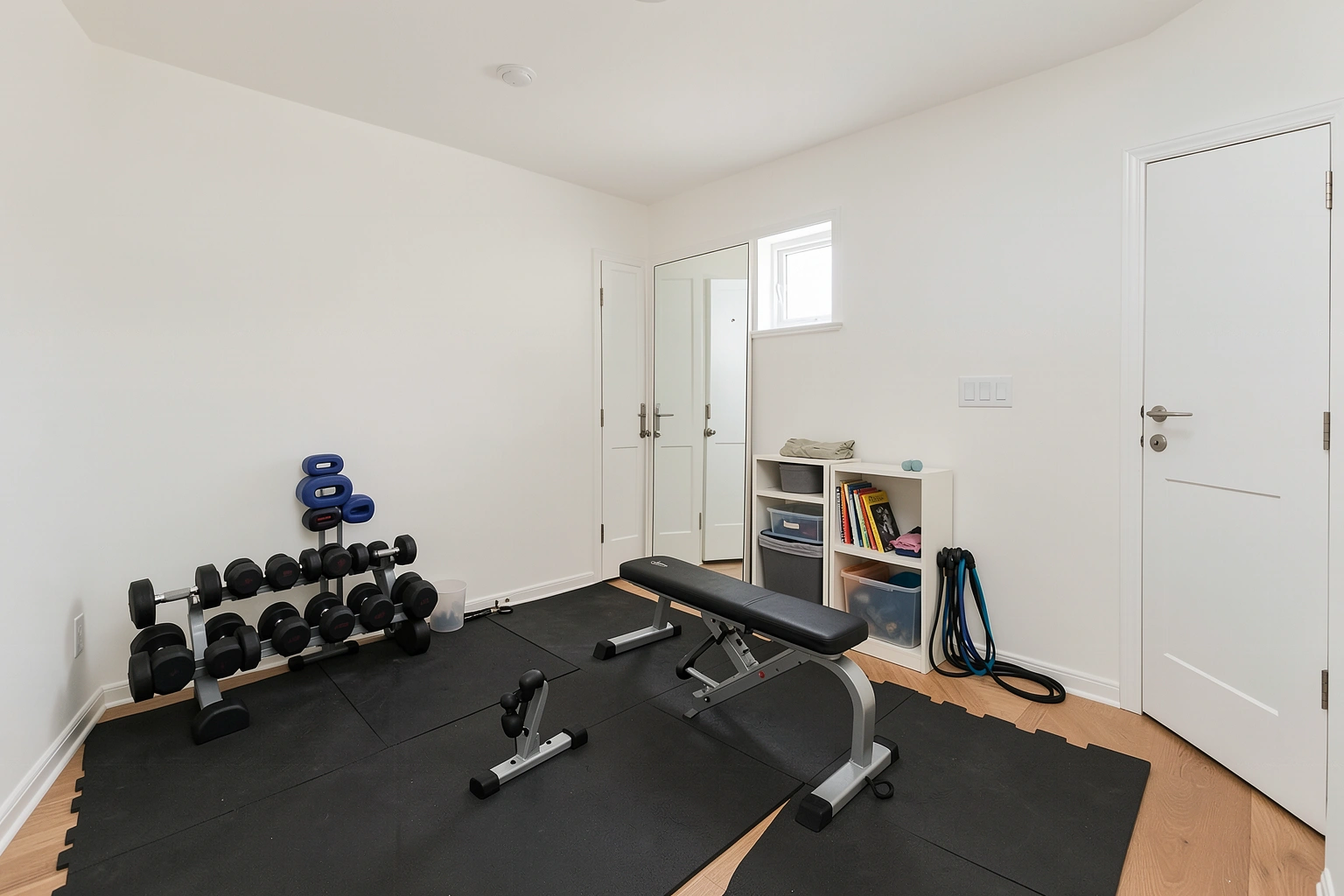
If you later decide you want barbell work, you can build toward that with a rack, barbell, and plates once the room, ceiling height, and budget are clear. That staged approach is usually better than buying the full system before you know how the space feels in daily use.
[IMAGE PLACEHOLDER 2]
When to Consult a Professional
Some setup decisions are simple. Others are not.
Consider speaking with a qualified installer, contractor, or equipment manufacturer when you are:
- Mounting racks, pull-up bars, or wall systems
- Unsure whether a wall, stud layout, or concrete surface can support the equipment
- Setting up a gym in a garage, basement, or older room with unknown conditions
- Dealing with electrical work, ventilation changes, or structural concerns
For anything that depends on load-bearing, anchoring, or building conditions, follow the manufacturer documentation and use professional help when needed. That is especially true for wall-mounted or ceiling-mounted equipment.
Common Home Gym Setup Regrets to Avoid Next Time
Before you buy, check your plan against these common regrets:
- Buying equipment before defining your training goals
- Underestimating the room size and ceiling height
- Spending the budget on one premium item too early
- Choosing bulky machines that limit movement
- Skipping flooring and storage
- Forgetting clearance space around benches and racks
- Buying accessories before essentials
- Choosing gear that is too specialized for a beginner routine
A good home gym does not have to be large or expensive. It just has to be planned well enough to support the workouts you actually want to do.
If you get the order right, the room stays usable, the budget lasts longer, and the equipment you buy is more likely to earn its place.