
How to Lubricate a Treadmill Belt (Step by Step)

How to lubricate a treadmill belt: signs it needs lube, which lubricant to use, a 7-step method, how often to do it, and the mistakes that damage belts and motors.
This article may contain affiliate links. If you buy through them, we may earn a small commission at no extra cost to you. Learn more.
As an Amazon Associate, we earn from qualifying purchases. If you buy through a link on this page we may earn a small commission at no extra cost to you. We do our best to keep that from influencing what we recommend.
A treadmill belt slides over a flat deck thousands of times every workout. A thin layer of lubricant between the two keeps that friction low. When the lube dries out, the motor works harder, the belt and deck wear faster, and the machine can start to jerk, squeak or trip its breaker.
The good news: lubricating a treadmill belt takes about 15 minutes and no special skills. Here is how to do it safely.
First, check your manual
Every treadmill is a little different. Some belts are pre-waxed and the maker says never to add lube. Others specify a lubricant, an amount and a schedule. Your owner’s manual always wins over general advice, including ours. If you have lost it, most brands post manuals on their websites.
Signs your treadmill belt needs lubricating
- Lift the side of the belt and touch the deck: it feels dry instead of slightly slick.
- The belt hesitates or jerks when you step on it.
- You hear more squeaking or a louder motor than usual.
- The console shows a “lube” reminder (some treadmills have one).
- The treadmill trips your circuit breaker or overheats.
What lubricant to use
Most home treadmills call for 100% silicone treadmill lubricant. It usually comes in a squeeze bottle with a long nozzle that slides under the belt. Do not use WD-40, household oils or spray silicone with other additives. They can damage the belt and deck or attract dirt.

How to lubricate a treadmill belt: 7 steps
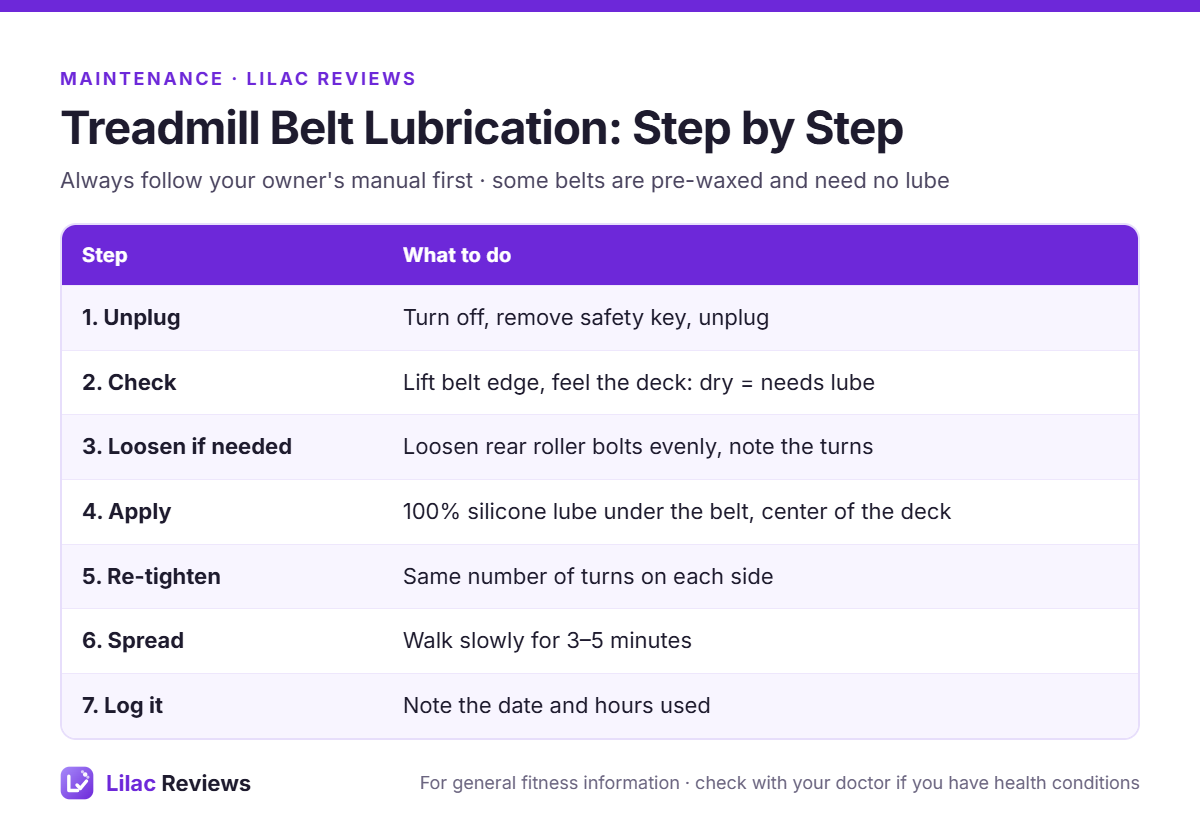
1. Turn it off and unplug it
Remove the safety key and unplug the power cord. Never work under a belt on a treadmill that is plugged in.
2. Check the deck
Lift one edge of the belt and run your fingers over the deck near the center. If it is dry, chalky or rough, it needs lube. Wipe away any dust you can reach with a dry, lint-free cloth.
3. Loosen the belt if needed
If you cannot lift the belt far enough to reach the center of the deck, loosen the rear roller bolts with the Allen key that came with your treadmill. Turn each side the same number of times, and count them, so you can restore the original tension.
4. Apply the lubricant
Slide the nozzle under the belt toward the middle of the deck and apply a thin line of silicone, front to back, in the area where your feet land. Repeat on the other side. Follow the amount in your manual; many lube bottles suggest about half an ounce for a home treadmill. More is not better.
5. Re-tighten the belt
Tighten the rear roller bolts by the same number of turns on each side. The belt should not slip when you walk, but it should not be drum-tight either.
6. Spread the lube
Plug in, clip on the safety key, and walk slowly at 1 to 2 mph for three to five minutes. This spreads the lubricant across the deck.
7. Check tracking and log it
Watch the belt from behind. If it drifts to one side, make small quarter-turn adjustments to the rear roller bolt, as your manual describes. Then write down the date and roughly how many hours or miles you have used the treadmill, so you know when to do it next.
How often should you lubricate?
It depends on the treadmill and how much you use it, which is why the manual matters. As a rough guide, many manufacturers suggest checking every few months or after a set number of hours or miles. Heavy users and heavier runners will need to do it more often than someone who walks 20 minutes a few times a week. Checking the deck by touch every month or two is a simple habit that catches it early.
Mistakes to avoid
- Too much lube: it can make the belt slip and drip onto the floor or rollers.
- Wrong product: petroleum oils and multipurpose sprays can damage the belt.
- Lubing the top of the belt: lube goes between the belt and the deck only.
- Uneven tightening: turning one bolt more than the other makes the belt drift.
- Skipping the safety step: always unplug first.
Other quick maintenance
While you are at it, vacuum under and around the treadmill, wipe the side rails and console, and check that the power cord is not pinched. A mat underneath helps keep dust out of the motor area. Our home gym safety guide has more checks for cardio machines.
If you are still shopping, see our best treadmills for home and Horizon T101 review. Walking pads need lube too; the WalkingPad C2 review covers its quirks.
FAQ
Can I use WD-40 on a treadmill belt?
No. Use the 100% silicone lubricant your manufacturer recommends.
How do I know if I used too much?
The belt may slip or feel slick underfoot, and you may see silicone on the floor. Wipe off the excess and walk slowly to spread what is left.
Do walking pads need lubrication?
Many do. Check the manual; most come with a small bottle of silicone lube and a recommended schedule.
Bottom line
Unplug, check the deck, apply a modest amount of 100% silicone lube under the belt, re-tighten evenly and walk it in. Fifteen minutes every few months keeps your treadmill quieter, smoother and lasting longer.
If your treadmill still trips breakers, smells hot or jerks after lubricating, stop using it and contact the manufacturer or a technician.
This guide is for general information only and is not medical advice. Talk to a qualified professional before starting a new exercise program, especially if you have an injury or health condition.