
Elliptical vs Treadmill: Which Should You Buy for Home?

Elliptical vs treadmill for a home gym: joint impact, calorie burn, space, noise and cost compared, with a clear answer for bad knees, seniors, runners and walkers.
This article may contain affiliate links. If you buy through them, we may earn a small commission at no extra cost to you. Learn more.
As an Amazon Associate, we earn from qualifying purchases. If you buy through a link on this page we may earn a small commission at no extra cost to you. It never changes what we write.
The elliptical vs treadmill question comes up in almost every home gym plan, and the honest answer is that both are good machines. The better one is the one that fits your joints, your goals and your room. Here is how they really differ, without the marketing.
Quick answer
- Choose an elliptical if you have sore knees, hips or feet, want a quieter machine, or like working your arms as well as your legs.
- Choose a treadmill if you want to walk or run for real, are training for a race, or want incline walking as your main workout.
- Seniors and beginners: either can work. A treadmill with long handrails suits people who enjoy walking; an elliptical suits people whose joints complain after walks.
Impact on your joints
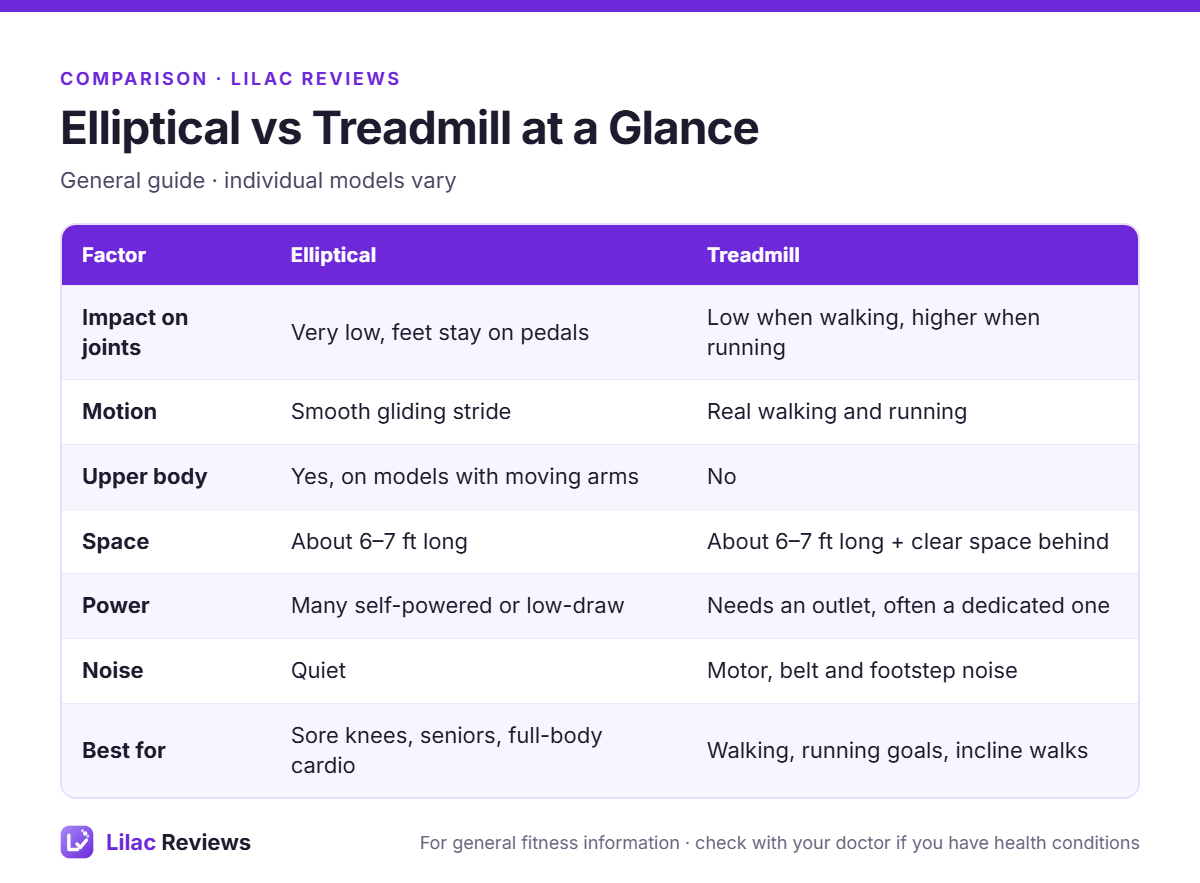
This is the biggest difference. On an elliptical, your feet never leave the pedals, so there is no landing shock with each step. That makes it one of the most joint-friendly ways to get your heart rate up. Treadmill walking is also low impact, but running adds a landing force with every stride, and some people feel that in their knees, shins or back.
If you are coming back from a knee or hip problem, ask your doctor or physical therapist which they prefer for you. Many people start on an elliptical or a bike and add treadmill walking later.
Calorie burn and workout feel
At similar effort, the calorie difference is smaller than ads suggest. Based on the Compendium of Physical Activities, 30 minutes on an elliptical at a moderate effort burns roughly 185 calories for a 155 lb person. Brisk treadmill walking at 3.5 mph lands around 160, and jogging at 5 mph is closer to 300. In other words, the treadmill only pulls ahead if you run, or walk on a steep incline.
The feel is different too. An elliptical is smooth and rhythmic, and many people find it easier to keep going for 30 or 40 minutes. A treadmill feels more natural for walkers and builds the exact fitness you need for walking and running outdoors.
Upper body work
Ellipticals with moving handles let you push and pull with your arms. It is not strength training, but it spreads the effort over more muscles. Treadmills are legs only. If you hold the rails on a treadmill, you actually make the workout easier, not harder.
Space and setup
Both take up about 6 to 7 feet of length. The treadmill also needs clear space behind it for safety, roughly 6.5 feet according to ASTM guidance, while an elliptical just needs room to step on and off. Ellipticals are often taller when you stand on the pedals, so check your ceiling: your height plus the highest pedal position plus a few inches of headroom. Folding treadmills are easier to store; most ellipticals do not fold.
Noise and power
Ellipticals are quieter. Many use a small power supply for the console and resistance, and some are self-powered. Treadmills have a motor and a moving belt, plus the sound of your feet, which carries through floors. If you live in an apartment or have people sleeping upstairs, that matters. Our apartment home gym ideas cover ways to reduce noise.
Cost and upkeep
At the budget end, ellipticals are often cheaper, but cheap ellipticals tend to have short strides and wobbly frames. Good treadmills cost more because of the motor and deck. Upkeep differs too: treadmills need occasional belt lubrication and alignment, while ellipticals mostly need bolts checked and the rails wiped clean.
Which is better for…
Bad knees
Usually the elliptical, because there is no impact. Keep the resistance moderate and avoid very high incline settings that push your knees forward.
Seniors
It depends on balance and preference. A treadmill with long handrails and a slow start speed suits people who love walking. An elliptical with a low step-up height suits people whose joints ache after walks. Our elliptical workouts for seniors and incline walking plan show what a week looks like on each.
Weight loss
Whichever you will use more often. Consistency beats the small difference in calories per minute. Pair either one with regular strength work for best results.
Runners
The treadmill. An elliptical is a good cross-training tool on easy days, but it does not train the impact and timing of running.
Our recommendation
If you already enjoy walking or want to run, buy a treadmill. Our guide to the best treadmills for home matches motor and belt size to how you will use it. If your joints are the main concern, or you want a quiet full-body machine, an elliptical is the better pick. Either way, measure your room first and sit or stand on the machine at a store if you can.
FAQ
Is 30 minutes on an elliptical as good as walking?
At a moderate effort, it burns a similar or slightly higher number of calories than brisk walking, with less impact. Both count toward the CDC’s 150 minutes a week of moderate activity.
Does an elliptical build leg muscle?
A little, mostly endurance. For real strength, add squats, lunges or a few dumbbell exercises two days a week.
Which takes less space?
Their footprints are similar, but a folding treadmill can be stored upright. If floor space is very tight, look at a walking pad or an under-desk elliptical instead.
Bottom line
Treadmills win for walkers and runners. Ellipticals win for joints, noise and full-body effort. Pick the one you will happily use four or five days a week, and you have made the right choice.
Check with your doctor before starting a new exercise routine, especially if you have heart, joint or balance conditions.
This guide is for general information only and is not medical advice. Talk to a qualified professional before starting a new exercise program, especially if you have an injury or health condition.