
Balance Exercises for Seniors at Home: 8 Simple Moves

Eight balance exercises for seniors you can do at home next to a kitchen counter, with a three-level progression, a weekly plan and safety tips to lower fall risk.
This article may contain affiliate links. If you buy through them, we may earn a small commission at no extra cost to you. Learn more.
Disclosure: As an Amazon Associate, we earn from qualifying purchases. If you buy through a link on this page, we may earn a small commission at no extra cost to you.
Balance is a skill, and like any skill it fades when you don’t use it. The good news is that it also comes back with practice, often faster than strength does. A few minutes of balance work most days can make walking, turning and getting in and out of the shower feel steadier.
Falls are a major health concern for older adults. According to the CDC, about one in four adults aged 65 and older reports a fall each year. Exercise that combines balance and strength is one of the best-supported ways to lower that risk. These balance exercises for seniors need nothing more than a sturdy counter or chair.
Safety setup first
- Stand at a kitchen counter or the back of a heavy chair that won’t tip. It should be within easy reach at all times.
- Wear supportive shoes, or go barefoot on a non-slip floor. Avoid socks on hard floors.
- Clear the area of rugs, pets and clutter.
- If you have dizziness, recent falls or a condition that affects balance, ask your doctor or a physical therapist for a tailored program first.
How the progression works
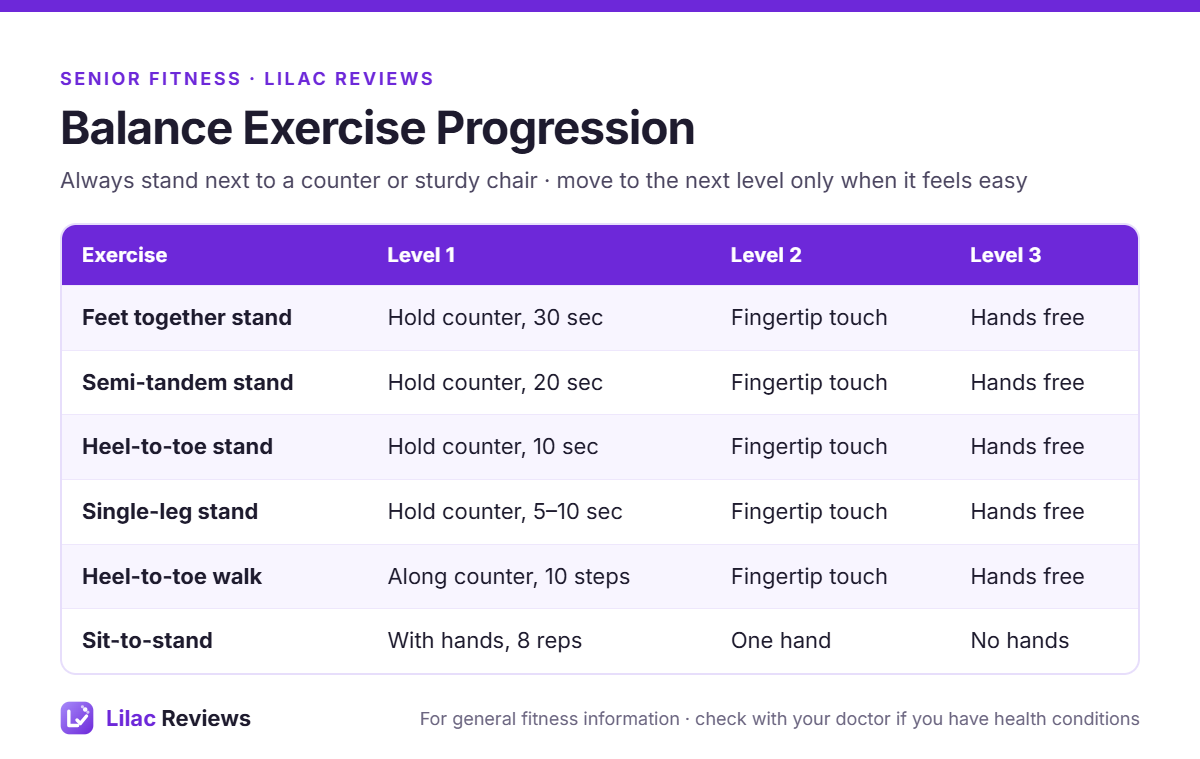
Every exercise has three levels. Start at Level 1 with both hands on the counter. When you can do it steadily for the target time on two days in a row, move to Level 2 with just your fingertips touching. Level 3 is hands free, but stay close to the counter.
The 8 balance exercises
1. Feet-together stand
Stand tall with your feet touching, eyes looking straight ahead. Hold for up to 30 seconds. This is the foundation for everything else.
2. Semi-tandem stand
Place the heel of one foot next to the big toe of the other, so your feet are half a step apart. Hold 20 seconds, then switch which foot is forward.
3. Heel-to-toe (tandem) stand
Put one foot directly in front of the other, heel touching toe, like standing on a tightrope. Hold up to 10 seconds per side. This is harder than it looks; stay at Level 1 as long as you need.
4. Single-leg stand
Hold the counter and lift one foot a few inches off the floor. Build up to 10 seconds per leg. Later, try it while brushing your teeth (with one hand on the sink).
5. Heel-to-toe walk
Walk along the counter placing your heel directly in front of your toes on every step, 10 steps forward. Turn around slowly and come back.
6. Sit-to-stand
Stand up from a chair and sit back down slowly, 8 times. Strong legs are a big part of good balance. Our chair exercises for seniors include more seated strength moves.
7. Side leg raise
Holding the counter, lift one leg out to the side about 6 inches, keeping your toes pointing forward and your body upright. 8–10 reps per side. This strengthens the hip muscles that stop you tipping sideways.
8. Calf raises
Rise up onto your toes, pause, then lower slowly, 10–15 times. Strong calves and ankles help you catch yourself when you trip.
A simple weekly plan
- Most days (5–10 minutes): exercises 1–5, at the level you’re on.
- 2–3 days a week: add exercises 6–8 for strength.
- Every day: sneak in practice, like standing on one leg while the kettle boils.
The National Institute on Aging recommends combining balance, strength, endurance and flexibility exercise. Pair this routine with regular walking; our 30-day walking plan is an easy way to build that up.
Helpful equipment
You don’t need gear for balance work. Two things can help: a firm, non-slip exercise mat for floor and standing work, and a light loop band to make side steps and hip work harder as you improve.
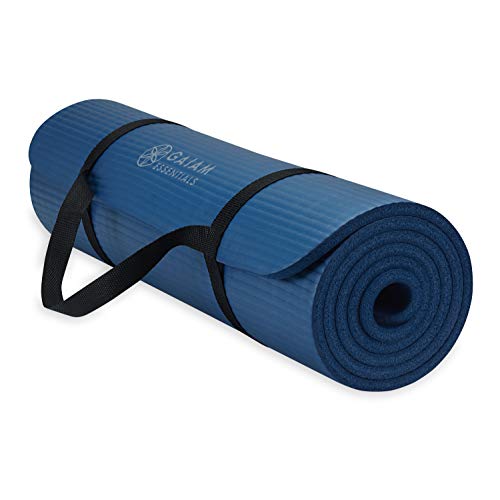

Avoid wobble boards, balance pads and bosu-style domes until you are comfortable with Level 3. They can be useful, but they make falls more likely for beginners. More ideas are in our home gym safety guide.
Signs you’re improving
- You need the counter less, or only with fingertips.
- You can hold each position longer without wobbling.
- Turning around, stepping off curbs or walking on grass feels easier.
FAQ
How long does it take to improve balance?
Many people notice small changes within a few weeks of practice most days. Bigger changes usually take a few months.
Should I close my eyes during balance exercises?
Only once you are steady at Level 3, and only with a counter right next to you. Closing your eyes makes balance much harder.
Is tai chi good for balance?
Yes. Tai chi is one of the best-studied activities for balance in older adults, and many community centers offer beginner classes.
Can I do balance exercises if I use a cane?
Often yes, with a physical therapist’s guidance. They can choose exercises that match your stability and show you how to use support safely.
Written by the Lilac Reviews Editorial Team. This article is general fitness information, not medical advice. If you have a health condition, recent injury or surgery, talk to your doctor or physical therapist before starting a new exercise routine.
This guide is for general information only and is not medical advice. Talk to a qualified professional before starting a new exercise program, especially if you have an injury or health condition.