
Recumbent vs Upright Exercise Bike: Which Is Right for You?

Recumbent vs upright exercise bike: comfort, back support, muscles worked, calorie burn, space and safety compared, with clear advice for seniors, back pain and fitness riders.
This article may contain affiliate links. If you buy through them, we may earn a small commission at no extra cost to you. Learn more.
As an Amazon Associate, we earn from qualifying purchases. If you buy through a link on this page we may earn a small commission at no extra cost to you. It never changes what we write.
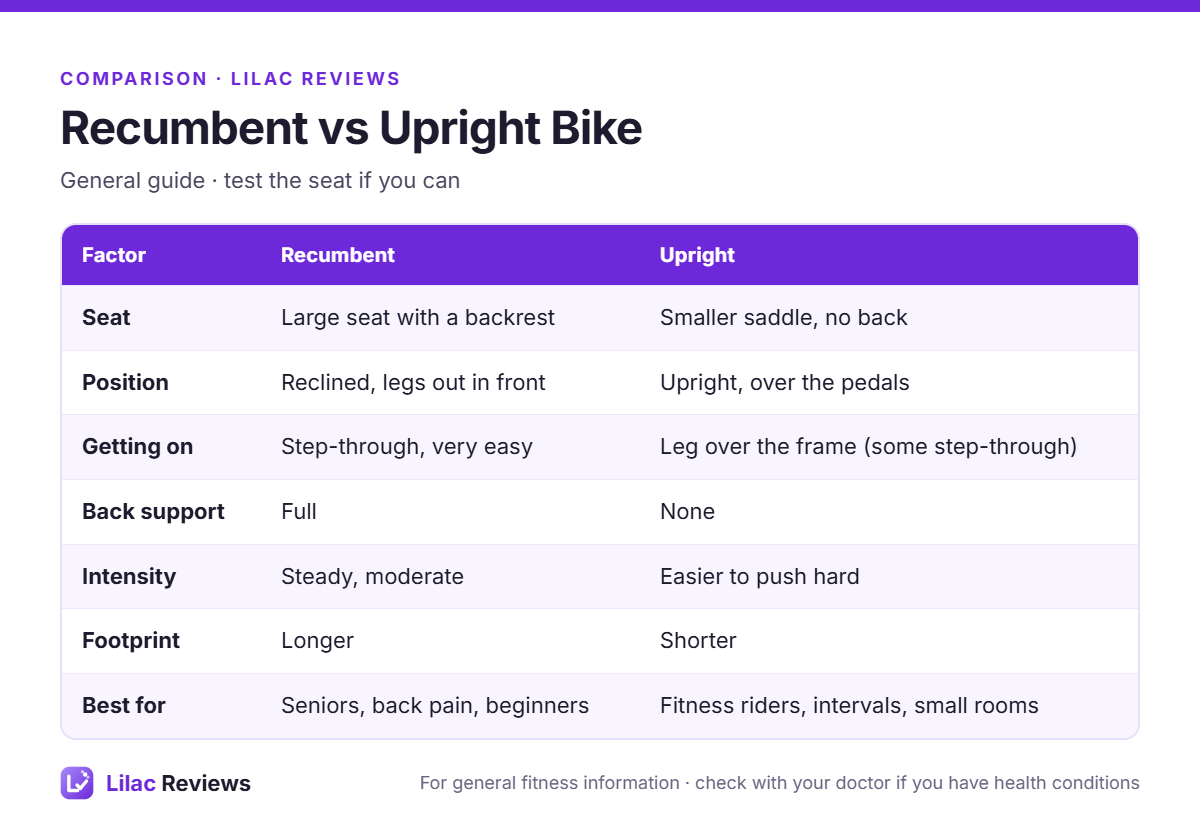
Both bikes give you low-impact cardio at home, and both are quieter and safer than most cardio machines. The real difference is how you sit. A recumbent bike puts you in a reclined seat with a backrest and your legs out in front. An upright bike puts you over the pedals on a smaller saddle, like riding outdoors.
That one difference affects comfort, intensity, space and who each bike suits.
Quick answer
- Recumbent: best for seniors, back pain, beginners, larger riders and anyone who wants comfort for long, steady rides.
- Upright: best for fitness-minded riders, intervals, people training for outdoor cycling and smaller rooms.
Comfort and back support
A recumbent seat is wide and padded, with a backrest that supports your lower back. Your weight is spread out instead of resting on a small saddle. For many people with back pain or sore hips, that makes the difference between riding and not riding.
Upright bikes have a smaller saddle and no back support, so your core and back hold you up. Some people like that; others find the saddle uncomfortable after 20 minutes. Padded shorts or a wider seat help.
Getting on and off
Most recumbent bikes have a step-through frame: you walk in and sit down. Upright bikes usually ask you to swing a leg over or step through a higher frame, then balance as you settle on the saddle. For anyone with limited hip mobility or balance concerns, recumbent is easier.
Intensity and muscles worked
Both work the quads, hamstrings, glutes and calves. Recumbent bikes shift a bit more effort to the glutes and hamstrings because of the reclined angle. Upright bikes involve the core more and let you stand up on some models for harder efforts.
At the same effort, calorie burn is similar. Upright bikes simply make it easier to push hard. Values from the Compendium of Physical Activities suggest moderate stationary cycling burns roughly 250 calories in 30 minutes for a 155 lb person, whichever bike you use.
Space
Recumbent bikes are longer, often 5 to 5.5 feet. Upright bikes are shorter and narrower, and some fold. If floor space is tight, upright usually wins.

Which is better for…
Seniors
Recumbent, in most cases. The backrest, step-through frame and stable seat lower fall risk and make it easier to ride longer. See our best recumbent bikes for seniors.
Back pain
Recumbent is usually more comfortable. Adjust the seat so your knees never lock and your lower back stays against the pad.
Knee problems
Both are knee-friendly when set up correctly. Seat distance (recumbent) or saddle height (upright) matters more than bike type.
Weight loss and fitness
Either works. Upright bikes make intervals and standing climbs easier, which some people enjoy more. Pick the one you will ride most.
App classes
Upright and spin-style bikes dominate app classes. If you want Peloton-style workouts, an indoor cycling bike like the one in our Schwinn IC4 review is the better fit.
Models worth a look
For recumbent, the Schwinn 230 is a long-time favorite: simple, quiet and easy to adjust. For upright, Schwinn’s 190 upright bike and the IC4 spin bike are common picks, depending on whether you want a comfortable upright or a class-style bike.


Setup tips for either bike
- Recumbent: slide the seat so your knee is slightly bent at the farthest pedal position.
- Upright: set saddle height so your knee is slightly bent at the bottom of the stroke and your hips do not rock.
- Tighten pedal straps, start on a low level for five minutes, and put a mat underneath.
FAQ
Is a recumbent bike as good a workout as an upright?
Yes, at the same effort level. You may need to raise resistance a little on a recumbent to feel the same intensity, because the supported position feels easier.
Which bike is better for belly fat?
Neither targets belly fat directly. Overall activity, strength training and diet matter more than bike type.
Can I use a recumbent bike every day?
Most people can, at a moderate effort. The CDC recommends 150 minutes of moderate activity a week, which works out to about 20 to 30 minutes most days.
Bottom line
If comfort and safety come first, choose recumbent. If you want to push harder, ride classes or save floor space, choose upright. Both are excellent, low-impact ways to stay active at home.
Check with your doctor before starting a new exercise routine, especially if you have heart, joint or balance conditions.
This guide is for general information only and is not medical advice. Talk to a qualified professional before starting a new exercise program, especially if you have an injury or health condition.