
Cable Machine Exercises for a Full-Body Home Workout

12 cable machine exercises by muscle group plus a simple two-day full-body workout, weight selection tips and safety checks for home cable machines.
This article may contain affiliate links. If you buy through them, we may earn a small commission at no extra cost to you. Learn more.
A cable machine is one of the most useful pieces of equipment you can own. One pulley, a handful of attachments, and you can train almost every muscle in your body from standing, kneeling or seated positions. Unlike free weights, the cable keeps tension on the muscle through the whole movement, and you can change the angle just by moving the pulley up or down.
This guide covers 12 cable machine exercises grouped by muscle, a simple two-day full-body home workout, and the setup and safety basics for home cable systems.
What kind of cable machine do you have?
Home cable setups come in a few flavors, and they all work with this guide:
- Functional trainer: two adjustable pulley columns with weight stacks. The most versatile option, but also the largest.
- Single-stack cable tower or wall-mounted pulley: one adjustable pulley. Every exercise below can be done one side at a time.
- Rack-mounted pulley (plate-loaded): a pulley attached to a power rack, loaded with weight plates. Budget-friendly, but you’ll adjust height less often.
Before you buy any of them, measure. Functional trainers often need a ceiling of about 7 to 8 feet and a footprint of roughly 5 x 4 feet plus room to step away from the machine. Our guide on how much space you need for a home gym walks through it, and home gym ideas for high ceilings helps if you’re working with a tall garage or basement.
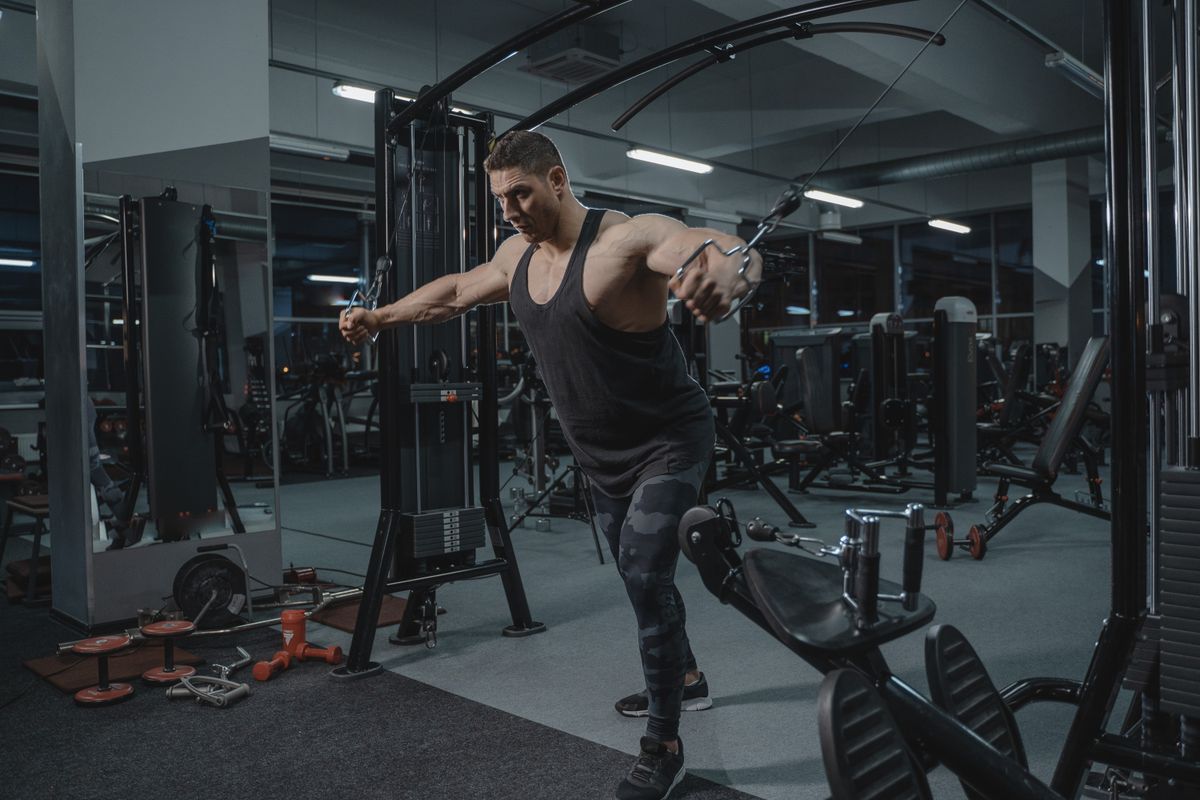
Attachments you’ll use most
- Single D-handle: for one-arm rows, presses, flyes and lateral raises.
- Rope: for triceps pushdowns, face pulls and crunches.
- Straight or lat bar: for pulldowns and curls.
- Ankle strap: for glute kickbacks and hip abduction.
12 cable machine exercises by muscle group
Back
1. Lat pulldown (high pulley, bar). Kneel or sit, pull the bar to your upper chest, elbows driving down toward your ribs. Don’t lean way back to cheat the weight.
2. Seated or standing cable row (mid pulley). Pull the handle to your lower ribs, squeeze your shoulder blades together, and let your arms extend fully on the return.
3. Face pull (high pulley, rope). Pull the rope toward your forehead, hands finishing beside your ears. Great for posture and shoulder health; keep the weight light.
Chest
4. Standing cable chest press (mid pulley). Stand in a split stance facing away from the machine and press forward. Do one arm at a time on a single-stack machine.
5. Cable fly (mid or high pulley). With a slight bend in the elbows, bring your hands together in front of your chest in a hugging motion. Control the stretch on the way back.
Shoulders
6. Single-arm lateral raise (low pulley). Stand side-on, cable crossing in front of you, and raise your arm out to shoulder height. Cables make this far smoother than dumbbells.
7. Single-arm overhead press (low pulley, kneeling). Kneeling stops you from arching your back. Press up and slightly forward.
Arms
8. Biceps curl (low pulley, bar or rope). Elbows stay pinned at your sides.
9. Triceps pushdown (high pulley, rope). Push down and spread the rope ends at the bottom. Keep your upper arms still.
Legs and glutes
10. Cable goblet squat (low pulley, rope or handle). Hold the handle at your chest, take a step back, and squat. The cable gently pulls you forward, which encourages an upright torso.
11. Pull-through (low pulley, rope). Face away from the machine with the rope between your legs, hinge at the hips, then drive your hips forward. An excellent way to learn the hip hinge.
Core
12. Pallof press (mid pulley). Stand side-on, hold the handle at your chest and press it straight out, resisting the pull to rotate. Hold for 2 seconds. It looks easy and isn’t.
A two-day full-body cable workout
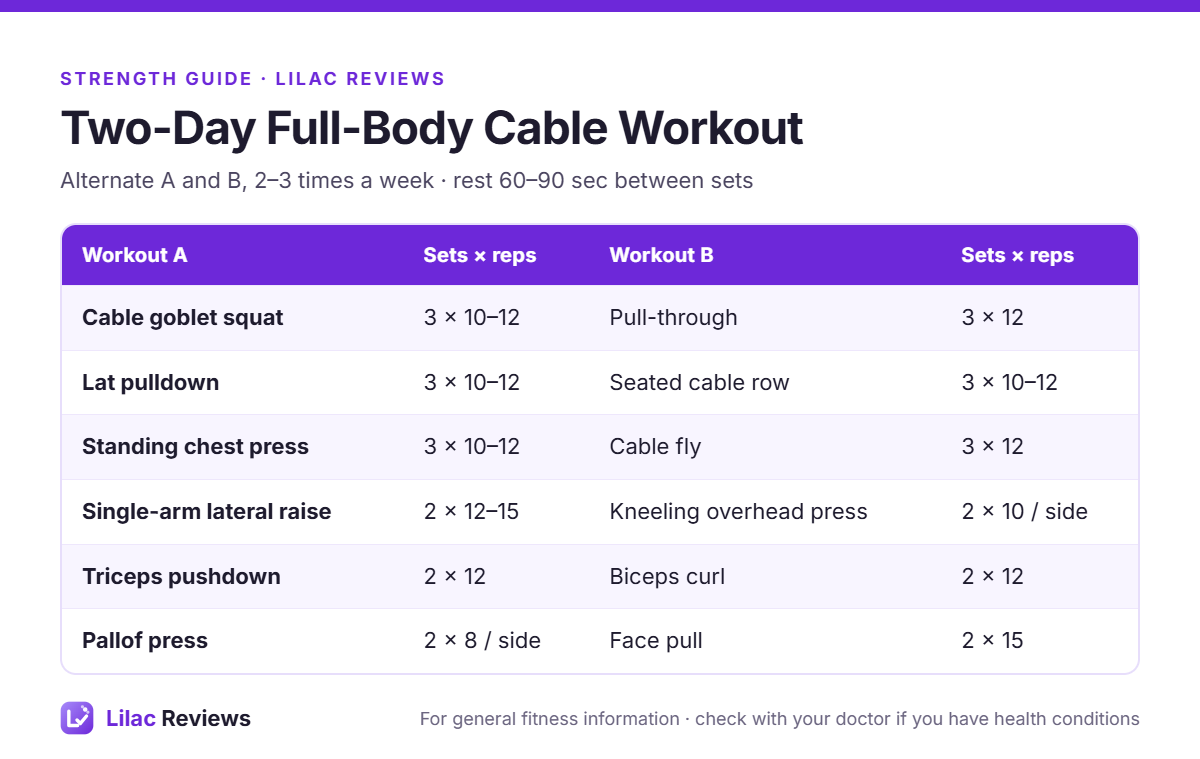
Alternate Workout A and Workout B, two or three times a week (for example A on Monday, B on Wednesday, A on Friday). Rest 60 to 90 seconds between sets.
Choosing the weight
Pick a weight you can lift for the target reps with 2 or 3 reps “left in the tank.” When you can hit the top of the rep range on every set with good form, go up one plate on the stack. Cable machines with a 2:1 pulley ratio feel lighter than the number on the stack; that’s normal, just compare against your own past sessions.
Form and safety basics
- Check the cable before each session. Look for fraying, kinks or a loose pulley. Replace worn cables right away; the manufacturer’s manual will list the parts.
- Lock the pin fully into the weight stack and the pulley height adjuster.
- Don’t let the stack slam. Control the return. Banging plates is a sign the weight is too heavy and it wears the machine.
- Keep fingers and hair clear of the pulleys and stack.
- Anchor wall or rack-mounted units properly. Our home gym equipment assembly guide covers stability checks.
No cable machine yet?
Resistance bands anchored to a door can mimic almost every exercise on this list, though the tension changes as the band stretches. They’re a good stopgap or travel option; see whether resistance bands are effective for building strength. If your main goal is muscle size, our guide to a home gym setup for muscle building explains where a cable machine fits among racks, benches and dumbbells.
How often should you train?
Two to three full-body sessions a week is plenty for beginners and lines up with the recommendation to do muscle-strengthening activity at least two days a week from the CDC. Give each muscle group at least a day of rest between hard sessions.
FAQ
Can you build muscle with just a cable machine?
Yes. A cable machine can train every major muscle group with progressive resistance, which is what muscle growth needs. Many people add dumbbells or a barbell later for heavier lower-body work.
Are cables better than free weights?
Neither is better overall. Cables keep constant tension and are easy on the joints; free weights are better for heavy lower-body lifts and balance. Using both is ideal.
How many exercises should a cable workout have?
Five or six exercises covering legs, push, pull and core is enough for a beginner full-body session.
Why does the weight feel lighter than the number on the stack?
Many home cable machines use a 2:1 pulley ratio, which halves the effective resistance. It doesn’t matter as long as you track progress on the same machine.
This guide is for general information only and is not medical advice. Talk to a qualified professional before starting a new exercise program, especially if you have an injury or health condition.