
Stability Ball Exercises for Beginners: 8 Moves and a Size Guide

Eight stability ball exercises for beginners for core, hips and upper body, a ball size chart by height, how firm to inflate it and safety tips for older adults.
This article may contain affiliate links. If you buy through them, we may earn a small commission at no extra cost to you. Learn more.
Disclosure: As an Amazon Associate, we earn from qualifying purchases. If you buy through a link on this page, we may earn a small commission at no extra cost to you.
A stability ball (also called an exercise ball, Swiss ball or yoga ball) is a large inflatable ball you can sit, lie or lean on. Because it moves, your core and hip muscles have to work to keep you steady, which makes simple exercises more challenging. It’s also one of the cheapest pieces of home gym equipment you can buy.
Here are eight stability ball exercises for beginners, plus how to pick the right size and stay safe.
Pick the right size
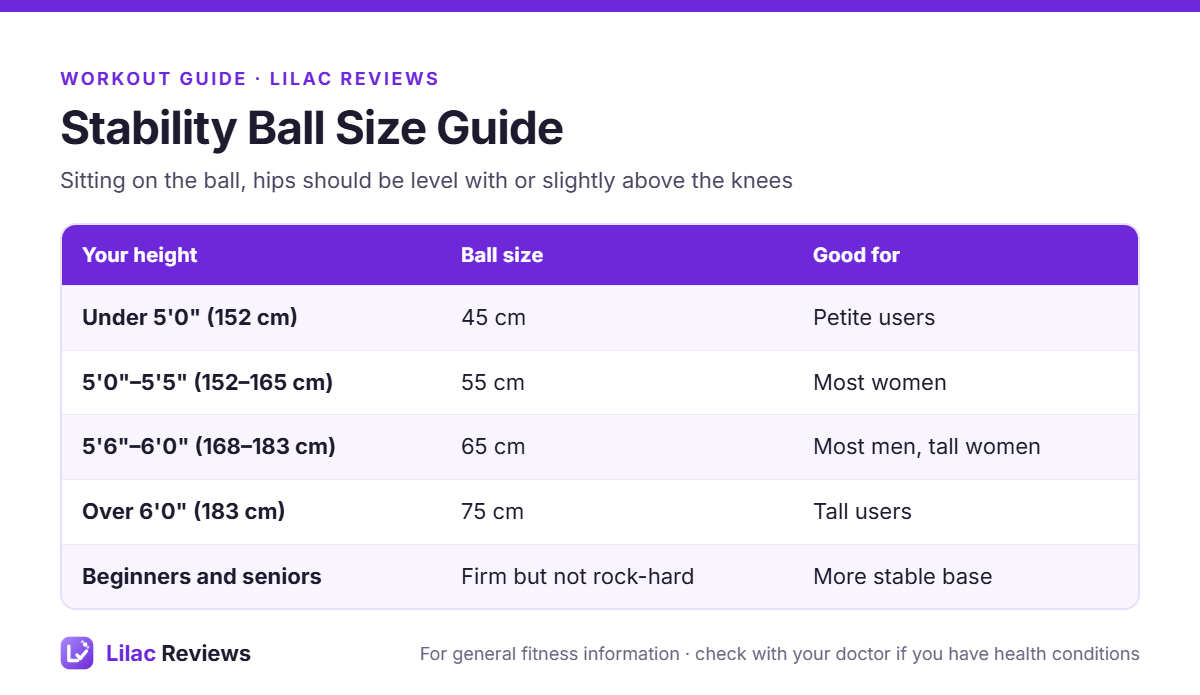
When you sit on the ball with feet flat on the floor, your hips should be level with or slightly above your knees. If you’re between sizes, a slightly smaller ball is usually more stable for beginners.
How firm should it be?
Inflate to the size printed on the box, then let a little air out if it feels too bouncy. A slightly softer ball is more stable because more of it touches the floor. Choose an “anti-burst” ball, which is designed to deflate slowly rather than pop if punctured.
Safety first
- Clear space around the ball, away from furniture edges and sharp objects.
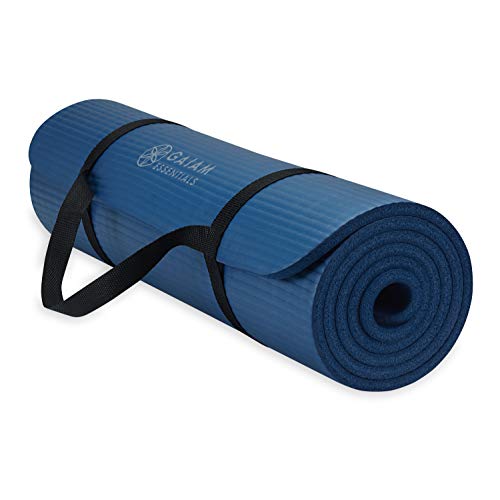
- Use it on a non-slip mat or carpet.
- Start next to a wall or sturdy chair you can grab.
- Older adults or anyone with balance problems should start with the wall squat and seated moves only, and keep a hand on support.
The 8 exercises
1. Seated balance and marches
Sit tall on the ball, feet flat and hip-width apart. Find your balance, then lift one foot an inch off the floor, set it down, and switch. 10 per side. This teaches the basic core control you’ll use for everything else.
2. Wall squat with ball
Place the ball between your lower back and a wall. Walk your feet forward and squat down, letting the ball roll up your back. Stand back up. 10–12 reps. The ball guides your movement, making this a great squat for beginners.
3. Glute bridge on the ball
Lie on your back with your heels on top of the ball. Press your heels down and lift your hips. Lower slowly. 8–10 reps. Harder than a floor bridge because the ball wants to roll.
4. Incline push-up with hands on the ball
Place the ball against a wall and put your hands on it. Walk your feet back and do push-ups. The wall keeps the ball from rolling away. 8 reps.
5. Ball pass (lying)
Lie on your back holding the ball overhead. Bring it up and pass it to your feet, lower your legs and arms toward the floor, then pass it back. Go only as low as you can while keeping your lower back down. 6–8 passes.
6. Stir-the-pot plank on knees
Kneel and place your forearms on the ball, then lean forward into a plank on your knees. Draw small circles with your forearms. 20–30 seconds.
7. Back extension
Lie face down over the ball with your hips on it and feet against a wall. Lift your chest slightly, then lower. 8–10 reps. Keep the movement small.
8. Hamstring curl
From the bridge position with heels on the ball, lift your hips and roll the ball toward you by bending your knees, then roll it back out. 6–8 reps. Save this for when bridges feel easy.
A 15-minute beginner routine
- Do exercises 1–6, 1–2 rounds, two or three times a week.
- Rest 30 seconds between moves.
- Add exercises 7–8 after two weeks.
Start each session with our 5-minute warm-up. For more core work, see our core exercises for seniors or wall Pilates for beginners.
Can you use a stability ball as a desk chair?
Some people like sitting on one for short periods to break up regular sitting. It doesn’t replace exercise, and many people slump on it after a while. If you try it, use it for 20–30 minutes at a time and switch back to a supportive chair.
Is a stability ball good for older adults?
It can be, with care. The seated moves and wall squat are good options for many seniors, with support close by. Lying and plank moves need confident balance and the ability to get up and down from the floor. The National Institute on Aging recommends safe balance and strength training as part of regular activity for older adults.
FAQ
What size stability ball do I need?
Most women use a 55 cm ball and most men a 65 cm ball, but check the height chart above.
Are stability ball exercises good for back pain?
Gentle core work can help some people with general back stiffness. Ask a doctor or physical therapist if you have ongoing pain.
How often should I use a stability ball?
Two or three sessions a week is plenty for beginners.
Can a stability ball pop?
Any inflatable can, but anti-burst balls are designed to deflate slowly. Keep it away from sharp objects and heat.
Written by the Lilac Reviews Editorial Team. This article is general fitness information, not medical advice. If you have a health condition, recent injury or surgery, talk to your doctor or physical therapist before starting a new exercise routine.
This guide is for general information only and is not medical advice. Talk to a qualified professional before starting a new exercise program, especially if you have an injury or health condition.