
Best Resistance Bands for Seniors (Gentle, Safe and Easy to Use)

The best resistance bands for seniors: flat therapy bands, tube bands with handles, mini loops and latex-free fabric bands, with which resistance to start and safety tips.
This article may contain affiliate links. If you buy through them, we may earn a small commission at no extra cost to you. Learn more.
Disclosure: As an Amazon Associate, we earn from qualifying purchases. If you buy through a link on this page, we may earn a small commission at no extra cost to you.
Resistance bands are one of the friendliest ways for older adults to build strength at home. They’re light, cheap, easy to store, and you can use them seated in a chair. Physical therapists use them every day because the resistance is smooth and easy to adjust. If you’ve been told to “do some strength work,” a few bands may be all you need to start.
This guide covers the best resistance bands for seniors, how to pick the right resistance, and how to stay safe while using them.
How we put this guide together: we didn’t lab-test these bands. We compared manufacturer information (band type, resistance levels, material, accessories) and read verified owner feedback with an eye on comments from older users, such as ease of gripping, snapping, latex smell and how clear the instructions are. Check current listings before you buy.
Quick picks
- Best for physical therapy-style exercises: TheraBand professional latex resistance bands
- Best with handles: Black Mountain Products resistance band set
- Best for leg and hip exercises: Fit Simplify resistance loop bands
- Best latex-free option: fabric resistance loop bands
The four types of bands
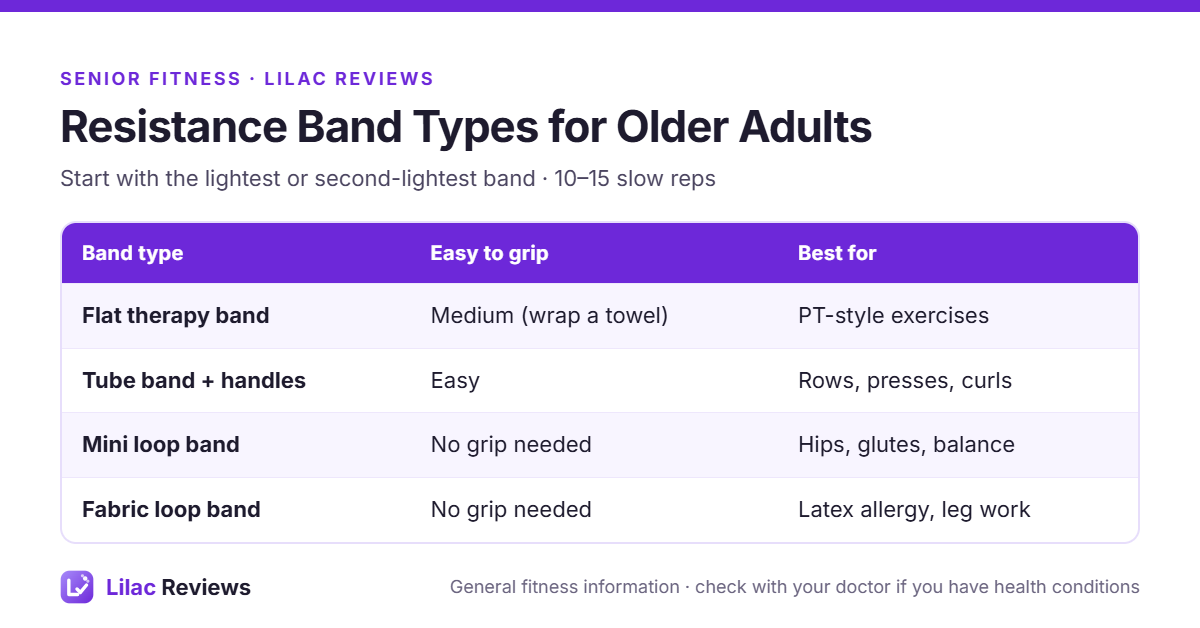
Flat therapy bands
Long, flat strips of latex, often sold by the yard or in pre-cut lengths. They’re the classic physical therapy band. You wrap them around your hands, feet or a chair leg.
Tube bands with handles
Rubber tubes with foam handles. Easier to grip than flat bands, and most sets include a door anchor so you can do rows and presses.
Mini loop bands
Small, continuous loops that go around the thighs or ankles. Excellent for hip and glute exercises, which help with walking and balance.
Fabric bands
Wider loops made of cloth with rubber threads. They don’t roll up or pinch and are a good choice for latex allergies.
The best resistance bands for seniors
1. TheraBand professional latex bands: best for therapy-style exercises
TheraBand is the brand many physical therapists use, with a well-known color system from very light to very heavy. Starter packs with the lightest colors are ideal for older adults.
- Good for: following exercises from a physical therapist, gentle upper and lower body work.
- Keep in mind: flat bands can be harder to grip with arthritic hands. Wrapping them around a rolled towel helps.

2. Black Mountain Products band set: best with handles
This tube band set comes with handles, a door anchor and several resistance levels you can stack. The handles make it easy to hold for rows, chest presses and curls.
- Good for: seniors who want gym-style exercises at home.
- Keep in mind: make sure the door anchor is on the hinge side of a closed, locked door.

3. Fit Simplify resistance loop bands: best for legs and hips
A set of five color-coded mini loops in different strengths. They’re great for side steps, clamshells, seated leg presses and glute bridges. We cover them in detail in our Fit Simplify loop bands review.
- Good for: hip strength, balance support, physical therapy leg exercises.
- Keep in mind: thin loops can roll on bare skin. Wear them over pants or long socks.

4. Fabric resistance loop bands: best latex-free option
Fabric loops are wider, softer and don’t snap the way thin latex can. They’re a good choice if you’re allergic to latex or dislike the smell of rubber.
- Good for: latex allergies, leg and hip exercises, comfort.
- Keep in mind: even the “light” fabric bands can feel strong. Start with the lightest one.
Which resistance should seniors start with?
Start with the lightest or second-lightest band. You should be able to do 10 to 15 slow reps with good posture, with the last few feeling like work. If you can’t complete 10, go lighter. If 15 is easy, move up a color. Resistance colors vary by brand, so read the chart that comes with your set rather than going by color alone.
Six simple band exercises for seniors
- Seated row: loop the band around your feet, pull the ends toward your waist.
- Chest press: band behind your back, press forward.
- Seated leg press: band around one foot, push the leg forward.
- Side steps: loop above the knees, step sideways holding a counter.
- Biceps curl: stand on the band, curl up slowly.
- Pull-apart: hold the band at chest height and gently pull apart.
For a full weekly plan with chair and balance exercises, see our guide to easy home exercises for seniors over 60. Bands can also be used alongside light dumbbells.
Safety tips
- Check bands for small tears or sticky spots before each use. Replace worn bands.
- Don’t aim a stretched band toward your face.
- Anchor bands to something solid, never to furniture that can tip.
- Move slowly in both directions. Don’t let the band snap back.
- Store bands out of direct sunlight to help them last.
- Talk to your doctor or physical therapist before starting if you have recent surgery, joint replacements, heart problems or osteoporosis.
The National Institute on Aging recommends strength exercises as part of a balanced routine for older adults, and the CDC suggests muscle-strengthening at least two days a week.
FAQ
Are resistance bands good for seniors?
Yes. They’re light, low-impact and easy to adjust, and they can be used seated, which makes them one of the safest strength tools for older adults.
What color resistance band should a senior use?
Usually the lightest or second-lightest in the set. Colors differ between brands, so check the brand’s chart.
Are bands as good as weights?
For general strength and everyday function, bands work very well. Weights make it easier to measure progress, so many people use both. Our article on whether resistance bands are effective explains more.
How often should seniors use resistance bands?
Two or three days a week, with a rest day in between, is a good target.
Can I use resistance bands if I’m allergic to latex?
Choose fabric bands or bands labeled latex-free.
The bottom line
For most older adults, a light set of therapy bands or tube bands with handles, plus a pack of mini loops for the legs, is the ideal start. Pick the lightest resistance, move slowly, and build two or three short sessions into your week.
Written by the Lilac Reviews Editorial Team. This article is general fitness information, not medical advice. Product details may change; check the retailer listing for current specifications.
This guide is for general information only and is not medical advice. Talk to a qualified professional before starting a new exercise program, especially if you have an injury or health condition.