
Walking Pad Workouts: 4 Plans for Under-Desk and At-Home Walking

Four walking pad workouts from easy under-desk strolls to brisk pyramids, with speeds, times, desk setup tips and how to fit more steps into a work-from-home day.
This article may contain affiliate links. If you buy through them, we may earn a small commission at no extra cost to you. Learn more.
Disclosure: As an Amazon Associate, we earn from qualifying purchases. If you buy through a link on this page, we may earn a small commission at no extra cost to you.
A walking pad is a compact, low-profile treadmill made for walking rather than running. Most fold or slide under a sofa, many have no handrail, and their top speed is usually around 3.7–4 mph. That makes them perfect for two jobs: walking slowly while you work, and short brisk walks when the weather keeps you indoors.
Owning one and actually using it are two different things, though. These four walking pad workouts give you a plan for every kind of day.
Before you start
- Stand in the middle of the belt and look ahead, not at your feet.
- Start the belt at the lowest speed before stepping on, or step on first if your model starts very slowly.
- Use the safety features: keep the remote handy and learn the stop button. Many pads auto-stop if you step off.
- Put it on a mat to protect floors and cut noise for downstairs neighbors. See our apartment home gym ideas.
- Most walking pads have no handrail. If your balance isn’t steady, a treadmill with rails is a safer choice.
The 4 workouts
1. The desk stroll (20–45 minutes)
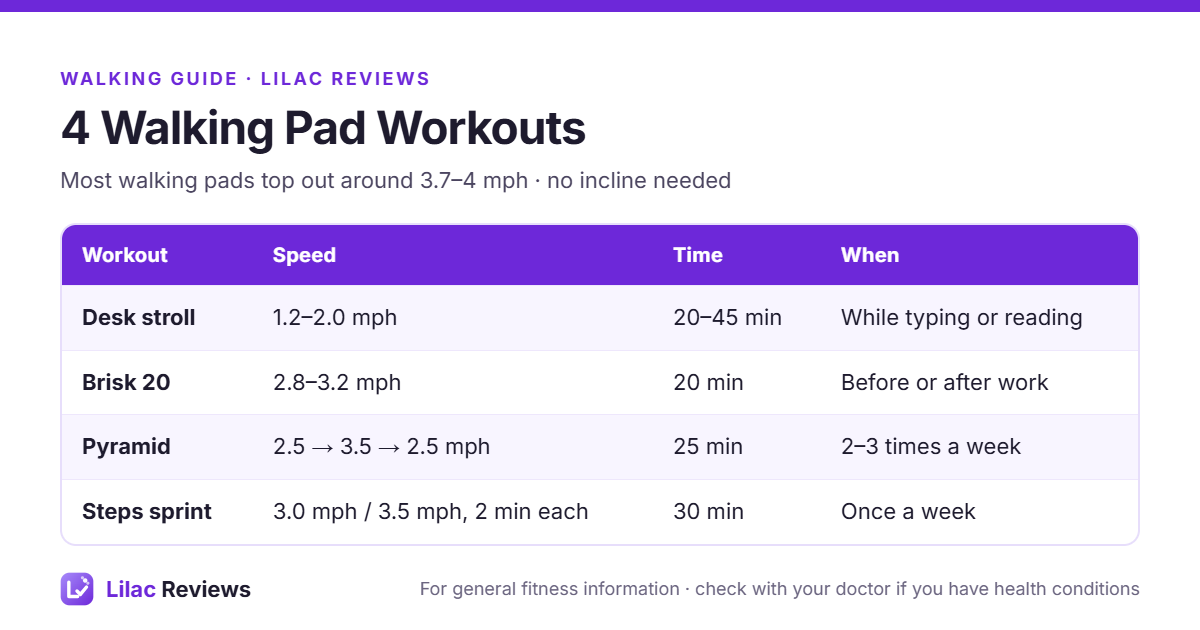
Set the speed to 1.2–2.0 mph. That’s slow enough to type, read email or take calls. Start with 20 minutes and build up. Many people find two or three desk strolls a day works better than one long one. Stand tall and keep the screen at eye level so you aren’t hunching.
2. Brisk 20 (20 minutes)
No desk this time. Warm up for 3 minutes at 2.0 mph, then walk 15 minutes at 2.8–3.2 mph, a pace where you can still talk but notice your breathing. Cool down for 2 minutes. Do this before or after work.
3. Pyramid (25 minutes)
Warm up 3 minutes. Then go up 0.2 mph every 2 minutes from 2.5 to 3.5 mph, and back down the same way. Cool down 2 minutes. The changing pace keeps it interesting and gives you a solid workout without incline.
4. Speed swaps (30 minutes)
After a 5-minute warm-up, alternate 2 minutes at 3.0 mph and 2 minutes at 3.5 mph (or your top comfortable speed) for 20 minutes, then cool down 5 minutes. Once a week is plenty.
A sample work-from-home week
- Mon–Fri: two 20–30 minute desk strolls during calls or email time.
- Mon, Wed: Brisk 20 after work.
- Thu: Pyramid.
- Sat: Speed swaps or an outdoor walk.
Brisk walking counts toward the 150 weekly minutes of moderate activity the CDC recommends for adults. Very slow desk walking is still better than sitting, but it’s light activity, so add the brisk sessions too. New to walking? Start with our 30-day walking plan for beginners.
Setting up a walking desk
- Desk height: your elbows should be at about 90 degrees while standing on the belt, so you’ll need a standing desk or a desk converter.
- Screen height: top of the screen at or just below eye level.
- Cables: keep power cords away from the belt.
- Shoes: wear supportive sneakers; slippers and socks can slide.
Track your steps
A wrist tracker makes it easy to see your daily steps and active minutes, which helps you notice when you’ve been sitting too long. Wrist trackers can undercount steps when your hands are on a keyboard, so treat the numbers as a guide. See our Fitbit Charge 6 review.

Walking pad care
Check the belt alignment every few weeks, vacuum under and around it, and lubricate the belt as the manual says. Our WalkingPad C2 review covers storage and the quirks of one popular folding model.
FAQ
Is a walking pad a good workout?
Yes, at a brisk pace. Slow desk walking is gentle activity that helps break up sitting time, and brisk sessions count as moderate exercise.
How long should I walk on a walking pad?
Start with 20 minutes and build up. Many people end up walking 60–90 minutes across a day in shorter sessions.
Can I run on a walking pad?
Most are designed for walking only. Check your model’s top speed and the manual before trying anything faster.
Is a walking pad good for seniors?
It can be, if balance is good. Seniors who need something to hold should choose a treadmill with handrails.
Written by the Lilac Reviews Editorial Team. This article is general fitness information, not medical advice. If you have a health condition, recent injury or surgery, talk to your doctor or physical therapist before starting a new exercise routine.
This guide is for general information only and is not medical advice. Talk to a qualified professional before starting a new exercise program, especially if you have an injury or health condition.