
Resistance Band Exercises for Seniors: 10 Gentle Moves

Ten resistance band exercises for seniors that can be done seated or standing, with how to pick a band, a twice-weekly workout and tips for sore joints.
This article may contain affiliate links. If you buy through them, we may earn a small commission at no extra cost to you. Learn more.
Disclosure: As an Amazon Associate, we earn from qualifying purchases. If you buy through a link on this page, we may earn a small commission at no extra cost to you.
Resistance bands are one of the friendliest ways for older adults to build strength. They’re light, cheap, easy to store, and the resistance builds gradually as the band stretches, which tends to be kind to joints. You can use them sitting in a chair or standing at a counter.
Below are ten resistance band exercises for seniors, a simple twice-weekly routine and tips on choosing the right band.
Why strength training matters after 60
Muscle mass and strength naturally decline with age, and that makes everyday tasks like climbing stairs, carrying groceries and getting up from a low sofa harder. The CDC guidelines for older adults recommend muscle-strengthening activity on at least two days a week. Bands are an easy way to get there at home.
Choosing a band
- Loop bands (mini bands): short loops for legs and hips. Good for side steps and bridges.
- Long flat or tube bands: better for rows, presses and curls. Tube bands with handles are easiest to grip if you have arthritis in your hands.
- Start light. Choose a band that lets you do 15 smooth reps with the last few feeling moderately hard. Most sets are color-coded from light to heavy.
Check bands for nicks or thinning before each use, and replace any that look worn. Our guide to whether resistance bands are effective explains how they compare with weights.

The 10 exercises
Upper body
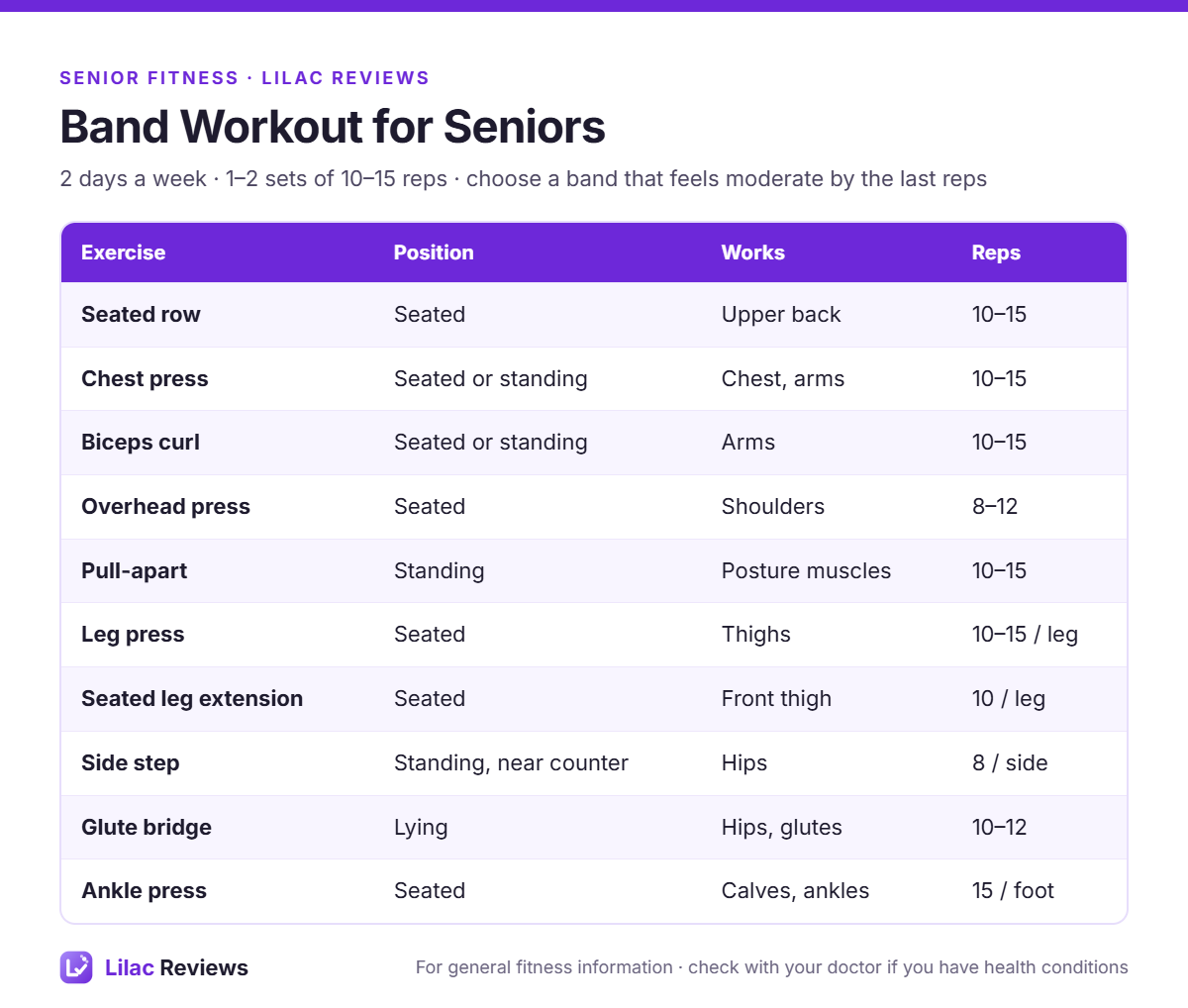
1. Seated row: sit tall, loop the band around the soles of your feet with legs slightly bent, and pull the ends toward your waist, squeezing your shoulder blades. Release slowly.
2. Chest press: wrap the band behind your upper back (or around the chair back), hold an end in each hand at chest height and push forward until your arms are nearly straight.
3. Biceps curl: stand or sit on the middle of the band, hold the ends with palms up and curl your hands toward your shoulders, keeping elbows by your sides.
4. Overhead press: sit on the band, hold the ends at shoulder height and press up. Skip or shorten the range if you have shoulder pain.
5. Pull-apart: hold the band at shoulder height in front of you with hands shoulder-width apart, then pull your hands out to the sides. Excellent for posture.
Lower body
6. Seated leg press: loop the band around one foot, hold the ends, bend your knee toward your chest and push your foot forward against the band.
7. Seated leg extension: tie a loop band around both ankles and straighten one knee at a time.
8. Side step: with a loop band above your knees, stand at the counter and take small steps sideways, 8 each way. Keep your toes pointing forward.
9. Glute bridge: lie on your back with knees bent and a loop band above your knees. Press your knees gently outward and lift your hips. Skip this if getting on the floor is difficult.
10. Ankle press: sit with one leg straight, loop the band around the ball of your foot and press your toes away, like pressing a gas pedal.
A twice-weekly band workout
- Pick 6–8 of the exercises above, mixing upper and lower body.
- Do 1 set of 10–15 reps in weeks 1–2, then 2 sets after that.
- Rest 30–60 seconds between exercises.
- Train on two or three non-consecutive days, such as Monday and Thursday.
Warm up first with a few minutes of marching or the seated warm-up in our chair exercises for seniors. Add balance work on other days with our balance exercises for seniors.
Tips for joints and arthritis
- Move slowly in both directions; don’t let the band snap back.
- Work in a pain-free range. Mild effort is fine, joint pain is a signal to ease off.
- Use handles or wrap the band around your palm rather than pinching it with your fingers.
- The CDC’s arthritis pages note that physical activity can reduce arthritis pain and improve function for many people.
When to make it harder
When 15 reps feel easy for two sessions in a row, either add a second set, slow the lowering phase to three seconds, or move to the next band color. Change one thing at a time.
FAQ
Are resistance bands good for seniors?
Yes. They’re light, adjustable and can be used seated, which makes them a safe way for many older adults to build strength.
What resistance band should a senior start with?
Usually the lightest or second-lightest band in a set. You should be able to do 15 controlled reps.
How long until I see results?
Many people feel stronger in daily tasks within four to eight weeks of training twice a week.
Can I use bands every day?
Give the same muscles a day of rest between sessions. Gentle stretching or walking can fill the other days.
Written by the Lilac Reviews Editorial Team. This article is general fitness information, not medical advice. If you have a health condition, recent injury or surgery, talk to your doctor or physical therapist before starting a new exercise routine.
This guide is for general information only and is not medical advice. Talk to a qualified professional before starting a new exercise program, especially if you have an injury or health condition.