
DeskCycle 2 Review: The Under-Desk Bike for Lower Desks

DeskCycle 2 review: 9 or 10 inch pedal height, 8 magnetic resistance levels, desk clearance you need, display quirks and who should pick it.
This article may contain affiliate links. If you buy through them, we may earn a small commission at no extra cost to you. Learn more.
As an Amazon Associate, we earn from qualifying purchases. If you buy through a link on this page we may earn a small commission at no extra cost to you. It never changes what we write.
Most under-desk pedal exercisers fail at one thing: your knees hit the desk. The DeskCycle 2 was designed around that problem, with a low pedal height that can be set to 9 or 10 inches off the floor.
It also uses magnetic resistance with a weighted flywheel, which tends to be smoother and quieter than cheap friction pedalers. Here is how it stacks up and what to measure before you buy.
The short version
The DeskCycle 2 is one of the better under-desk bikes for people with standard-height desks. The low pedal height, eight magnetic resistance levels and quiet action make it practical for office use. The display is small and hard to read, there is no carry handle, and you still need at least about 27 inches of desk height.
- Best for: office workers with standard desks who want quiet seated cycling.
- Skip it if: your desk is lower than about 27 inches or you want a big, readable display.
- Standout spec: pedal height adjustable to 9 or 10 inches.

How we put this review together
We did not run a long-term lab test on this one, and we are not going to pretend we did. This review of the DeskCycle 2 is built from published specifications and independent reviews from established fitness publications. Where sources disagree on a number, we say so. Prices change constantly, so we don’t list them here; check the current price on Amazon before you buy.
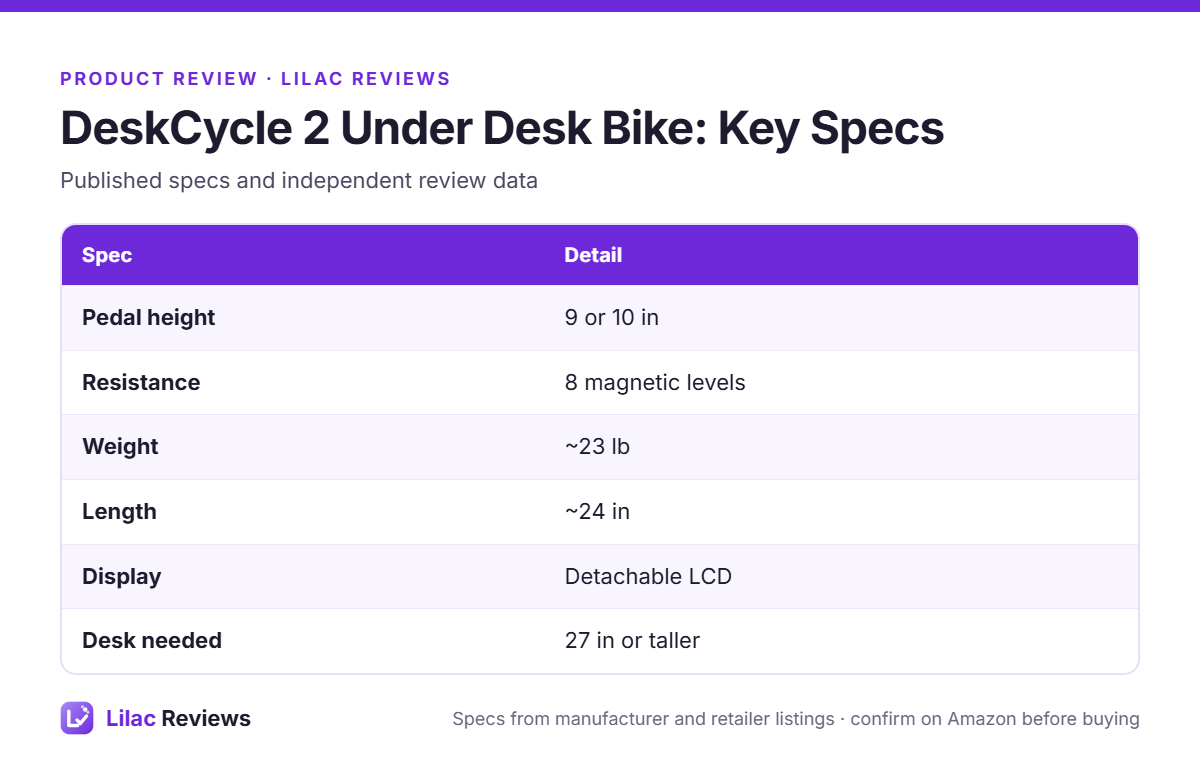
DeskCycle 2 Under Desk Bike specs at a glance
| Spec | Detail |
|---|---|
| Pedal height | Adjustable, 9 or 10 inches from the floor |
| Resistance | 8 levels, magnetic, with weighted flywheel |
| Weight | About 23 lb (some listings say 24 lb) |
| Size | About 24″ L x 10.2″ W x 20.1″ H |
| Display | Detachable LCD: time, distance, RPM, calories |
| Desk height needed | At least 27 inches (27″ fits users up to about 5’8″, 28″ up to about 5’11″) |
| Warranty | 1 year (per review spec table) |
Listings disagree on the maximum user weight, so we have left it out. Check the current Amazon listing if this matters to you.
What we like about the DeskCycle 2
Designed for real desks
A 9-inch pedal height is the headline feature. With most other pedalers, people with standard desks end up pushing their chair back so far they can barely type. The DeskCycle 2 makes a normal seated position more realistic.
Smooth, quiet magnetic resistance
Magnetic resistance with a weighted flywheel gives a smoother feel than friction-strap pedalers, and it is quiet enough for an office or a video call. Reviewers consistently call out the quiet operation.
Real range of effort
Eight levels go from barely-there to genuinely hard. The top level is tough enough that most people won’t use it for long while working, which is a good sign for range.
Useful as a light cardio tool
Seated cycling at a moderate pace can count as light-to-moderate activity. The CDC’s guide to measuring intensity explains the talk test, which works well here: if you can talk but not sing, you are in moderate territory.
What could be better
The display is hard to read
The detachable LCD is small, and reviewers found it hard to read. Put it on your desk instead of on the floor if you want to watch your numbers.
No carry handle
At about 23 lb, it isn’t heavy, but the lack of a handle makes it awkward to move around. The front stabilizer can also detach during transport.
Takes up desk depth
At about 24 inches long, it can poke out from under a shallow desk. Measure depth as well as height.
Pros and cons
Pros
- Low 9″ pedal height
- Quiet magnetic resistance
- Eight levels with real range
- Detachable display
Cons
- Small, hard-to-read LCD
- No carry handle
- Needs at least ~27″ desk height
- Long footprint under shallow desks
Who should buy the DeskCycle 2 (and who shouldn’t)
Buy the DeskCycle 2 if you work at a standard desk and want to pedal while you type, take calls or read. It is a good match for people who found other pedalers too tall.
Skip it if your desk is unusually low, if you want app connectivity, or if you would rather stand. A walking pad suits standing desks better.
Measure these three things before you buy
- Desk height: at least 27 inches from floor to the underside of the desk.
- Desk depth: the bike is about 24 inches long.
- Your chair: it should stay put. Lock casters or use a chair without wheels.
Once it is set up, start at a light level for 10 to 15 minute blocks. Our guide for beginners has more on building activity gradually.
Alternatives to consider
- Cubii Move Under Desk Elliptical: an elliptical motion instead of a cycle, lighter but with less resistance.
- Schwinn 230 Recumbent Bike: a full recumbent bike for longer, harder sessions.
- WalkingPad C2 Folding Walking Pad: for standing desks and walking meetings.
FAQ
What desk height do I need for the DeskCycle 2?
At least 27 inches. A 27-inch desk suits users up to about 5’8″, and 28 inches up to about 5’11″.
Is the DeskCycle 2 quiet?
Yes. Magnetic resistance makes it quiet, which reviewers highlight as a strength.
How many resistance levels does it have?
Eight magnetic levels.
Can I use it with a recliner or sofa?
Many people do, but the bike can slide. A mat underneath and a front stabilizer help.
Bottom line
If you have tried an under-desk bike before and your knees hit the desk, the DeskCycle 2 fixes that better than most. The display could be better, but the low pedal height and quiet resistance are the parts that matter day to day.
This guide is for general information only and is not medical advice. Talk to a qualified professional before starting a new exercise program, especially if you have an injury or health condition.